
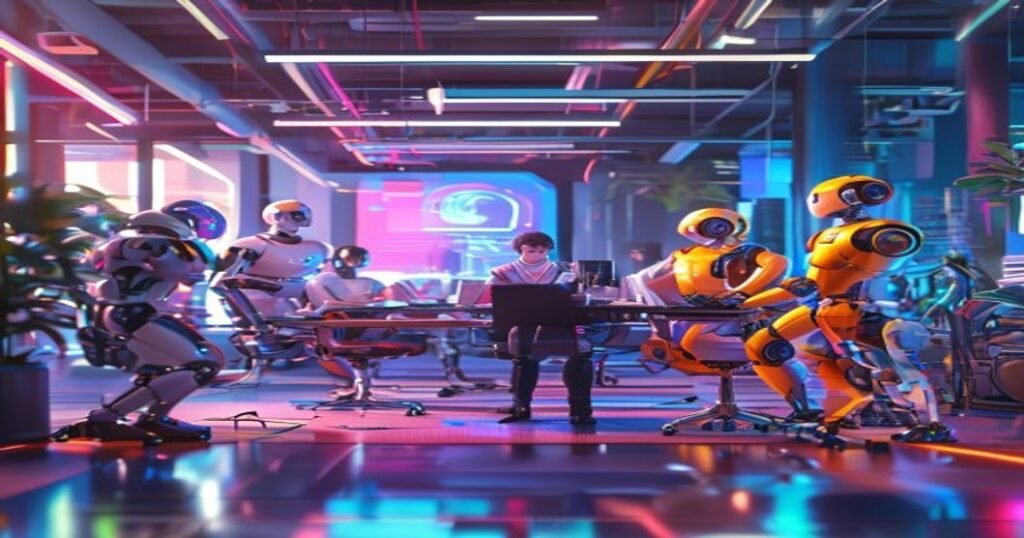

Alright, let’s be honest. Every time a new AI breakthrough hits the news cycle, a tiny, anxious voice in the back of our minds starts whispering: ‘Is this it? Is my job next?’ We see headlines screaming about robots taking over, algorithms writing articles, and smart machines diagnosing illnesses. It’s easy to get caught up in the fear-mongering, to imagine a dystopian future where humans are simply… obsolete.
But what if that’s not the full story? What if, instead of preparing for an unemployment apocalypse, we should be gearing up for an era of unprecedented human potential, where AI acts as our most powerful co-pilot, not our replacement? As someone deeply immersed in the world of technology and its impact, I’ve spent countless hours dissecting this very question, and my conclusion is both nuanced and, I believe, profoundly optimistic. It’s not about if AI will change our jobs, but how, and more importantly, how we choose to adapt.
The Rumors of Our Job’s Demise Have Been Greatly Exaggerated… Mostly.
The Automated Apocalypse: A Tale as Old as Time (But Different This Time?)
Let’s clear the air: the fear of machines replacing human labor isn’t new. The Industrial Revolution saw weavers smashing looms, fearful that their livelihoods were vanishing. Later, computers arrived, then the internet, and with each wave, cries of mass unemployment followed. Yet, here we are, with more jobs, more complex industries, and a global economy that continues to evolve.
However, AI feels different, doesn’t it? It’s not just about automating brute force or repetitive tasks. AI can learn, adapt, and even ‘reason’ in ways that mimic human cognition. This cognitive leap is what genuinely rattles many. Suddenly, jobs that require analysis, creativity, and even communication seem vulnerable. Lawyers, graphic designers, customer service representatives – no field seems entirely safe from the reach of increasingly sophisticated algorithms.
But here’s the crucial distinction: while AI excels at pattern recognition, data processing, and optimizing existing processes, it still largely lacks true creativity, complex emotional intelligence, and genuine human understanding. It can generate a thousand design concepts, but it can’t understand the nuanced human emotion a client wants to evoke with a single, perfect one. It can sift through legal precedents in seconds, but it can’t empathize with a client’s distress or strategize a groundbreaking defense based on human intuition. This isn’t just about factory floors; it’s a profound AI earthquake that’s rocking every corner of our planet, reshaping everything from our economies to our daily lives, and demanding a new kind of readiness from all of us.
Beyond Replacement: The Rise of the Human-AI Hybrid Workplace
AI as Your Co-Pilot, Not Your Successor
The most compelling vision of the future isn’t AI taking over, but AI augmenting. Think of AI not as your competitor for a job, but as the most efficient, tireless, and knowledgeable intern you’ve ever had. It handles the grunt work, processes vast amounts of information, and offers insights that would take humans weeks to uncover, freeing you to focus on what only you can do.
- Healthcare: AI assists doctors in rapid diagnosis by analyzing medical images and patient data, allowing doctors to focus on treatment plans, patient interaction, and complex decision-making.
- Creative Industries: AI can generate initial drafts, brainstorm ideas, or create visual assets, enabling designers, writers, and artists to iterate faster and focus on the conceptualization, storytelling, and emotional impact.
- Education: AI personalizes learning paths and automates grading, giving teachers more time for one-on-one mentorship, curriculum development, and fostering critical thinking.
My belief is that the future belongs to those who learn to work with AI, not against it. It’s about developing ‘AI fluency’ – understanding its capabilities, limitations, and how to best leverage it to amplify your own human skills. The aim isn’t to replace humans but to empower them to achieve more, innovate faster, and solve problems that were previously out of reach.
The Uniquely Human Edge: Where We Still Reign Supreme
What AI struggles with, and what will remain our unique value proposition, are the ‘soft skills’ – the inherently human attributes that drive our world. These include:
- Creativity and Innovation: While AI can generate permutations, true out-of-the-box thinking, paradigm shifts, and artistic genius still belong to humans.
- Emotional Intelligence and Empathy: Understanding, responding to, and managing human emotions is crucial in leadership, customer service, healthcare, and almost every collaborative role.
- Critical Thinking and Complex Problem Solving: Navigating ambiguous situations, making ethical judgments, and developing strategies in unpredictable environments are areas where human discernment remains paramount.
- Interpersonal Communication and Collaboration: Building rapport, negotiating, inspiring teams, and resolving conflicts are deeply human processes.
Think about the last time you truly felt connected to a brand or a service. Was it the perfectly optimized chatbot, or the human who listened, understood, and offered a truly bespoke solution? That human touch, that ability to connect on a deeper level, is our enduring superpower.
Future-Proofing Your Career: Skills for the AI-Augmented Era
Learning to Learn: The Ultimate Skill
The single most important skill in the AI age isn’t coding, though that’s valuable. It’s adaptability. It’s the willingness and ability to continuously learn, unlearn, and relearn. Roles will change, tools will evolve, and staying stagnant is the only true path to obsolescence. This brings us to one of the most crucial battlegrounds for the future: education. The very fabric of how we learn and adapt is being redefined, asking whether the mind-blowing AI revolution in education is the end of traditional learning as we know it, or its ultimate evolution.
Investing in continuous skill development, whether through online courses, certifications, or even just diving deep into new AI tools, will be non-negotiable. Embrace curiosity. Experiment. Don’t be afraid to fail, because every failure is a data point for future success.
Embrace the ‘Soft’ Skills – They’re the Hardest for AI
While technical skills are important, the ‘human’ skills mentioned earlier – empathy, creativity, critical thinking, communication, collaboration – are becoming increasingly valuable. These are the skills that enable us to effectively direct AI, interpret its outputs, and apply them with human judgment and ethical consideration. Focus on cultivating these traits; they are your shields and your swords in the new professional landscape.
New Industries, New Opportunities: The AI Innovation Boom
From Prompt Engineering to AI Ethics Boards: Jobs We Haven’t Even Imagined Yet
Historically, technological revolutions don’t just destroy jobs; they create entirely new ones, often in fields that didn’t exist before. The internet created web developers, SEO specialists, social media managers – roles unimaginable a few decades prior. AI is doing the same, and then some.
Consider the emerging roles: ‘prompt engineers’ who specialize in crafting effective queries for AI models, AI ethicists who ensure responsible development, AI trainers who refine model behavior, and specialists in AI integration for various industries. Beyond these direct roles, AI’s ability to supercharge discovery is opening up vast new scientific and technological frontiers. It’s truly the AI catalyst, turbocharging science from cures to the cosmos, and with it, spawning entirely new industries and job categories we’ve only just begun to conceptualize.
The challenge and the opportunity lie in anticipating these needs and positioning ourselves to fill them. Governments, educational institutions, and businesses must collaborate to provide reskilling and upskilling opportunities, ensuring a smoother transition for the workforce.
Addressing the Elephant in the Room: Ethical Concerns and Policy
Who Gets Left Behind? The Social Safety Net Question
While I maintain a strong sense of optimism, it would be naive to ignore the genuine concerns. There will inevitably be job displacement in certain sectors, and not everyone will adapt easily. This raises critical questions about social safety nets, universal basic income (UBI), and robust reskilling programs. Societies will need to proactively address how to support those most affected by automation, ensuring that the benefits of AI are shared broadly and do not exacerbate existing inequalities.
Furthermore, the ethical deployment of AI – preventing bias, ensuring transparency, and maintaining human oversight – will be paramount. We need strong policy frameworks and public discourse to shape AI development in a way that aligns with human values. On a more personal level, as societies grapple with these monumental shifts, questions of individual well-being and adaptation become paramount. Thankfully, we’re also seeing how AI is stepping up to help us navigate these stresses, unlocking your best life by revolutionizing personal wellness and providing tools to manage the anxieties and opportunities of this new era.
The Human Imperative: Shaping Our AI Future
It’s Not Just About Technology, It’s About Us
Ultimately, the future of work in the age of AI isn’t a predetermined path. It’s a future we are actively building right now. The choices we make as individuals, as businesses, and as societies will dictate whether AI becomes a tool for widespread prosperity and human flourishing or a source of increased inequality and disruption.
My opinion is that we must embrace AI with an open mind, a willingness to learn, and a commitment to ethical deployment. We must view it as an opportunity to shed mundane tasks, enhance our capabilities, and focus our uniquely human talents on complex problems and creative pursuits. This isn’t about humans vs. machines; it’s about humans with machines, achieving more than either could alone.
Conclusion: Adapt, Create, Thrive
The AI job revolution is not a cliff edge we’re hurtling towards, but a vast, undulating landscape of change. Yes, some jobs will disappear, just as they always have with every technological leap. But many more will evolve, and entirely new ones will emerge. The key is to be proactive: cultivate your uniquely human skills, embrace continuous learning, and understand how to leverage AI as a powerful ally.
So, should you fear the robots coming for your job? Perhaps a little healthy apprehension is warranted – enough to spur you into action. But more importantly, you should be excited. Excited for a future where tedious tasks fade away, where human creativity and connection are valued more than ever, and where our potential, amplified by intelligent machines, truly knows no bounds. The golden age of human potential isn’t a fantasy; it’s within our grasp, if only we choose to reach for it, hand-in-hand with AI.


