
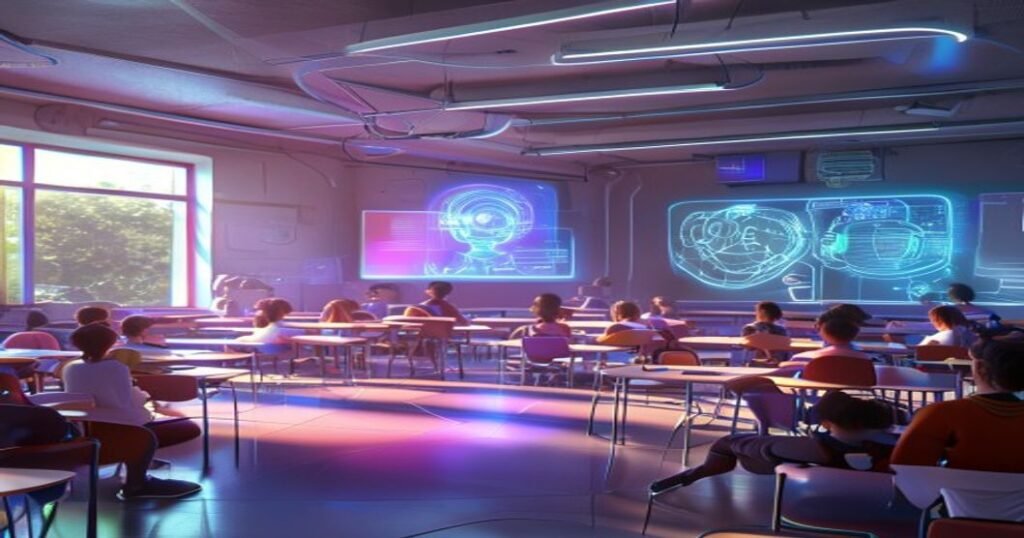

Alright, let’s talk about something truly seismic happening right now, something that’s shaking the very foundations of how we learn, teach, and grow. I’m talking about Artificial Intelligence (AI) and its burgeoning role in education. Forget those dusty textbooks and ‘chalk and talk’ lectures; the classroom, as we know it, is undergoing a metamorphosis, and frankly, it’s both thrilling and a little terrifying. As someone who’s always got an eye on the intersection of technology and human potential, I can tell you this isn’t just another tech trend; it’s a paradigm shift, an AI Earthquake, and its aftershocks are set to redefine what ‘education’ truly means.
For too long, our educational systems, particularly traditional ones, have operated on a ‘one-size-fits-all’ model. We’ve crammed diverse minds into uniform boxes, expecting everyone to learn at the same pace, in the same way, and absorb the same information. But let’s be honest, that approach has always been inherently flawed. Every student is a universe of unique strengths, weaknesses, curiosities, and learning styles. And this, my friends, is where AI steps onto the stage, not as a replacement for human educators, but as a revolutionary enabler.
The Promise of Personalized Learning: An End to One-Size-Fits-All?
Imagine a learning experience perfectly tailored to you. Not a generic textbook or a lecture designed for the ‘average’ student, but content that adapts, evolves, and responds to your individual needs in real-time. This isn’t science fiction anymore; it’s the beating heart of AI in education.
Adaptive learning platforms, powered by sophisticated algorithms, are already doing this. They analyze a student’s performance, identifying areas where they excel and where they struggle. Based on this data, they can offer customized exercises, recommend specific resources, or even adjust the difficulty of material. Think of it as having a personal tutor who knows exactly when you’re getting bored, when you’re overwhelmed, or when you’re ready for the next challenge. This level of individual attention was once a luxury reserved for the elite, but AI is democratizing it.
My opinion? This is nothing short of revolutionary. It moves us away from rote memorization and towards genuine understanding. It fosters a deeper, more intrinsic motivation because students feel seen and supported. And let’s not forget the broader implications: when learning becomes this individualized, it’s not just about academics. It’s about empowering individuals to truly thrive in all aspects of their lives. It’s about Unlocking Your Best Life: How AI is Revolutionizing Personal Wellness, by providing the tailored mental and intellectual nourishment needed for holistic growth.
Empowering Educators, Not Replacing Them
Now, I know what some of you might be thinking: ‘Is AI going to take teachers’ jobs?’ And honestly, that’s a valid concern, one often raised when we discuss any major technological disruption. But my firm belief, and what we’re seeing in practice, is that AI isn’t here to replace educators; it’s here to empower them, to elevate their role from mere information dispensers to true facilitators of learning.
Streamlining the Mundane: AI as the Ultimate Teaching Assistant
Let’s face it, a significant portion of a teacher’s day is often consumed by administrative tasks: grading assignments, tracking progress, planning lessons, responding to routine inquiries. These are essential, yes, but they often pull educators away from their core mission: interacting with students. This is where AI shines as the ultimate teaching assistant.
- Automated Grading: AI can quickly and accurately grade multiple-choice questions, essays (with surprising nuance), and coding assignments, providing instant feedback to students and freeing up countless hours for teachers.
- Personalized Feedback: Beyond just a grade, AI tools can offer detailed, constructive feedback on written work, highlighting grammatical errors, suggesting improvements in argumentation, or pointing out logical fallacies.
- Data Analytics: AI platforms can gather and analyze vast amounts of student data, providing teachers with actionable insights into class performance, identifying students who might be falling behind, or pinpointing areas where the curriculum needs adjustment.
- Content Curation: Need engaging resources for a specific topic? AI can sift through mountains of information, suggesting relevant articles, videos, or interactive simulations.
By taking on these laborious tasks, AI allows teachers to focus on what they do best: mentoring, inspiring, guiding discussions, fostering critical thinking, and addressing the unique emotional and social needs of their students. They move from being lecturers to true learning guides.
The Curriculum Reimagined: Skills for an AI-Powered World
The world is changing at an unprecedented pace, driven largely by the very technologies we’re discussing. Therefore, the skills we equip our students with must also evolve. Rote memorization of facts that are easily accessible via a quick search? That’s rapidly becoming obsolete. What students need now, more than ever, are ‘human’ skills, augmented by a deep understanding of how to leverage technology.
We’re talking about:
- Critical Thinking: Discerning fact from fiction in a sea of information.
- Creativity and Innovation: Solving novel problems and generating new ideas.
- Problem-Solving: Tackling complex challenges with a structured approach.
- Collaboration: Working effectively in diverse teams.
- Emotional Intelligence: Understanding and managing emotions, both their own and others’.
- AI Literacy: Understanding how AI works, its capabilities, and its limitations, and how to use it ethically and effectively.
AI isn’t just a subject to be taught; it’s a tool for teaching these skills. Simulation environments powered by AI can offer students hands-on experience with complex scenarios, from managing virtual businesses to conducting scientific experiments. This approach is turbocharging how we prepare the next generation for challenges in fields from biology to space exploration, much like The AI Catalyst: How Smart Machines Are Turbocharging Science, From Cures to Cosmos, and Why It Matters to YOU. It provides a playground for innovation and critical application of knowledge.
Breaking Down Barriers: Access and Equity in the AI Era
Perhaps one of the most exciting aspects of AI in education is its potential to level the playing field. Access to quality education remains a significant global challenge, with geographical, economic, and physical barriers often preventing millions from reaching their full potential. AI offers powerful tools to mitigate these disparities:
- Global Reach: Online learning platforms, enhanced by AI, can deliver high-quality educational content to remote areas, overcoming geographical limitations.
- Language Barriers: AI-powered translation tools can make educational materials accessible to students in their native languages, opening up a world of knowledge.
- Accessibility: For students with disabilities, AI offers assistive technologies like sophisticated text-to-speech, speech-to-text, and real-time captioning, making learning environments more inclusive.
- Cost-Effectiveness: While initial development can be costly, AI solutions can scale incredibly efficiently, potentially lowering the per-student cost of high-quality education over time.
Imagine a child in a rural village having access to the same caliber of personalized learning and resources as a student in a bustling city. This vision, while still facing infrastructure challenges, is becoming increasingly attainable thanks to AI. It offers a glimmer of hope for true educational equity on a global scale.
The Ethical Tightrope: Navigating the Challenges
No transformative technology comes without its caveats, and AI in education is no exception. As much as I champion its potential, it would be irresponsible not to address the critical challenges and ethical considerations we must navigate with extreme care.
- Data Privacy: AI systems thrive on data, and in an educational context, this means highly sensitive information about students. Ensuring robust data privacy and security measures is paramount. Who owns this data? How is it protected? And for how long?
- Algorithmic Bias: AI models are only as unbiased as the data they’re trained on. If historical biases exist in the data (e.g., socioeconomic disparities in educational outcomes), AI systems could inadvertently perpetuate or even amplify these biases, leading to unfair or inaccurate assessments for certain student groups.
- The ‘Black Box’ Problem: Sometimes, complex AI algorithms make decisions in ways that are opaque, even to their creators. Understanding why an AI made a particular recommendation or assessment is crucial for trust and accountability, especially in high-stakes educational contexts.
- Digital Divide: While AI promises to bridge gaps, it could also exacerbate the existing digital divide if access to the necessary technology (devices, internet connectivity) isn’t universal.
- Over-reliance and Deskilling: There’s a risk that both students and educators might become overly reliant on AI, potentially leading to a decline in fundamental skills like critical thinking or even basic arithmetic if not carefully managed.
These aren’t minor hurdles; they are fundamental ethical considerations that require continuous dialogue, rigorous research, and thoughtful policymaking. We need to approach this AI Tsunami with caution, ensuring we build guardrails as we innovate.
Looking Ahead: Our Collective Responsibility
So, is this the end of traditional learning? In many ways, yes, and I believe that’s a good thing. The ‘traditional’ model, forged in a different era, is simply not equipped to prepare our children for a rapidly evolving, AI-powered future. What we’re witnessing isn’t just an upgrade; it’s a fundamental rethinking of how knowledge is acquired, skills are developed, and potential is unleashed.
The integration of AI into education is not a question of ‘if,’ but ‘how.’ It demands a proactive, collaborative approach from all stakeholders: policymakers, educators, technology developers, parents, and students themselves. We must champion ethical development, ensure equitable access, prioritize human-centric design, and continuously adapt our understanding of what it means to be ‘educated’ in a world where intelligent machines are our collaborators, not just our tools.
This is an exciting, challenging, and profoundly important journey. The future of learning is no longer a distant concept; it’s unfolding right before our eyes, powered by the ingenuity of AI. And if we play our cards right, it promises to be a future where every single student has the opportunity to unlock their fullest potential, learn in a way that truly resonates with them, and step into the world ready to create, innovate, and contribute meaningfully. It’s time to embrace the change, with open minds and a strong ethical compass guiding the way.


