
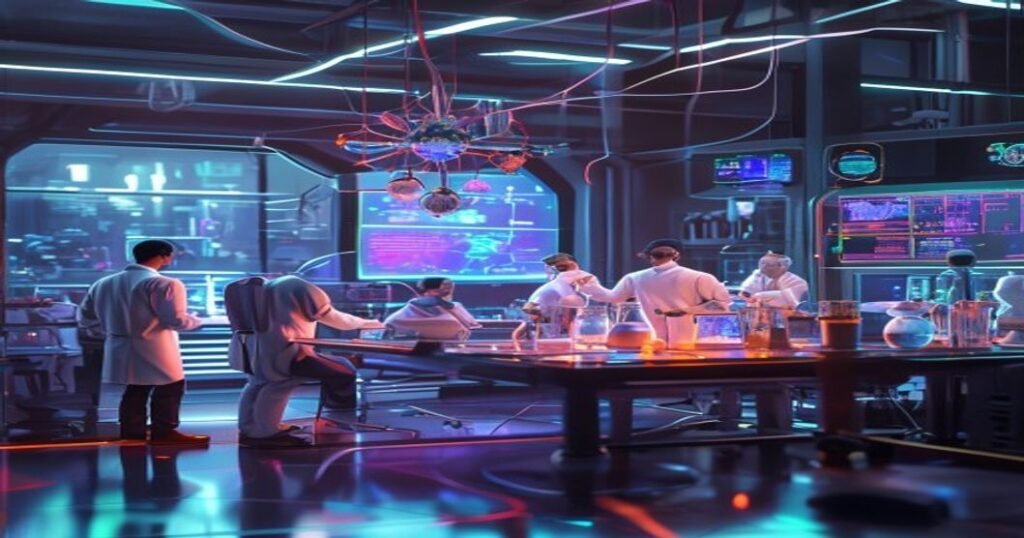

For centuries, the march of scientific discovery has been a testament to human ingenuity, perseverance, and more often than not, a whole lot of trial-and-error. From Newton’s apple to Mendel’s peas, progress has been a painstaking process, often taking decades, even centuries, to yield monumental breakthroughs. But what if I told you we’re now entering an era where the pace of discovery isn’t just accelerating, but undergoing a fundamental, mind-bending transformation? We’re talking about a paradigm shift so profound that it’s not just speeding up research; it’s redefining what’s even possible in the lab, in our hospitals, and even among the stars.
Welcome to the age of Artificial Intelligence (AI) as science’s ultimate co-pilot. This isn’t just about faster data analysis; it’s about intelligent systems predicting outcomes, designing experiments, and uncovering connections that would remain invisible to the human eye, no matter how brilliant. And frankly, if you’re not paying attention to how The AI Tsunami: How Smart Machines Are Reshaping Our World, Our Work, and Our Very Humanity (And Why You Need to Be Ready), you might be missing the biggest story of our time.
The Data Deluge: A Scientist’s Blessing and Burden
Think about it: modern scientific research generates an unfathomable amount of data. Genomic sequencing, particle physics experiments, astronomical observations, clinical trials – each field produces petabytes of information daily. For human scientists, sifting through this mountain of data to find the proverbial needle (a significant pattern, a novel insight) is like trying to drink from a firehose. It’s overwhelming, time-consuming, and frankly, often beyond our cognitive limits. This is where AI steps in, not just as a glorified spreadsheet but as a hyper-intelligent Sherlock Holmes, capable of spotting subtle correlations, anomalies, and emergent properties that would otherwise be lost in the noise.
My opinion? This isn’t just an upgrade; it’s a necessity. Without AI, we’d be drowning in our own data, unable to leverage the very information we’ve worked so hard to collect. AI is the lens that brings the microscopic and the cosmic into sharper focus, allowing us to ask bigger questions and, more importantly, get answers at unprecedented speed.
Revolutionizing Drug Discovery: From Years to Months
Nowhere is AI’s impact more immediately felt than in the realm of medicine and drug discovery. Developing a new drug traditionally takes over a decade and costs billions. It’s a grueling process of identifying targets, screening countless compounds, optimizing candidates, and rigorous testing. AI is ripping up that playbook.
Unlocking the Secrets of Proteins
- Protein Folding: Remember AlphaFold? That groundbreaking AI from DeepMind basically solved a 50-year grand challenge in biology – predicting a protein’s 3D structure from its amino acid sequence. Why does this matter? Because a protein’s shape dictates its function. Knowing this structure is crucial for understanding diseases and designing drugs that can precisely interact with them. AI can now predict these structures with stunning accuracy, accelerating fundamental biological understanding at an exponential rate.
- Target Identification: AI can analyze vast biomedical databases, connecting genes, proteins, and disease pathways to identify the most promising therapeutic targets far faster than any human team ever could.
- Compound Screening: Instead of laboriously testing millions of compounds in the lab, AI algorithms can virtually screen billions, predicting which ones are most likely to bind to a specific disease target, have the desired effect, and even predict potential side effects. This drastically narrows down the pool of candidates for physical testing.
The implications are immense. We’re talking about the potential for faster cures for diseases, more personalized treatments tailored to an individual’s genetic makeup, and a truly proactive approach to healthcare. It’s a game-changer for human longevity and quality of life.
Beyond Earth: AI in Space Exploration and Astronomy
Our quest to understand the universe is another arena where AI is proving indispensable. Telescopes like the James Webb Space Telescope and observatories around the globe generate staggering amounts of imagery and data. Analyzing this manually is simply impossible.
Cosmic Insights, AI-Powered
- Exoplanet Detection: AI algorithms are adept at sifting through telescope data to identify the subtle dips in starlight that indicate a planet passing in front of its star, leading to the discovery of new exoplanets at an incredible pace.
- Galaxy Classification: AI helps classify galaxies by shape, structure, and composition, allowing astronomers to build more accurate models of cosmic evolution.
- Black Hole Studies: By processing complex gravitational wave data and X-ray emissions, AI is helping us understand the elusive nature of black holes and other extreme cosmic phenomena.
- Autonomous Rover Navigation: On Mars, AI empowers rovers to navigate treacherous terrain, identify interesting geological features, and even decide which samples to collect, all without constant human oversight from millions of miles away.
It’s not an exaggeration to say that AI is giving us new eyes on the universe, allowing us to explore realms once thought impossible. The mysteries of the cosmos are slowly, but surely, yielding to the power of intelligent computation.
Materials Science and Environmental Solutions
Imagine designing new materials with specific properties – stronger, lighter, more conductive, or even self-healing. Traditionally, this is a laborious process of synthesis, testing, and refinement. AI is accelerating this too.
- Predicting Material Properties: AI can predict how new combinations of elements will behave before they are even synthesized, dramatically reducing experimental trial and error. This is crucial for developing next-generation batteries, superconductors, and catalysts.
- Climate Modeling: AI is vital for building more accurate and complex climate models, helping us understand and predict the impacts of climate change, from rising sea levels to extreme weather events. This data is critical for informed policy-making and mitigation strategies.
- Sustainable Solutions: From optimizing energy grids to designing more efficient solar panels and carbon capture technologies, AI is providing the computational muscle to tackle some of humanity’s most pressing environmental challenges.
The Human-AI Synergy: Our New Co-Pilot, Not Replacement
Now, I know what some of you might be thinking: Is AI going to replace human scientists? And it’s a valid question. The rise of sophisticated AI often sparks fears about job displacement. However, when it comes to scientific discovery, the consensus among experts is clear: AI isn’t here to replace human intellect; it’s here to augment it. It’s a powerful tool, a brilliant assistant that handles the grunt work, crunches the numbers, and points us toward new avenues of inquiry. This allows human scientists to focus on what they do best: asking creative questions, designing innovative experiments, interpreting complex results, and making those intuitive leaps that only human consciousness can achieve. If you’re concerned about your career in this rapidly evolving landscape, I highly recommend exploring Future-Proof Your Career: Why AI Won’t Steal Your Job, It’ll Transform It (And How To Thrive) – it offers a refreshing perspective on adapting to these changes.
In essence, AI is our new co-pilot. It handles the immense data load and pattern recognition, freeing up human scientists to engage in higher-level reasoning and creative problem-solving. This collaboration promises a future where breakthroughs happen faster and with greater depth than ever before. It’s less about handing over the steering wheel completely, and more about having an incredibly intelligent navigation system that anticipates challenges and suggests optimal routes, as explored in The Creativity Revolution: Is Generative AI Our New Co-Pilot, or Are We Handing Over the Steering Wheel?
Challenges on the Horizon: Ethics, Bias, and Interpretability
Of course, no transformative technology comes without its challenges. The rapid integration of AI into scientific research raises important ethical questions. We need to ensure that AI models are trained on diverse and unbiased datasets to prevent perpetuating existing societal biases in scientific outcomes, especially in areas like medical diagnostics. The ‘black box’ problem, where AI makes decisions that are difficult for humans to understand or explain, also needs careful attention. Scientists need to trust the recommendations of AI, and that trust comes from transparency and interpretability.
As The AI Earthquake: How Smart Tech Is Rocking Every Corner of Our Planet – Are We Ready for the Aftershocks? article aptly puts it, the shake-up is real, and we need to be prepared for the aftershocks by actively addressing these concerns now.
The Future is Now, and It’s Electrifying
What we’re witnessing is more than just technological advancement; it’s a fundamental shift in how we approach the very act of discovery. From personalized medicine that tailors treatments to our unique genetic code, to uncovering the building blocks of new, miraculous materials, and gazing deeper into the cosmic abyss, AI is not just a tool; it’s a catalyst. It’s turbocharging the human endeavor to understand ourselves, our planet, and the universe around us.
So, as a final thought, whether you’re a budding scientist, a curious citizen, or someone just trying to keep up with the pace of innovation, understand this: the future of science isn’t just about bigger telescopes or faster supercomputers. It’s about smarter ones, working hand-in-hand with human brilliance. And that, my friends, is an electrifying prospect for us all.


