
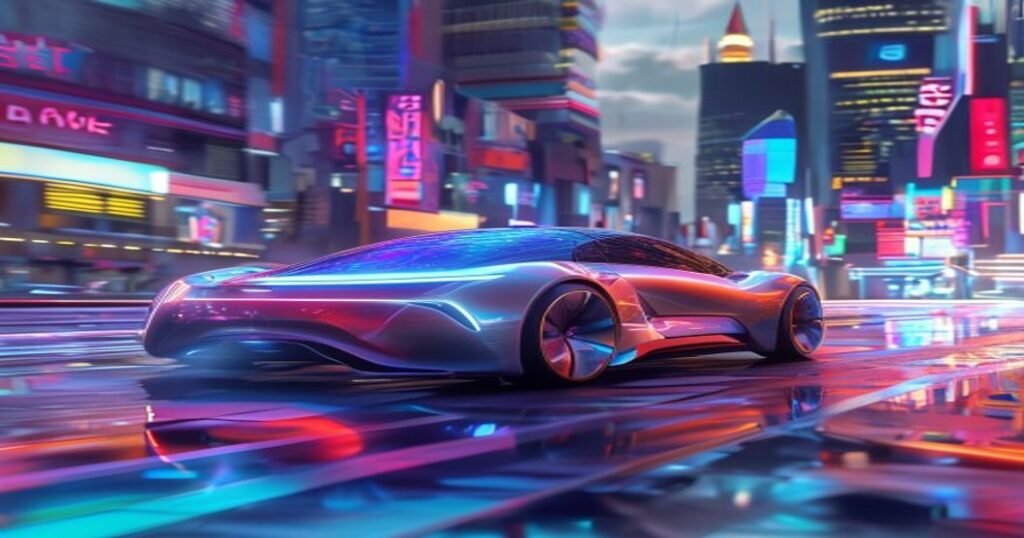

Alright, let’s be honest. For decades, the car has been a symbol of freedom, independence, and a little bit of rebellion. The open road, the wind in your hair, the roar of the engine – it’s ingrained in our cultural DNA. But what if I told you that the very essence of driving, as we know it, is undergoing a silent, yet seismic revolution? We’re not just talking about electric motors replacing gas guzzlers anymore; we’re talking about an invisible driver, a digital brain, taking the wheel. And in my humble opinion, this shift, powered by Artificial Intelligence, is arguably the most transformative event in automotive history.
The Brain Behind the Wheel: Deconstructing Automotive AI
It’s easy to think of self-driving cars as something out of a sci-fi movie, a distant fantasy. But the truth is, AI is already deeply embedded in the cars we drive today, far beyond simple cruise control. From advanced driver-assistance systems (ADAS) that keep you in your lane or brake automatically to sophisticated navigation systems that learn your preferences, AI is steadily taking on more and more cognitive load.
Sensors, Signals, and Sentience (Almost!)
At the heart of every autonomous vehicle (AV) is a complex network of sensors: cameras that see traffic lights and pedestrians, radar that measures distance and speed, LiDAR that creates 3D maps of the surroundings, and ultrasonic sensors for close-range detection. But these are just the ‘eyes and ears.’ The real magic happens when AI algorithms process this torrent of data in milliseconds, identifying objects, predicting movements, and making driving decisions. It’s like giving your car superhuman perception and a lightning-fast analytical mind.
Machine learning, especially deep learning, is the engine of this perception. These systems are fed billions of miles of real-world and simulated driving data, learning to differentiate between a plastic bag and a child, a shadow and a pothole. They’re constantly improving, constantly adapting. It’s a perpetual state of learning, making today’s AI-driven cars smarter than their predecessors, and tomorrow’s even more so.
Beyond Autonomy: The AI-Powered Driving Experience of Tomorrow
The vision for AI in cars extends far beyond simply getting from point A to B without human intervention. It’s about creating a fundamentally better, safer, and more enjoyable travel experience. Imagine a car that anticipates your needs before you even voice them.
- Personalized Ecosystems: Your car will learn your preferred temperature, music genres, common routes, and even your driving style. It will adjust accordingly, turning your commute into a truly bespoke journey. Infotainment systems, once clunky, will become intuitive, voice-activated companions.
- Predictive Maintenance: AI can analyze vehicle data in real-time, predict potential mechanical failures before they happen, and even schedule service appointments for you. No more unexpected breakdowns!
- Hyper-Safety Features: Beyond current ADAS, future AI will anticipate dangerous situations with unprecedented accuracy, reacting faster and more reliably than any human. This proactive safety is what truly excites me, promising a drastic reduction in road accidents.
- Traffic Optimization: With vehicles communicating with each other (V2V) and with infrastructure (V2I) – all orchestrated by AI – traffic jams could become a relic of the past. Smart routing, synchronized traffic lights, and optimized speed flows will make commuting smoother and faster for everyone.
The Ethical Crossroads and Societal Upheaval
As fascinating as this technological leap is, it’s not without its profound implications. The rise of autonomous vehicles brings with it a host of ethical dilemmas and societal shifts that we need to actively address, not passively observe.
The Job Revolution and a New Economic Landscape
Perhaps the most immediate and impactful concern for many is the future of jobs. What happens to the millions of professional drivers – truckers, taxi drivers, delivery personnel – when their primary function can be performed by an AI? This isn’t a hypothetical question for some distant future; it’s a very real challenge approaching us now. We’ve seen similar shifts in other sectors due to automation, but the scale of this one in the automotive industry is immense. It forces us to confront questions about workforce retraining, universal basic income, and the very definition of work in a hyper-automated world. This dramatic re-evaluation of human labor in the face of machine capabilities resonates with broader discussions about The Great AI Job Revolution: Are We Headed for Unemployment Armageddon or a Golden Age of Human Potential? It’s a conversation we desperately need to have now, across industries.
Liability, Trust, and Public Acceptance
Who is responsible when an autonomous car gets into an accident? The manufacturer? The software developer? The car’s ‘owner’? These are not easy questions, and legal frameworks are scrambling to catch up. Moreover, widespread public trust in autonomous technology is crucial. A single high-profile accident, regardless of its cause, can set back adoption by years. Overcoming this trust deficit will require flawless execution, transparent communication, and robust safety standards.
Revolutionizing Our Daily Lives: More Than Just Driving
When you detach the act of driving from human effort, a world of possibilities opens up. Think about your daily commute. Instead of being stuck in traffic, stressed and frustrated, imagine reclaiming that time. You could catch up on work, read a book, watch a movie, or simply relax. For millions, this means gaining back precious hours each week.
This newfound ‘free time’ in transit has significant implications for personal well-being. Reduced stress from commuting, the ability to engage in mindfulness activities, or even getting an extra few minutes of sleep before arriving at the office – these are all direct benefits. In a world where every minute counts, reclaiming commute time through autonomous transport can genuinely contribute to a better quality of life and personal equilibrium. It’s a compelling argument that aligns with how Unlocking Your Best Life: How AI is Revolutionizing Personal Wellness (And Why We Can’t Ignore It) is becoming a critical topic.
Beyond personal convenience, AVs promise a revolution in accessibility. For the elderly, people with disabilities, or those who simply cannot drive, autonomous vehicles offer unprecedented mobility and independence. Urban planning will also transform; with fewer parking spaces needed and more efficient traffic flow, cities could redesign themselves to be greener, more pedestrian-friendly, and more livable.
The Road Ahead: Challenges and Opportunities
Despite the incredible advancements, reaching full, Level 5 autonomy (where a car can drive itself in all conditions, all the time, without human intervention) is still a monumental challenge. Bad weather, unexpected road construction, or simply human unpredictability can still stump even the most advanced AI. There’s also the need for robust infrastructure, including high-speed 5G networks for vehicle-to-everything (V2X) communication, and the constant iteration of regulatory frameworks.
Yet, the opportunities far outweigh these hurdles. The continuous pursuit of solving these complex problems is pushing the boundaries of what’s possible in AI, robotics, and sensor technology. This relentless innovation isn’t confined to the auto industry; it’s turbocharging advancements across countless scientific disciplines. From developing advanced materials to designing more efficient neural networks, the quest for truly autonomous vehicles is acting as a powerful The AI Catalyst: How Smart Machines Are Turbocharging Science, From Cures to Cosmos, and Why It Matters to YOU. The lessons learned and technologies developed for self-driving cars will undoubtedly spill over into other fields, leading to unforeseen breakthroughs.
Conclusion: Buckle Up for the Future
The transformation of the automotive industry by AI isn’t just a trend; it’s a fundamental paradigm shift that will redefine our relationship with transportation. It’s exciting, a little bit scary, and undeniably exhilarating. The invisible driver is here, and it’s slowly but surely taking the wheel. Whether you embrace it or view it with skepticism, one thing is certain: the future of driving won’t look anything like the past. And honestly, I can’t wait to see where this incredible journey takes us.


