
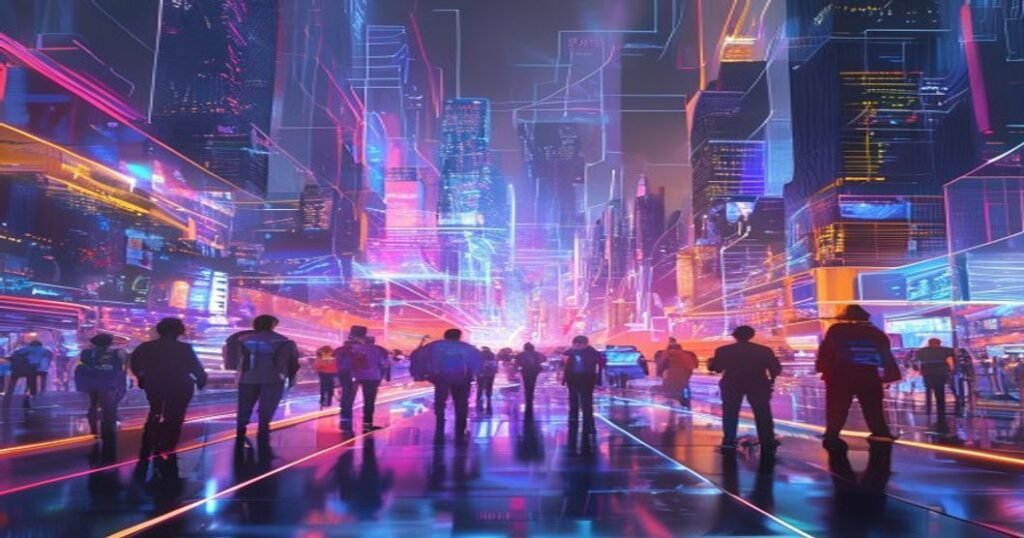

Alright, let’s be honest. When we talk about ‘news’ these days, it often feels like we’re drowning in a deluge of information, constantly trying to catch up. But what if I told you there’s an even bigger, more profound shift happening, one that’s so fundamental it’s reshaping the very fabric of our lives, often without us even realizing it? I’m talking about Artificial Intelligence, and it’s not just a trend; it’s an earthquake, rattling the foundations of everything we know, from how we work to how we consume content, and even how we interact with the world around us. And frankly, the news cycle, as fast as it is, struggles to truly capture the magnitude of this transformation.
For a long time, AI felt like something out of science fiction – robots, supercomputers, a distant future. But look around you now. It’s no longer confined to laboratories or Hollywood scripts. AI is in your pocket, in your smart speaker, in the algorithms that recommend your next binge-watch, and in the tools powering industries across the globe. It’s not a single, monolithic entity, but a vast, intricate web of technologies that are quietly, yet powerfully, changing our daily existence. And this, my friends, is why it’s the biggest story of our time, one that demands our sustained attention.
The Silent Takeover: How AI Infiltrates Our Everyday
Think about your morning. Perhaps you checked the weather on your phone, optimized your commute with a navigation app, or listened to a personalized playlist. Each of these seemingly mundane actions is likely powered by AI. It’s the invisible hand, making our lives smoother, more efficient, and often, more tailored to our individual preferences. From predicting traffic patterns to suggesting what groceries you might need, AI is working tirelessly in the background. It’s a testament to its seamless integration that most of us don’t even register its presence until it does something truly remarkable.
And it’s not just about convenience. AI is fundamentally altering how we interact with technology and our environment. Remember the days of flipping through TV channels or manually searching for music? Those days are rapidly fading. Now, content platforms use sophisticated AI to understand your tastes, predict what you’ll love, and serve it up on a silver platter. This kind of personalized experience extends far beyond entertainment. It’s reshaping how services are delivered, how products are designed, and even how cities are managed. It’s a pervasive force that truly underscores how Beyond the Screen: How AI is Quietly Remaking Your Daily Lifestyle (And Why You’re Already Loving It).
From Creation to Consumption: AI’s Grip on Entertainment and Media
One area where AI’s impact is particularly visible – and often jaw-dropping – is in the creative industries. Generative AI, in particular, has exploded onto the scene, capable of creating everything from compelling articles and lifelike images to entire musical compositions and video clips, all from simple text prompts. This isn’t just a fancy parlor trick; it’s a revolutionary shift. Artists are using AI tools to enhance their work, filmmakers are exploring new visual effects, and musicians are experimenting with AI-generated sounds. It’s a fascinating, sometimes controversial, but undeniably powerful evolution.
But it’s not just about creation. AI is also deeply embedded in how we consume media. The algorithms behind your favorite streaming platforms, social media feeds, and news aggregators are constantly learning from your behavior, optimizing what you see and hear. This means that our media diet is increasingly curated by artificial intelligence, shaping our perspectives and preferences in ways we’re only just beginning to understand. It’s clear that The AI Encore: How Artificial Intelligence is Reshaping Everything You Watch, Listen To, and Play is well underway, fundamentally altering our relationship with entertainment.
The Creative Conundrum: Opportunity or Threat?
This surge in generative AI has sparked intense debate. For some, it’s an incredible accelerant for human creativity, allowing us to push boundaries and explore new artistic horizons with unprecedented speed. Imagine a graphic designer generating dozens of logo variations in minutes, or a writer overcoming writer’s block with AI-assisted brainstorming. The possibilities are truly exciting.
However, the question of job displacement looms large. Will AI replace human artists, writers, and musicians? While the definitive answer is complex, it’s more likely to augment human capabilities, changing the nature of many creative roles rather than outright eliminating them. Those who adapt and learn to wield these new tools will undoubtedly be at an advantage. It’s a dynamic period where we’re witnessing Unleashing the Creative Storm: How Generative AI Is Redefining Art, Work, and Our Future, and the rules are still being written.
Beyond the Classroom: Reshaping Education and Learning
And what about education? The traditional classroom model, for all its strengths, has often struggled with personalization. Every student learns differently, at a different pace, and with different strengths. Enter AI. We’re seeing a significant shift towards AI-powered learning platforms that can adapt to individual student needs, offering customized curricula, intelligent tutoring, and instant feedback.
Imagine an AI assistant that identifies precisely where a student is struggling in mathematics and then provides targeted exercises and explanations, or a language learning app that converses with you like a native speaker. This isn’t futuristic fantasy; it’s happening right now. It’s a powerful tool that promises to democratize access to quality education and make learning more engaging and effective for everyone. In essence, The AI Classroom Revolution: Why Education Will Never Be the Same (And That’s a Good Thing!) is more than just a tagline; it’s a tangible reality that offers immense hope for future generations.
The Ethical Maze and the Path Forward
Of course, with such profound power comes profound responsibility. The rapid deployment of AI raises critical ethical questions: concerns about bias in algorithms, privacy of data, the potential for misuse, and the impact on truth and misinformation. As AI becomes more sophisticated, its ability to generate convincing ‘deepfakes’ or spread automated propaganda poses serious challenges to the integrity of information and public discourse. These are not minor footnotes; they are central challenges that we, as a society, must actively address.
The news industry, in particular, is at the forefront of this battle. AI can be a powerful tool for investigative journalism, data analysis, and content creation, but it also presents a significant threat when used to generate fake news or manipulate public opinion. It demands a heightened sense of media literacy from every individual and a renewed commitment to ethical guidelines from developers and platforms.
Navigating this ethical maze requires open dialogue, robust regulation, and a collective commitment to using AI for good. It’s not about halting progress, but about guiding it responsibly. We need to build guardrails as we speed down this technological highway, ensuring that the benefits of AI are broadly shared and that its potential harms are mitigated.
What This Means For You, Right Now
So, what’s the takeaway from this AI earthquake? It’s simple: adaptation is key. The world isn’t waiting, and neither should we. Understanding AI’s capabilities, its limitations, and its ethical implications is no longer just for tech enthusiasts; it’s essential for everyone. Embrace continuous learning, explore new tools, and stay informed about the latest developments.
The changes AI brings will continue to unfold at an astonishing pace. It’s a story that isn’t just making headlines; it’s writing them, editing them, and in many ways, shaping the very reality they describe. The future is being built right now, byte by byte, algorithm by algorithm, and it’s up to all of us to ensure that this future is one that serves humanity, not just technology. This isn’t just news; it’s a call to action, a moment for us to engage, to question, and to help steer the incredible power of AI towards a better tomorrow. Get ready, because the revolution is still unfolding, and we’re all living right in the middle of it.


