
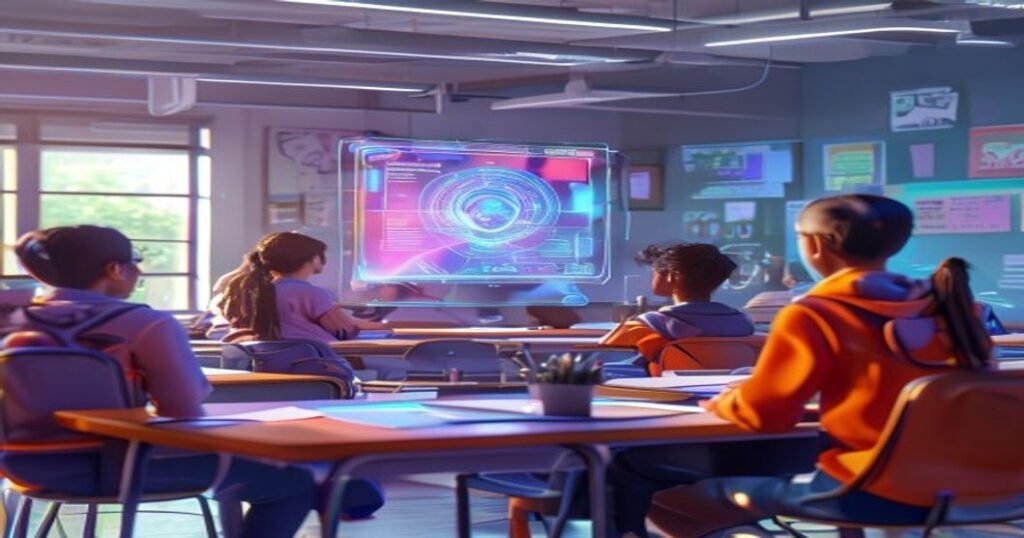

Remember the days when the internet was just a ‘fad’ in schools? Or when calculators were seen as the harbinger of mathematical doom? Fast forward to now, and it’s clear: every major technological leap eventually finds its way into the classroom, fundamentally altering how we learn, teach, and think. Today, that seismic shift isn’t coming from a new operating system or a faster broadband connection; it’s coming from Artificial Intelligence, specifically Generative AI. And honestly, it’s got a lot of people both exhilarated and utterly terrified.
As a seasoned observer of the tech landscape and its ripple effects, I can tell you this: the conversation around AI in education isn’t just about preventing plagiarism (though that’s a valid concern). It’s about a complete re-evaluation of what education means in a world where machines can write essays, solve complex equations, and even generate art. It’s about understanding if this technological marvel is truly a friend, an indispensable tool for unlocking human potential, or a foe, threatening to automate critical thinking and dehumanize the learning process. My take? It’s complicated, but overwhelmingly, it’s an opportunity we cannot afford to squander.
The Promise of Hyper-Personalized Learning: A Dream Realized?
For decades, educators have dreamed of truly personalized learning – an education system that adapts to each student’s unique pace, style, and interests. In a classroom of 30, 40, or even more students, this has always been an impossible ideal for a single human teacher. Enter AI. Suddenly, that dream feels tangible.
Imagine an AI tutor that knows exactly where a student struggles with algebra, not just what they got wrong, but *why*. It can then craft bespoke practice problems, explain concepts in three different ways until one clicks, and even recommend external resources perfectly tailored to that student’s preferred learning modality. For the student who thrives on visual learning, it might generate diagrams and infographics. For the auditory learner, it could provide engaging explanations and podcasts. This isn’t just about efficiency; it’s about equity. AI has the potential to level the playing field, providing every student, regardless of their background or current academic standing, with a virtually unlimited, infinitely patient, and perfectly customized learning assistant.
This isn’t to say it’s without its challenges. Data privacy, equitable access to technology, and ensuring the AI is truly adaptive rather than simply rigid in its programming are crucial hurdles. But the potential for individual growth, for unlocking understanding in ways we’ve only ever theorized, is immense.
AI as the Super-Tutor & Assistant: Beyond Rote Learning
When we talk about AI in education, many immediately jump to concerns about cheating. But that’s a narrow, fear-driven lens. Let’s look at the incredible practical applications that are already here or on the horizon:
-
Instant Feedback and Iteration:
AI can provide immediate, detailed feedback on written assignments, coding projects, or even creative works. Students no longer have to wait days for a teacher’s comments; they can receive suggestions for improvement instantly, allowing for rapid iteration and deeper learning. This shift from ‘wait and receive a grade’ to ‘learn, apply, refine’ is revolutionary.
-
Adaptive Practice and Remediation:
Beyond basic tutoring, AI systems can identify knowledge gaps and generate targeted practice questions. If a student struggles with a specific type of word problem, the AI can create dozens more, slowly increasing complexity until mastery is achieved. This frees teachers from the drudgery of creating endless worksheets and allows them to focus on higher-order thinking and engagement.
-
Accessibility Champion:
AI can translate content into multiple languages, provide real-time captions for lectures, convert text to speech, and even generate alternative formats for students with learning disabilities. It breaks down barriers, making education more inclusive than ever before.
The implications of this kind of assistive technology extend far beyond the classroom. The way we conceptualize work and creative output is already shifting dramatically. If you’ve been following the discussions around The Great Redefinition: How Generative AI is Reshaping Art, Work, and Our Very Selves, you’ll understand that the skills needed for success are changing. Education must adapt to prepare students not just for existing jobs, but for roles that haven’t even been invented yet, roles that will undoubtedly involve collaboration with AI.
Empowering Educators, Not Replacing Them
Perhaps the biggest misconception is that AI will replace teachers. I vehemently disagree. Instead, AI stands to be the most powerful teaching assistant ever invented. Think about it: how much time do teachers spend on grading, administrative tasks, lesson planning, and managing classroom logistics?
AI can automate a significant portion of these tasks, freeing up teachers to do what they do best: build relationships, inspire critical thinking, foster creativity, address emotional and social needs, and provide truly human mentorship. Imagine a teacher, unburdened by stacks of papers, able to spend more one-on-one time with struggling students, design more engaging projects, or simply have more energy at the end of the day.
The role of the educator will evolve from a purveyor of information to a facilitator of learning, a guide, and a mentor. They will teach students not just *what* to learn, but *how* to learn effectively with AI, how to critically evaluate AI-generated content, and how to harness these powerful tools responsibly and ethically.
Navigating the Ethical Minefield: Bias, Privacy, and Authentic Learning
Of course, it’s not all sunshine and pedagogical bliss. The integration of AI into education comes with a weighty ethical responsibility:
-
Bias in Algorithms:
AI systems are only as unbiased as the data they’re trained on. If that data reflects societal biases, the AI will perpetuate them, potentially exacerbating inequalities in education. We must be vigilant in auditing these systems and ensuring fairness.
-
Data Privacy:
Personalized learning means collecting vast amounts of student data. Protecting this data from breaches and misuse is paramount. Robust regulations and transparent policies are non-negotiable.
Authentic Learning vs. AI Dependency:
How do we ensure students are still developing their own critical thinking, problem-solving, and writing skills, rather than simply relying on AI to do the heavy lifting? This requires a fundamental shift in assessment methods and a renewed focus on process-oriented learning. It demands educators teach students *how* to use AI as a tool for deeper inquiry, not as a shortcut to avoid thinking.
These aren’t small challenges, but they are surmountable with thoughtful design, ethical guidelines, and ongoing research. Humanity has always faced such dilemmas with new technologies. Our ancient drive for innovation, which we explore in articles like The Ghost in the Machine: How Humanity’s Ancient Drive for Innovation Echoes in Our AI Age, has always been accompanied by a need to adapt and define ethical boundaries.
The Skills Revolution: What Becomes Paramount?
In an AI-augmented world, the skills that education prioritizes must shift. Rote memorization and basic computational tasks become less important, while skills that AI struggles with (or enhances) come to the forefront:
- Critical Thinking & Evaluation: The ability to discern fact from fiction, evaluate AI-generated content, and ask the right questions.
- Creativity & Innovation: Leveraging AI as a creative partner, not a replacement for original thought.
- Problem-Solving: Tackling complex, ambiguous problems that require human insight and intuition.
- Communication & Collaboration: Working effectively with both humans and AI systems.
- Ethical Reasoning: Understanding the societal impact of technology and making responsible choices.
- Digital Literacy & AI Fluency: Knowing how to effectively use, prompt, and understand AI tools.
This is where education becomes truly transformative. It moves beyond preparing students for standardized tests and instead equips them with the adaptability and resilience needed to thrive in a constantly evolving technological landscape. It’s about shaping future leaders and innovators who can navigate complexities, not just regurgitate facts.
Embracing the Evolution, Not Fearing It
The conversation around AI in education is just beginning, and it’s one that requires active participation from educators, policymakers, parents, and students alike. We cannot afford to bury our heads in the sand or let fear dictate our approach. The future of learning is here, and it’s intertwined with AI.
Just as we once debated the merits of textbooks versus digital resources, or chalkboards versus smartboards, we are now tasked with integrating a technology that promises to redefine the very essence of learning. Looking ahead, the convergence of technology and human capability will only intensify. We’re already seeing groundbreaking research into areas like Mind Over Machine: How Brain-Computer Interfaces Are Redefining Humanity’s Next Chapter, which suggests a future where our interaction with knowledge and learning might be even more direct and seamless. These advancements, while futuristic, highlight the relentless march of innovation and its potential to continually reshape our educational paradigms.
Our role is to steer this powerful ship responsibly, harnessing AI’s immense power for good, mitigating its risks, and preparing the next generation not just to understand the world, but to actively shape it. The classroom of tomorrow won’t be a place devoid of human interaction; it will be a place where human potential is amplified, where learning is more engaging, more equitable, and more profoundly impactful than ever before. Let’s build it together.


