
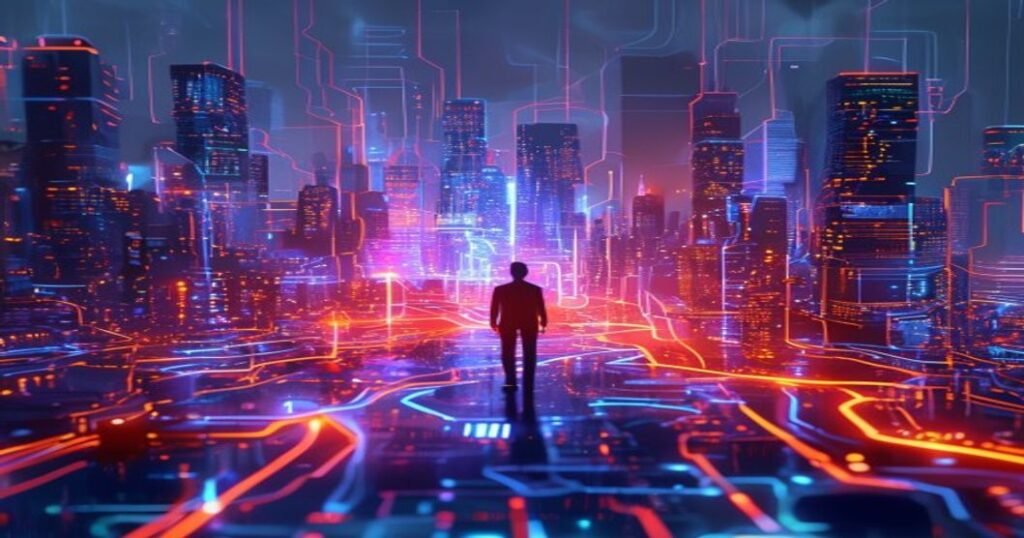

Have you ever had that feeling, a quiet hum in the background that slowly crescendos into an undeniable roar? That’s exactly how I describe the current state of Artificial Intelligence. It’s no longer a sci-fi fantasy relegated to distant futures or academic labs; it’s here, it’s now, and frankly, it’s an absolute game-changer. What we’re witnessing is more than just technological advancement; it’s a societal earthquake, a global force reshaping everything from how we work and learn to how we simply exist. And if you’re not paying attention, you’re missing the biggest story unfolding before our very eyes.
The Unstoppable Surge: What’s Powering This Revolution?
Let’s be honest, for years, AI was a promise, a concept bandied about by tech giants. But something fundamental has shifted. The sheer processing power available, coupled with mountains of data and increasingly sophisticated algorithms, has pushed AI into an exponential growth curve. This isn’t just about computers getting faster; it’s about them getting smarter, more intuitive, and astonishingly, more creative.
Think about it: the ability for machines to generate entirely new content – be it text, images, code, or even music – is nothing short of revolutionary. This isn’t just replicating; it’s creating. If you want to dive deeper into this fascinating realm, you absolutely need to explore Beyond the Code: How Generative AI Is Unleashing Humanity’s Next Great Leap. It’s a profound look at how this capability isn’t just a party trick, but a fundamental shift in our relationship with technology. We’re talking about tools that can assist in brainstorming entire marketing campaigns, design architectural mock-ups, or even write screenplays. The implications for industries reliant on creativity and innovation are mind-boggling, and the ripple effects are only just beginning to be understood.
Jobs, Jobs, Jobs: Friend or Foe?
Ah, the million-dollar question: will AI take our jobs? It’s a fear as old as the industrial revolution, and it’s resurfacing with renewed intensity. And I get it. When you see AI writing articles, diagnosing diseases, or even driving cars, it’s natural to feel a tremor of anxiety. But here’s my take: the narrative isn’t simply “AI replaces jobs.” It’s far more nuanced.
What we’re seeing is a massive shift, not necessarily an outright purge. Many routine, repetitive tasks are indeed ripe for automation. This isn’t to say those jobs vanish without a trace; rather, the nature of work changes. New roles are emerging – prompt engineers, AI ethicists, data curators, AI-assisted designers, and countless others we haven’t even conceived of yet. The key here is augmentation. AI isn’t replacing the human; it’s empowering them to do more, to focus on the higher-level, uniquely human aspects of their roles – critical thinking, emotional intelligence, complex problem-solving, and creativity.
Think of an architect who can now iterate through hundreds of design possibilities in minutes, or a doctor who can analyze patient data with unprecedented speed and accuracy. These aren’t people replaced; they’re people supercharged. The challenge lies in adaptation. We, as a society, need to invest heavily in upskilling and reskilling programs, ensuring that the workforce of today is equipped for the opportunities of tomorrow. It’s an urgent societal imperative, not just a corporate one. The future of work isn’t about human vs. machine; it’s about humans *with* machines, collaboratively pushing the boundaries of what’s possible. Ignoring this wave won’t make it disappear; it will only leave individuals and nations behind.
From Healthcare to Home Life: AI’s Personal Touch
Beyond the workplace, AI is quietly, yet profoundly, infiltrating our daily lives, making things smarter, more personalized, and frankly, a bit more magical. Take healthcare, for instance. We’re moving beyond a one-size-fits-all approach. AI is processing vast amounts of genetic data, medical history, and real-time biometric information to offer truly personalized treatment plans. Diagnoses are becoming faster, drug discovery is accelerating, and preventative care is becoming more precise than ever. If you’re curious about how this is changing lives, I highly recommend reading Beyond the Lab Coat: How AI is Unlocking the Future of Personalized Health and Ending Disease As We Know It. It offers a glimpse into a future where disease management is transformed, and our well-being is truly prioritized by intelligent systems.
But it’s not just life-saving applications. Think about entertainment. Gaming, once a purely human-driven experience, is being redefined. AI isn’t just an opponent anymore; it’s a dynamic storyteller, a creator of ever-evolving worlds, and an adaptive companion. Non-player characters (NPCs) are becoming astonishingly realistic, generating dialogue on the fly and adapting their behavior based on player interaction. It’s making virtual worlds more immersive and reactive than we ever thought possible. For a deep dive into this evolving landscape, check out Gaming’s Next Level: How AI Isn’t Just Playing the Game, It’s Redefining Reality! – it’s a testament to how creativity and technology are converging. This blending of AI into our leisure and personal care illustrates its pervasive nature, touching the most intimate aspects of our existence and promising experiences that were once confined to our wildest imaginations.
The Ethical Tightrope Walk: Navigating the Future Responsibly
With great power comes great responsibility, right? And AI, my friends, wields immense power. This brings us to the thorny, yet crucial, subject of ethics. As AI becomes more integrated, questions around bias, privacy, accountability, and even the potential for autonomous decision-making become paramount. These aren’t just theoretical musings for academics; they are practical challenges that demand our immediate attention.
We’ve seen instances where AI models, trained on biased datasets, inadvertently perpetuate and even amplify societal inequalities, from loan approvals to hiring processes. We worry about deepfakes blurring the lines between reality and fiction, and the implications for trust in information, especially in an era already fraught with misinformation. Who is accountable when an AI makes a critical error in a medical diagnosis or a self-driving car incident? How do we ensure these powerful systems are developed and deployed in a way that benefits all of humanity, not just a select few, and without infringing on fundamental human rights or privacy? These aren’t abstract academic debates; they are real-world challenges that demand immediate and thoughtful attention from policymakers, technologists, and the public alike. Ignoring them would be a catastrophic mistake. We need robust regulatory frameworks, transparent development practices, and ongoing public dialogue to ensure we guide AI’s evolution responsibly, putting human values at the forefront of its design and deployment. The conversation isn’t just about what AI *can* do, but what it *should* do.
Your World, Reimagined: An Unstoppable Global Force
So, where does all this leave us? In a thrilling, terrifying, and utterly transformative moment in human history. The AI revolution isn’t a niche tech trend; it’s a fundamental restructuring of our global society. It’s influencing geopolitics, economics, culture, and our very definition of intelligence and creativity. It’s reshaping industries, redefining education, and altering the fabric of our communities. From smart cities to global supply chains, AI is the invisible hand guiding the wheels of progress, sometimes with a gentle nudge, other times with a powerful shove.
It’s tempting to either fear it or blindly embrace it, but neither approach serves us well. Instead, we must engage with it, understand it, and actively shape its trajectory. The decisions we make now – about data governance, ethical AI development, education, and societal adaptation – will dictate whether this unstoppable force leads us to an unprecedented era of prosperity and enlightenment, or to a future riddled with unintended consequences. For a broader perspective on this monumental shift and its worldwide implications, don’t miss Your World, Reimagined: The Unstoppable Global Force of AI and Its Mind-Blowing Impact. It articulates just how sweeping and profound these changes truly are, making it clear that this isn’t just a technological shift, but a global awakening.
This isn’t just about silicon and algorithms; it’s about us. It’s about human ingenuity, adaptability, and our collective will to build a better future. AI is a tool, arguably the most powerful tool humanity has ever wielded. The question isn’t whether it will change our world – it already has. The real question is: how will we choose to direct that change? And that, my friends, is a story we are all writing together, right now.


