
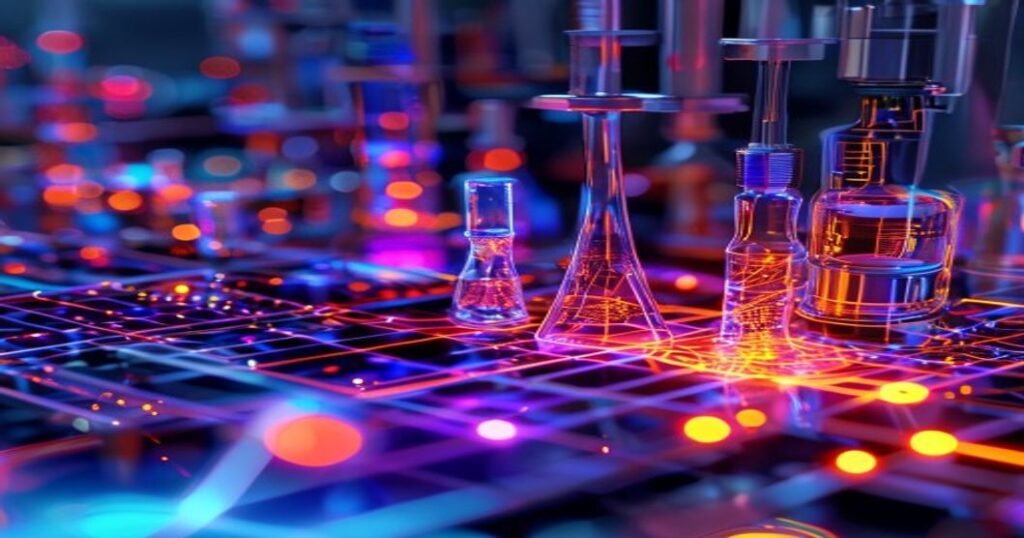

Alright, let’s talk about something truly mind-boggling, something that’s quietly (and not-so-quietly) transforming the very fabric of how we understand our universe: Artificial Intelligence in scientific discovery. Forget the flashy headlines about chatbots or self-driving cars for a moment. While those are undeniably cool, the real revolution, in my opinion, is happening deep within the labs, observatories, and data centers where AI is no longer just a tool, but a co-pilot – an algorithmic alchemist, if you will – in humanity’s quest for knowledge.
For decades, scientific progress often felt like a slow, deliberate march. Brilliant minds would hypothesize, experiment, analyze, and iterate, often spending years, sometimes lifetimes, on a single problem. It was a noble pursuit, fueled by human intuition and sheer grit. But what if we could accelerate that process by orders of magnitude? What if we could sift through mountains of data in seconds, identify patterns invisible to the human eye, and even propose novel solutions that no human mind might conceive? That, my friends, is the promise and now, the reality of AI in science.
The Dawn of the AI-Powered Research Revolution
It’s not an overstatement to say we’re witnessing a paradigm shift. AI isn’t just crunching numbers faster; it’s fundamentally changing the methodology of discovery across almost every scientific discipline. This isn’t just about automation; it’s about augmentation, taking human intellect and supercharging it with computational prowess. And let’s be honest, it’s about time. The complexity of modern scientific challenges demands it.
Unlocking Nature’s Secrets: From Molecules to Galaxies
- Drug Discovery & Medicine: Imagine a world where the search for new medicines, which typically takes over a decade and billions of dollars, is dramatically shortened. AI is making this a reality. Algorithms can analyze vast libraries of chemical compounds, predict their interactions with biological targets, and even design novel molecules from scratch. This doesn’t just speed up drug development; it opens doors to treatments for diseases that were once considered intractable. We’re talking about personalized medicine on an unprecedented scale, where treatments are tailored not just to a patient’s disease, but to their individual genetic makeup.
- Material Science: From stronger alloys to more efficient solar cells, new materials are the building blocks of progress. Traditionally, discovering a new material was often a painstaking process of trial and error. Now, AI can simulate millions of material compositions, predict their properties with remarkable accuracy, and guide scientists toward the most promising candidates. This means faster innovation in everything from aerospace engineering to sustainable energy solutions.
- Climate Modeling & Environmental Science: Our planet is an incredibly complex system, and understanding its intricate climate patterns is crucial for our future. AI models are far superior at processing vast amounts of environmental data – satellite imagery, sensor readings, historical climate records – to make more accurate predictions about weather, climate change impacts, and even natural disasters. This allows for better preparation and more informed policy decisions.
- Astrophysics & Space Exploration: When telescopes like the James Webb Space Telescope beam back terabytes of data from across the cosmos, who’s going to analyze it all? AI, that’s who. Machine learning algorithms are identifying exoplanets, mapping dark matter, and even detecting gravitational waves with a speed and precision that would be impossible for human researchers alone. It’s helping us grasp the unimaginable scale of the universe.
This isn’t just about abstract models; it’s about real-world improvements. Think about electric vehicles, for instance. AI is optimizing everything from battery management to predictive maintenance, making them smarter and more efficient than we ever imagined. It’s truly Beyond the Battery: How AI is Revolutionizing Your Electric Vehicle Experience (And Why You’ll Never Look Back), showcasing how scientific advancements driven by AI translate directly into products that reshape our daily lives.
The Philosophical Crossroads: Augmentation, Not Replacement
Now, I know what some of you might be thinking: Is AI going to make human scientists obsolete? Absolutely not. While AI excels at pattern recognition, data processing, and hypothesis generation, it still lacks the spark of true human creativity, the ability to formulate entirely new questions based on abstract concepts, or the gut instinct that often guides a groundbreaking discovery. AI is our partner, our assistant, allowing us to spend less time on tedious tasks and more time on the truly creative, conceptual work.
It makes you wonder if, in a strange way, some of the ancient philosophers or myth-makers, with their tales of artificial life or all-knowing oracles, were in some obscure sense laying the groundwork for our current fascination. In fact, if you’re curious about how our ancestors might have envisioned such future-shaping forces, you might find Echoes of Eternity: How Ancient Minds Foresaw Our AI-Driven Destiny to be a fascinating read, exploring the deep roots of our human ambition to understand and shape the world around us.
AI’s Ripple Effect: Shaping Our Personal Worlds
The scientific breakthroughs powered by AI don’t stay confined to the laboratory. They inevitably ripple out, transforming our daily lives in ways both subtle and profound. The algorithms honed in scientific research for complex data analysis are the same ones making your streaming recommendations better, optimizing traffic flow in cities, and yes, even creating more personalized living spaces.
The same underlying AI principles that unlock scientific breakthroughs are also quietly transforming our homes. We’re moving far Beyond Basic: How Hyper-Personalized Homes Are Redefining Modern Living (And Why Yours Should Be Next), with systems learning our preferences for lighting, temperature, and even entertainment, creating spaces that truly adapt to us. This isn’t just about convenience; it’s about creating environments that actively enhance our well-being by understanding and anticipating our needs.
And it doesn’t stop at your doorstep. From tailoring your news feed to recommending your next binge-watch, AI is crafting experiences that feel uniquely yours. It’s even reinventing how we explore the world, helping us Escape the Tourist Trap: How Hyper-Personalized Travel is Rewriting Your Next Adventure by suggesting destinations and itineraries perfectly aligned with our interests and desires. This demonstrates how AI’s scientific advancements aren’t just for academics; they’re woven into the fabric of consumer experiences, making everything from our commute to our vacations smarter and more fulfilling.
Challenges and the Path Forward
Of course, with great power comes great responsibility. The rise of AI in science isn’t without its challenges. We need to contend with issues like data bias – if the data fed to an AI is biased, its discoveries will be too. There’s also the ‘black box’ problem, where sometimes even the creators of an AI can’t fully explain how it arrived at a particular conclusion, making trust and validation critical. Ethical considerations, responsible deployment, and ensuring equitable access to these powerful tools are paramount.
But these challenges are not insurmountable. They are conversations we must have, and problems we must actively solve as a global scientific community. The potential benefits – accelerating cures for diseases, solving climate change, unraveling the mysteries of the cosmos – are simply too great to ignore.
The Algorithmic Alchemist is Just Getting Started
So, where does this leave us? In a truly exhilarating place, I’d argue. We are at the cusp of an era where scientific discovery will be defined by the symbiotic relationship between human ingenuity and artificial intelligence. The algorithmic alchemist is not just transforming how we do science; it’s transforming what we believe is possible in science. It’s a testament to human curiosity and our relentless drive to push the boundaries of knowledge, now amplified by tools we could only dream of just a short while ago.
I genuinely believe that the coming years will be marked by breakthroughs that will fundamentally redefine our understanding of life, the universe, and everything in between, all thanks to this incredible partnership. So, buckle up, because the journey of scientific discovery just got a whole lot more interesting!


