
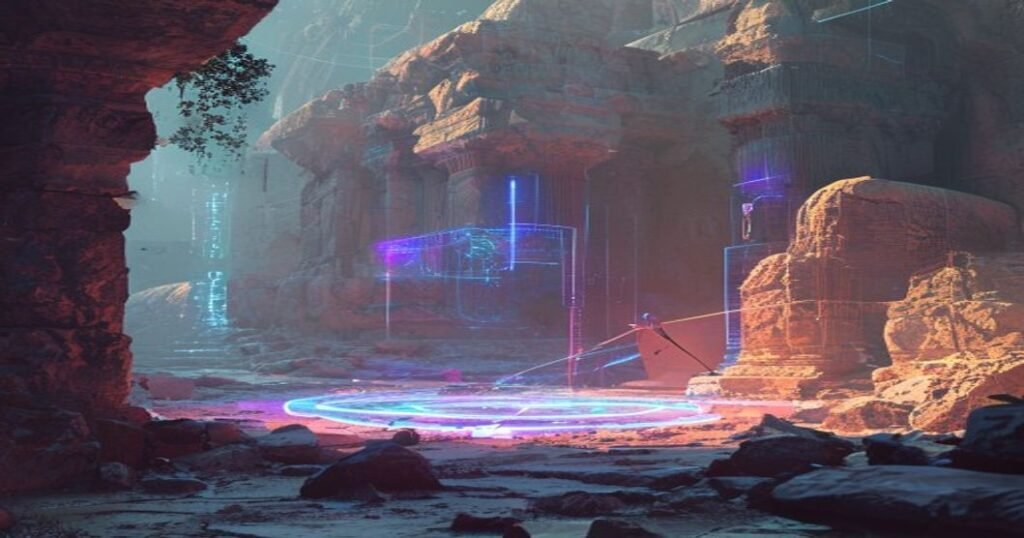

Remember that exhilarating feeling of stumbling upon a forgotten artifact, a dusty old letter, or a long-lost photograph? That spark of connection to a past you never knew existed? For historians and archaeologists, that feeling is their daily bread and butter. But let’s be real, for centuries, the process has been painstakingly slow, often relying on sheer luck, incredible dedication, and a lifetime of specialized knowledge. We’ve been piecing together humanity’s story like a colossal, multi-dimensional jigsaw puzzle, often with more missing pieces than actual ones.
Well, buckle up, because the world of historical discovery is undergoing a seismic shift. There’s a new player on the scene, not with a shovel or a magnifying glass, but with algorithms and neural networks. I’m talking about Artificial Intelligence, and it’s not just optimizing supply chains or crafting viral content; it’s actively rewriting our understanding of ancient civilizations, deciphering lost languages, and unearthing secrets from beneath layers of time and earth. And trust me, it’s nothing short of mind-blowing.
The Unsolvable Puzzles: Why History Has Always Been So Hard
Before we dive into AI’s superhero role, let’s acknowledge the sheer scale of the challenge. Imagine trying to reconstruct a complex narrative when:
- Evidence is Fragmented: Most of what survived from antiquity are broken pots, crumbling walls, half-eaten scrolls, and faded inscriptions. It’s like trying to understand a blockbuster movie from just a handful of blurry screenshots.
- Language Barriers are Goliaths: Entire civilizations communicated in scripts we can no longer read, languages we can barely comprehend. Think Egyptian hieroglyphs before the Rosetta Stone – an entire world locked behind an impenetrable code.
- Vastness of Data: Modern archaeological surveys, LiDAR scans, and satellite imagery produce petabytes of data. Humans simply can’t process it all in a meaningful timeframe, let alone detect subtle patterns across continents and millennia.
- Human Bias and Limitations: Even the most brilliant historian has a finite lifespan, a specific cultural lens, and can only hold so much information in their head. Important connections can easily be missed.
For too long, these have been the accepted limitations, the frustrating walls historians hit again and again. But what if those walls are starting to crumble?
Enter the Digital Archaeologist: How AI is Stepping In
This is where things get really exciting. AI isn’t just a fancy tool; it’s a paradigm shift in how we approach historical research. It acts as an tireless assistant, capable of processing information at a scale and speed that was once unthinkable. It allows us to ask questions we couldn’t even formulate before.
Deciphering the Indecipherable
One of the most thrilling applications of AI in history is its ability to tackle lost languages and fragmented texts. For centuries, texts like the enigmatic Linear A or the still-unreadable Rongorongo script of Easter Island have baffled scholars. Now, machine learning algorithms are being trained on existing deciphered languages to find patterns, statistical anomalies, and recurring symbols in unknown scripts. They can analyze context, frequency, and even the strokes used to form characters to suggest possible meanings or grammatical structures.
Take the Herculaneum scrolls, carbonized by Vesuvius’s eruption in 79 AD, so brittle they crumble at a touch. Traditional methods risk destroying them. But AI, combined with advanced imaging techniques like X-ray microtomography, can virtually unroll these scrolls and The AI Catalyst: How Smart Machines Are Turbocharging Science, From Cures to Cosmos, and Why It Matters to YOU is exactly what we’re seeing here. It’s not just about deciphering words; it’s about unlocking entire libraries of ancient thought, philosophy, and daily life that have been literally locked away for millennia. The initial success with identifying a specific Greek word in one of these scrolls was a monumental step, opening the door to potentially reading entire libraries.
Mapping the Unseen: From Satellites to Subterranean Secrets
Forget Indiana Jones with a map. Today’s archaeological frontier often involves satellites orbiting hundreds of miles above Earth. LiDAR (Light Detection and Ranging) technology, deployed from planes or drones, can penetrate dense jungle canopy or desert sands, creating incredibly detailed 3D maps of the terrain below. The raw data from these scans is immense, but AI-powered algorithms can sift through it, identifying anomalies that indicate ancient structures, roads, irrigation systems, or entire lost cities hidden from human eyes for centuries. The discovery of vast Mayan urban sprawl beneath Guatemalan rainforests is a prime example of AI’s power to reveal civilizations previously invisible.
Similarly, ground-penetrating radar (GPR) and magnetometry generate complex datasets from beneath the soil. AI can analyze these signals to differentiate between natural geological formations and human-made disturbances, pinpointing buried walls, graves, or artifacts with remarkable accuracy, significantly reducing the need for costly and destructive excavation.
Reconstructing Lost Worlds and Filling in the Blanks
When an archaeologist finds a pile of fragmented pottery, the human mind struggles to visualize the complete vessel. AI, trained on vast databases of archaeological artifacts, can analyze these fragments and suggest possible reconstructions, even generating 3D models of how they might have looked. This applies to architecture too – from a few surviving foundations, AI can help predict the probable layout and appearance of an entire Roman villa or a grand temple.
Beyond physical reconstruction, AI can also help in The Creativity Revolution: Is Generative AI Our New Co-Pilot, or are we handing over the steering wheel? for historians. It can analyze vast quantities of historical texts, political treaties, economic records, and even climate data to identify subtle patterns and correlations that human researchers might miss. This allows historians to formulate new hypotheses about migration patterns, trade networks, or the causes of societal collapse, offering a more nuanced and data-driven understanding of past events.
The Human Element: AI as Our Co-Pilot, Not Our Replacement
Now, before anyone pictures a robot with a trowel replacing our intrepid archaeologists, let’s be clear: AI isn’t taking over. Instead, it’s augmenting human capabilities in profound ways. It’s an incredibly powerful tool that empowers historians and archaeologists to do their jobs more efficiently, more thoroughly, and with greater insight. The interpretive leap, the contextual understanding, the nuanced narrative building – that remains firmly in the human domain. AI helps us find the needle in the haystack; we still need the human expertise to understand what that needle means and how it fits into the broader story.
Moreover, AI can help us identify biases in existing historical records or interpretations. By analyzing vast datasets, it can highlight areas where certain voices have been suppressed or certain narratives have been overemphasized, encouraging a more balanced and inclusive understanding of the past. It forces us to confront our own historical blind spots.
The Ethical Maze: Challenges and Concerns
Like any powerful technology, AI in history comes with its own set of challenges and ethical considerations. We need to be vigilant:
- Data Bias: If the AI is trained on incomplete or biased historical data, its outputs will reflect those biases, potentially perpetuating or even amplifying historical inaccuracies.
- Interpretation vs. Hallucination: AI models can sometimes generate plausible but incorrect interpretations (often called ‘hallucinations’). Human oversight is crucial to validate findings and prevent the spread of misinformation.
- Access and Democratization: Will these advanced tools be available to researchers globally, or will they create a new divide between well-funded institutions and those in developing nations? The benefits of historical discovery should be shared widely.
- The Lure of the ‘Objective’ Truth: We must remember that AI provides data-driven insights, but history is still an interpretative field. There’s no single ‘objective’ truth that AI can simply hand us. Nuance, debate, and diverse perspectives remain vital.
Beyond Academia: Why This Matters to YOU
You might be thinking, ‘Okay, cool, AI is helping nerds dig up old stuff. What’s that got to do with me?’ Well, our understanding of history profoundly shapes our present and future. It influences our national identities, our cultural values, and even our geopolitical relationships. When AI helps us correct historical inaccuracies or uncover entirely new narratives, it can literally reshape how we see ourselves and our place in the world.
Furthermore, the ability of AI to sift through vast amounts of fragmented information and find meaningful patterns isn’t unique to history. It’s the same core capability that’s driving revolutions in medicine, environmental science, and business. As The AI Tsunami: How Smart Machines Are Reshaping Our World, Our Work, and Our Very Humanity (And Why You Need to Be Ready), the tools and methodologies being refined in historical research today will have cascading effects across every aspect of our lives tomorrow. Understanding how AI tackles the seemingly ‘soft’ science of history gives us a powerful lens into its broader implications.
The Future of History: An Ever-Unfolding Story
We are just scratching the surface of what AI can achieve in the realm of history. Imagine AI models trained on millions of historical documents, archaeological reports, and genetic data, capable of generating predictive models for where new sites might be found, or even simulating ancient societies to test hypotheses about their development and decline. Imagine virtual reality experiences, meticulously reconstructed by AI from fragmented data, allowing us to walk through ancient Rome or explore the streets of Babylon as they once were.
The journey into our past is becoming faster, deeper, and more illuminating than ever before. AI is not just a tool; it’s a new chapter in the ongoing story of human discovery, enabling us to connect with our ancestors in ways that were once confined to the wildest dreams of science fiction. My take? It’s an incredibly exciting time to be alive, witnessing history literally being rewritten before our eyes, all thanks to a blend of human curiosity and artificial intelligence. We’re not just learning about the past; we’re actively bringing it back to life.


