
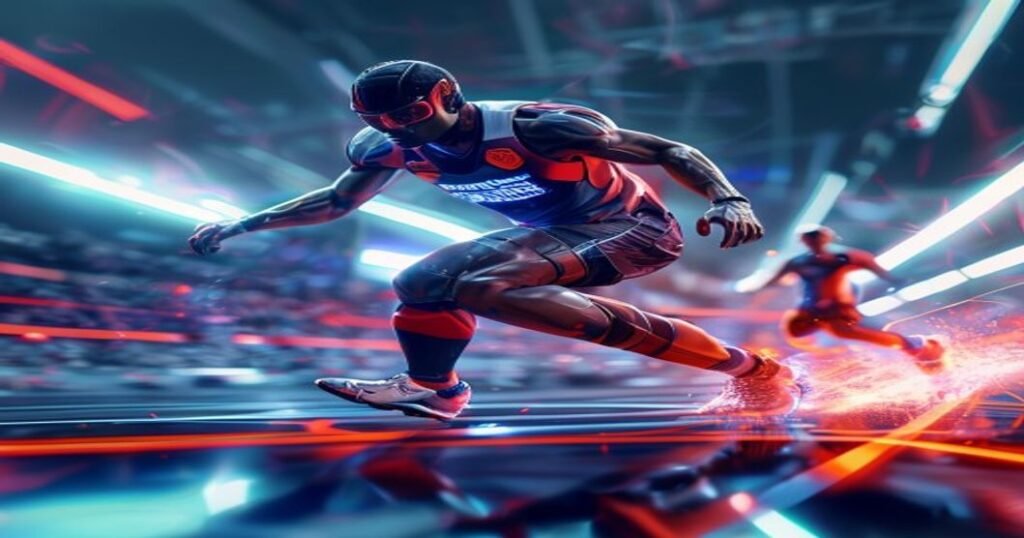

The roar of the crowd, the tension of a penalty shootout, the sheer athleticism of a championship game – these are the timeless elements that define sports. But what if that roar wasn’t just from a physical stadium, but echoed through a vast, interconnected digital arena? What if every athlete’s performance was optimized not just by human coaches, but by super-intelligent AI algorithms? Welcome to the world of sports in 2026, a landscape profoundly reshaped by the convergence of Artificial Intelligence and the Hyper-Real Metaverse.
For decades, technology has chipped away at the edges of sports, offering instant replays and statistical overlays. But we are now witnessing a fundamental, paradigm-shifting transformation. By 2026, AI is no longer a futuristic concept; it’s an indispensable partner in everything from athlete training and performance analysis to fan engagement and strategic decision-making. Simultaneously, the Hyper-Real Metaverse is transcending mere virtual reality, offering immersive experiences that blur the lines between the digital and physical worlds, promising a new era of sports spectatorship and participation.
The New Era of Fan Engagement: Beyond the Stadium Walls
Imagine attending the World Cup final not just from your living room, but from a virtual stadium seat that offers a 360-degree view, real-time player stats overlayed, and the ability to chat with fellow fans from across the globe – all in photorealistic detail. This isn’t science fiction; it’s the reality of sports fandom in 2026. The Hyper-Real Metaverse is enabling fans to literally step into the game, offering unprecedented levels of immersion.
Traditional broadcasting is being revolutionized. While linear TV still holds a place, interactive, personalized viewing experiences in the metaverse are becoming the gold standard. Fans can choose their camera angles, access player biometric data, and even switch perspectives to a referee’s point-of-view. AI acts as a personal broadcast director, curating highlights and commentary tailored to each individual’s preferences. It’s an evolution that goes beyond screens, creating an entirely new dimension of engagement.
- Virtual Stadiums & Arenas: Replicas of iconic venues or entirely new fantastical digital spaces where fans can congregate, interact, and watch live or archived events.
- Personalized Viewing: AI learns your favorite players, teams, and even preferred commentary styles, delivering a bespoke broadcast.
- Interactive Experiences: Participate in real-time polls, predict outcomes, or even engage in mini-games linked to the live action.
- Digital Collectibles & Merch: NFTs representing iconic moments, virtual team jerseys for your avatar, and exclusive digital fan club access are booming.
This level of immersive entertainment is truly transformative. It allows a global audience to feel intimately connected to their favorite sports, fostering communities and extending the reach of leagues and teams far beyond geographical boundaries. This isn’t just watching a game; it’s living it, proving that AI and the metaverse will truly enter the odyssey: how AI & the hyper-real metaverse will revolutionize entertainment in 2026, with sports being a prime beneficiary.
Athlete Performance & Training: The AI Edge
On the field, AI’s impact is even more profound. Elite athletes in 2026 are no longer relying solely on intuition and human observation; they’re training with AI-powered insights, leveraging data points previously unimaginable. Wearable technology, advanced sensors embedded in equipment and training facilities, and high-speed cameras collect vast amounts of data – from biomechanics and physiological responses to tactical positioning and decision-making patterns.
The Rise of Digital Twins
One of the most exciting applications is the creation of ‘digital twins’ for athletes. These are hyper-realistic virtual models of players, continuously updated with real-time data. Coaches and trainers can use these digital twins to simulate different scenarios, test new strategies, and predict injury risks without putting the actual athlete in harm’s way. Imagine a football coach running hundreds of offensive plays against a digital twin of an opposing team’s defense, optimizing strategy before game day.
AI algorithms analyze vast datasets to identify subtle inefficiencies in an athlete’s movement, suggest personalized training regimens, and even predict potential injuries before they manifest. From optimizing stride length in sprinters to refining a golfer’s swing or a tennis player’s serve, AI offers hyper-personalized feedback that human coaches, no matter how skilled, simply cannot match in scale or precision. This blend of AI, 6G connectivity for real-time data transfer, and digital twins is not just reshaping individual performance but fundamentally transforming industries. Indeed, the hyper-real metaverse unlocked: how AI, 6G, and digital twins are reshaping our world in 2026, and sports is at the forefront of this revolution.
- Injury Prevention: Predictive analytics identify fatigue markers and biomechanical stress points, reducing the incidence of career-threatening injuries.
- Personalized Training: AI crafts bespoke training plans, nutrition guidance, and recovery protocols tailored to an athlete’s unique physiology and goals.
- Skill Enhancement: Virtual reality simulations powered by AI allow athletes to practice complex scenarios repeatedly in a safe, controlled environment.
Coaching & Strategy: The Brain Behind the Brawn
Coaches in 2026 are more akin to data scientists, augmented by AI assistants. AI systems process game footage faster and more comprehensively than any human, identifying patterns, strengths, and weaknesses of both their own team and opponents. This allows coaches to make data-driven decisions on everything from player rotations and substitutions to offensive and defensive schemes.
Predictive analytics, powered by machine learning, can forecast opponent strategies based on historical data and real-time game flow, giving teams a crucial competitive edge. During a game, AI can provide real-time suggestions to coaches, analyzing player energy levels, tactical effectiveness, and potential match-ups. This doesn’t replace human ingenuity but significantly amplifies it, allowing coaches to focus on motivation, leadership, and adapting to the unexpected.
The Business of Sports: New Revenue Streams and Ethics
The integration of AI and the Metaverse is also creating entirely new economic models for sports. Digital sponsorships, metaverse advertising, and the booming market for sports-related NFTs (Non-Fungible Tokens) are generating significant revenue. Teams are selling virtual land in metaverses, offering exclusive digital experiences, and leveraging AI to identify and engage with fan demographics more effectively than ever before.
Sports betting, too, is undergoing a transformation. AI-driven analytics provide more sophisticated prediction models, influencing odds and offering personalized betting insights. While this enhances the experience for some, it also raises ethical concerns about responsible gambling and the potential for unfair advantages.
Ethical Considerations and the Road Ahead
As with any technological revolution, the integration of AI and the Metaverse into sports comes with its share of challenges. Data privacy is paramount, especially with the collection of sensitive athlete performance data and fan interaction records. The potential for algorithmic bias in AI systems, whether in player evaluation or content recommendation, must be carefully mitigated.
Accessibility is another crucial factor. While the metaverse promises global inclusion, ensuring that these advanced experiences are available and affordable to a wide audience is essential to prevent a digital divide in sports fandom. Furthermore, the role of human element in sports – the raw emotion, the unpredictable underdog story, the passion that transcends data – must be preserved.
By 2026, the blend of human athleticism and technological prowess is creating a sporting spectacle unlike anything seen before. AI is not just a tool; it’s a collaborator, an analyst, and an enabler, pushing the boundaries of what athletes can achieve and how fans can experience the magic of the game. The Hyper-Real Metaverse is no longer a niche concept but a vibrant, evolving landscape where sports transcend physical limitations.
The future of sports is bright, interconnected, and intelligent. It’s a world where the lines between reality and simulation blur, where every fan has a front-row seat, and every athlete can unlock their full, AI-augmented potential. Get ready, because the game has truly changed.


