
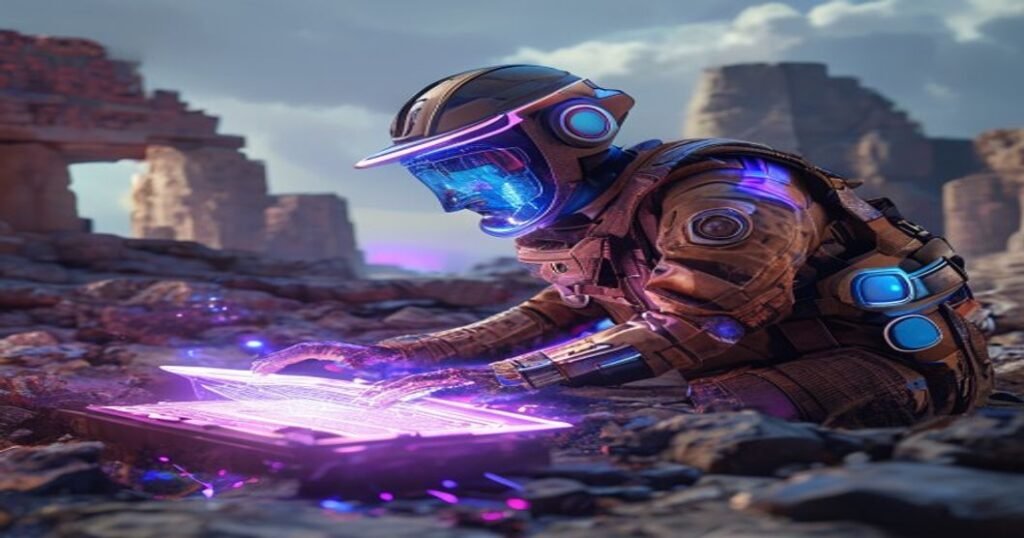

The Digital Rosetta Stone: How AI and Modern Tech are Cracking History’s Toughest Codes (And Rewriting Everything You Thought You Knew)
Remember history class? The endless dates, the names of long-dead kings, the dusty textbooks that felt, well, ancient themselves? Forget all of it. Seriously, wipe the slate clean. Because right now, as you read this, history isn’t just being recounted; it’s being actively rewritten, not by revisionist historians or political agendas, but by algorithms, drones, ground-penetrating radar, and the sheer computational power of modern technology. This isn’t just news; it’s a profound, exhilarating revolution that is fundamentally transforming our understanding of the human story.
For centuries, unlocking the past was a painstaking, often romantic endeavor. Think Indiana Jones, intrepid explorers battling jungles and booby traps, sifting through layers of dirt with a brush and a keen eye. And while that spirit of discovery remains, the tools of the trade have leapfrogged into a sci-fi future that even the most imaginative ancient chronicler couldn’t have conceived. We’re talking about a world where artificial intelligence deciphers lost languages, where satellite imagery reveals entire cities hidden for millennia, and where DNA analysis tells us exactly where our ancestors roamed and who they interacted with. It’s humbling, frankly, how much we thought we knew, only to have science pull back the curtain on a far richer, more complex, and often utterly surprising narrative.
Beyond the Shovel: Archaeology’s Tech-Powered Renaissance
The traditional image of an archaeologist is often someone with a trowel, meticulously sifting through dirt. While that still happens, the real game-changer today is happening far above the ground, or deep beneath it, without a single spade hitting the soil. Light Detection and Ranging (LiDAR) technology, mounted on drones or planes, can penetrate dense jungle canopies and reveal the outlines of forgotten cities and intricate road networks, essentially stripping away centuries of vegetation in a matter of hours. Imagine the sprawling Mayan metropolis of Tikal, hidden under the Guatemalan rainforest, suddenly appearing on a digital map with unprecedented detail. Or entire Roman villa complexes mapped without disturbing a single tile.
Ground-penetrating radar (GPR) and magnetometry allow researchers to peer beneath the earth’s surface, detecting anomalies that suggest buried structures, walls, or even individual artifacts, long before excavation begins. This not only speeds up discovery but also makes archaeology far less destructive, allowing for more informed decisions about what to excavate and what to preserve. The sheer volume of data these technologies generate — gigabytes, even terabytes, of geographical, topographical, and subsurface information — would be overwhelming for human analysis alone. This is where AI truly shines, sifting through patterns, identifying anomalies, and presenting potential sites with an efficiency that was once unthinkable. It’s like suddenly realizing that the very fabric of our physical world, and indeed our past, is being secretly rewired by these unseen digital forces, revealing layers we never knew existed.
Decoding the Undecipherable: AI and Ancient Texts
But the revolution isn’t just about uncovering physical structures. It’s about unlocking the very thoughts and stories of people who lived thousands of years ago. Imagine deciphering texts thought lost forever, or reading languages nobody has understood for millennia. This is no longer the stuff of fiction.
Artificial intelligence is proving to be the ultimate Rosetta Stone. Algorithms are now being trained to recognize patterns in ancient scripts, even when they’re damaged, fragmented, or written in unknown languages. Take the charred scrolls from Herculaneum, buried by the eruption of Vesuvius. For centuries, they were unreadable, too fragile to unroll. Now, advanced imaging techniques combined with AI are virtually unrolling and reading these texts, promising to reveal entirely new insights into Roman philosophy, literature, and daily life. Similarly, AI is helping piece together fragmented cuneiform tablets, identify individual scribes from their writing styles, and even reconstruct damaged papyri. The potential to unlock vast libraries of lost knowledge, to hear the voices of the ancients as never before, is absolutely breathtaking.
DNA’s Time Machine: Rewriting Human Stories
Beyond stones and scrolls, the most intimate historical records are often found within ourselves: our DNA. Advancements in ancient DNA (aDNA) analysis are allowing scientists to extract genetic material from bones, teeth, and even ancient soil samples, providing an unprecedented window into human history. We’re tracing migration patterns with incredible accuracy, understanding the spread of diseases, discovering surprising connections between ancient peoples, and even challenging long-held theories about conquest, cultural diffusion, and the very origins of specific populations.
Suddenly, the simplistic narratives we once accepted are being complicated, enriched, and often overturned. We’re seeing that ancient societies were far more interconnected, diverse, and fluid than previously imagined. It’s humbling, frankly, how much we thought we knew, only to have science pull back the curtain on a far richer, more complex, and often utterly surprising narrative. This biological time machine is arguably the most powerful tool for rewriting history we’ve ever had.
Reconstructing the Lost: Immersive Tech and the Past
Once these discoveries are made, how do we bring them to life for everyone? This is where immersive technologies step in. Virtual reality (VR) and augmented reality (AR) aren’t just for gaming anymore; they’re becoming powerful tools for historical reconstruction and education. Imagine not just reading about ancient Rome, but walking through a meticulously recreated digital model of the Forum as it stood at its zenith, complete with the sounds of bustling markets and orators. Or exploring the inside of an Egyptian pyramid with AR overlays explaining hieroglyphs and burial rituals in real-time. This isn’t just about learning; it’s about experiencing, about feeling the stones under your feet, the wind on your face, in a way that truly allows you to escape reality and step into another.
The New Historical Tourism (And Beyond)
These technological advancements aren’t just for academics; they’re transforming how we engage with history as a society. Historical tourism, a massive global industry, is undergoing a profound shift. Visitors to ancient sites can now use smartphone apps to overlay digital reconstructions onto crumbling ruins, seeing a vibrant city where only foundations remain. Personalized digital guides, powered by AI, can offer bespoke historical journeys tailored to individual interests, creating a far more engaging and informative experience.
Consider a trip to Pompeii where an AI assistant could tell you the story of a specific house and its inhabitants based on the latest archaeological findings, complete with visual reconstructions. Suddenly, your next adventure just got an AI upgrade, promising deeper, more meaningful engagement with the past than ever before. And it’s not just about physical travel; virtual historical experiences are becoming increasingly sophisticated, allowing anyone with an internet connection to explore the wonders of the past from their living room.
Ancient Innovations and Modern Echoes
This deep dive into the past, facilitated by cutting-edge tech, also offers a fascinating mirror to our present. As we uncover the intricate urban planning of ancient cities, the sophisticated irrigation systems of forgotten empires, or the ingenious engineering of structures like Roman aqueducts and Mayan temples, we can’t help but draw parallels. Ancient civilizations, despite their lack of silicon chips, often displayed a remarkable degree of intelligent design and sustainable practices. Their understanding of materials, hydrology, and social organization sometimes puts our modern approaches to shame.
For example, Roman concrete, lost for centuries, is now being studied for its incredible durability and self-healing properties, offering lessons for modern construction. Mayan agricultural systems, adapted to challenging jungle environments, provide insights into sustainable food production. In a way, understanding their clever solutions helps us appreciate the enduring challenge of intelligent design reshaping our homes into living sanctuaries, a quest that spans millennia. The past isn’t just a story; it’s a vast, untapped library of solutions to problems that continue to plague humanity today.
The Ethical Tightrope: Who Owns the Past?
Of course, with great power comes great responsibility. This technological revolution in history also raises crucial ethical questions. Who owns the vast datasets generated by LiDAR scans? Who controls access to the AI models deciphering ancient scripts? How do we ensure that these tools are used responsibly and ethically, respecting the cultural sensitivities of descendant communities?
The digitization of artifacts and sites also brings up questions of intellectual property and potential digital colonialism, where data from one culture might be controlled or exploited by another. As we unlock more and more of the past, we must also consciously navigate these complex waters, ensuring that the benefits of these discoveries are shared equitably and that the voices of those whose history is being unearthed are heard and respected.
The Future is History
We are living in an exhilarating time for anyone fascinated by the human story. The past, far from being static and unchangeable, is a living, breathing entity, constantly being re-evaluated, re-discovered, and re-written by the marvels of modern technology. From revealing hidden cities beneath impenetrable jungles to giving voice to the long-dead through ancient DNA and AI-powered text analysis, the digital age has handed us a veritable Rosetta Stone, capable of unlocking history’s toughest codes.
The dry, dusty dates of yesteryear are being replaced by vivid, immersive experiences that connect us to our ancestors in deeply personal ways. What will we uncover next? What long-held beliefs will be shattered? What forgotten wisdom will be brought to light? One thing is certain: the more we embrace these new technologies, the more profoundly we will understand not just where we came from, but who we are, and perhaps, where we are going. The future of history is now, and it’s far more incredible than any old textbook could have ever imagined.

