
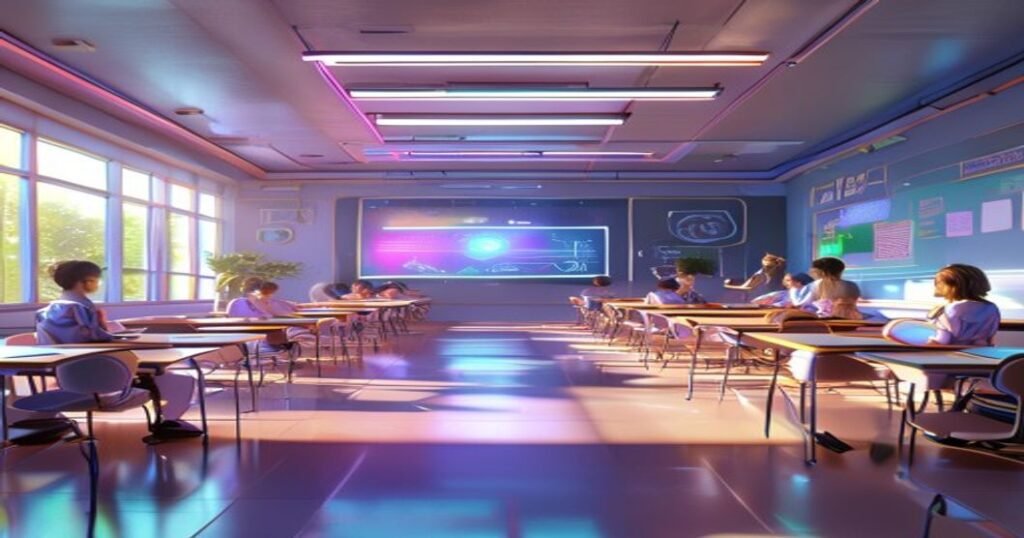

The AI Revolution in Education: Why Your Classroom Will Never Be The Same (And That’s a Good Thing!)
Let’s be honest: for decades, our education system, despite its best intentions, has felt a bit like a time capsule. We’ve talked about innovation, flipped classrooms, and project-based learning, but the core structure – a teacher at the front, students consuming information, standardized tests – has largely remained unchanged. But if you’ve been paying any attention to the broader technological landscape, you know that a seismic shift is underway, one that will fundamentally alter how we learn, teach, and prepare for the future. I’m talking, of course, about Artificial Intelligence, and trust me, its impact on education is nothing short of revolutionary.
Forget the dystopian sci-fi scenarios of robots replacing teachers entirely. That’s a dramatic oversimplification and, frankly, misses the point. What we’re witnessing is a profound evolution, a partnership between human intellect and algorithmic power that promises to unlock learning potential we’ve only ever dreamed of. It’s not just about integrating a new tool; it’s about reimagining the entire pedagogical process. And for anyone involved in education – whether you’re a student, a parent, an educator, or an administrator – understanding this shift isn’t just important, it’s absolutely critical. After all, The AI Earthquake: How Artificial Intelligence is Reshaping Everything We Know (And Why You Can’t Afford to Ignore It) is already here, and education is no exception.
The Cracks in the Traditional Edifice: Why AI is Our Best Hope
For too long, our educational model has operated on a ‘one-size-fits-all’ principle. We group 30 kids of varying abilities, interests, and learning styles into a single classroom, deliver the same lesson, and expect uniform outcomes. The reality? Some thrive, some struggle silently, and many just disengage. Teachers, despite their superhuman efforts, are stretched thin, juggling administrative tasks, lesson planning, grading, and the monumental task of addressing individual student needs.
This is where AI steps in as a game-changer. Imagine a world where every student has a personalized learning assistant, tailored content, and immediate feedback. A world where teachers are freed from the drudgery of rote tasks to focus on mentorship, critical thinking, and fostering creativity. That’s not a distant dream; it’s the trajectory we’re on right now.
Personalized Learning: The Holy Grail, Finally Within Reach
The promise of personalized learning has been around for ages, but scaling it up has always been the insurmountable hurdle. How do you tailor content for hundreds, even thousands, of students without a massive, unsustainable increase in resources? Enter AI. Intelligent tutoring systems can now adapt to a student’s pace, identify their strengths and weaknesses, and recommend resources specifically designed to address their individual learning gaps. Think about it: immediate feedback on homework, adaptive quizzes that get harder or easier based on performance, and content delivery methods that match a student’s preferred style (visual, auditory, kinesthetic).
This isn’t just about remedial work, either. AI can identify advanced learners who are bored and provide them with accelerated challenges, project opportunities, and deeper dives into subjects that captivate them. It transforms learning from a passive consumption of information into an active, dynamic, and deeply engaging experience for every single student.
Empowering Educators, Not Replacing Them
Many educators initially viewed AI with trepidation, fearing it would render their roles obsolete. My strong opinion? Nothing could be further from the truth. AI isn’t coming for their jobs; it’s coming to set them free. Think of AI as the ultimate teaching assistant, handling the mundane so human teachers can focus on what they do best: inspire, guide, and connect.
- Automated Grading & Feedback: AI can instantly grade multiple-choice, fill-in-the-blank, and even some essay questions, providing students with immediate feedback and giving teachers precious hours back.
- Content Curation & Creation: AI tools can help teachers find relevant articles, videos, and exercises, or even generate customized lesson plans and study guides based on specific curriculum requirements and student data.
- Early Intervention: By analyzing student performance data, AI can flag students who are falling behind or struggling with particular concepts much earlier than a human teacher might, allowing for timely intervention and support.
- Administrative Relief: From scheduling to managing student records, AI can streamline numerous administrative tasks, reducing the burden on educators and allowing them more time for direct student interaction.
This frees up teachers to become true facilitators of learning, focusing on developing critical thinking, creativity, emotional intelligence, and collaborative skills – areas where human interaction is irreplaceable. They can spend more time on one-on-one mentorship, group discussions, and project-based learning, cultivating the uniquely human skills that AI cannot replicate.
The Shifting Landscape of Skills: Preparing for an AI-Driven World
Perhaps the most profound impact of AI on education lies in its redefinition of what ‘educated’ truly means. As AI takes over routine, repetitive, and even complex analytical tasks, the demand for purely factual knowledge or rote memorization diminishes. What rises to prominence are uniquely human skills: creativity, critical thinking, complex problem-solving, collaboration, communication, ethical reasoning, and adaptability.
Our education systems must pivot dramatically to foster these competencies. It’s no longer enough to just know things; students must learn how to learn, how to adapt, and how to work alongside AI tools. They need to understand AI’s capabilities and limitations, how to prompt it effectively, and how to critically evaluate the information it provides. In essence, they need to be prepared for The Great Skill Shift: Why Your Dream Job Just Got Rewritten (and How to Master the New Rules).
This means a greater emphasis on project-based learning, interdisciplinary studies, ethical discussions, and real-world problem-solving. Education becomes less about content delivery and more about skill development, fostering curiosity, and building a lifelong love of learning.
Challenges and Ethical Considerations: Navigating the New Frontier
Of course, no technological revolution comes without its challenges. The integration of AI into education raises crucial questions that we must address thoughtfully and proactively:
- Data Privacy and Security: Student data is incredibly sensitive. Robust safeguards and clear ethical guidelines are paramount to protect privacy and prevent misuse.
- Bias in Algorithms: AI systems are only as unbiased as the data they’re trained on. We must be vigilant in identifying and mitigating biases that could perpetuate or even amplify educational inequalities.
- The Digital Divide: Unequal access to technology and reliable internet could exacerbate existing disparities. Ensuring equitable access to AI-powered learning tools is a societal imperative.
- Maintaining Human Connection: While AI can enhance learning, it cannot replace the empathy, mentorship, and social development fostered by human interaction. Striking the right balance is key.
- Teacher Training and Buy-in: Educators need comprehensive training and ongoing support to effectively integrate AI tools into their teaching practices and understand their full potential.
These are not trivial concerns, and ignoring them would be a grave mistake. The ‘AI Gold Rush’ in the ed-tech sector is real, as investors recognize the immense potential, but responsible development and deployment are crucial. The algorithmic revolution is here, and while its transformative power in education is immense, we must approach it with careful consideration for its ethical implications. Understanding The AI Gold Rush: Why Every Investor Needs to Understand the Algorithmic Revolution (Before It’s Too Late!) isn’t just for investors; it’s for all of us shaping the future.
The Future is Now: Embracing the Transformative Power
The convergence of AI and education is not merely an upgrade; it’s a paradigm shift. It offers us an unprecedented opportunity to move beyond outdated models and create a truly personalized, equitable, and effective learning experience for every student on the planet. I believe we are on the cusp of an educational renaissance, where technology finally lives up to its promise of empowering learners and liberating educators.
This isn’t about discarding everything we know; it’s about building upon it, amplifying human potential with intelligent tools. It’s about preparing the next generation not just for the jobs of tomorrow, but for a world that is constantly evolving, demanding adaptability, creativity, and a profound understanding of how to leverage powerful technologies responsibly. The classroom of the future is dynamic, personalized, and deeply human – and AI is the engine making it all possible. The time to embrace and shape this future is now.


