
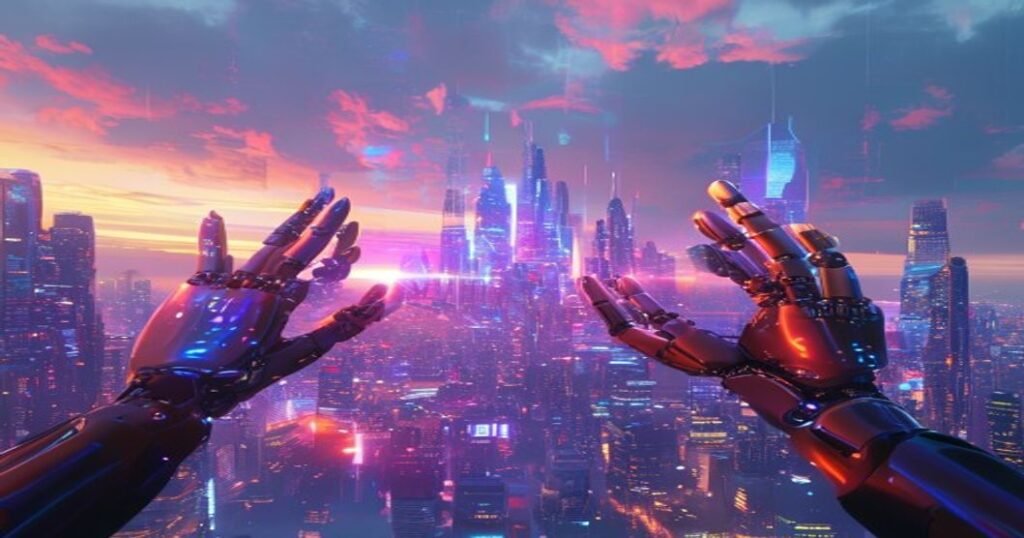

The AI Earthquake: Why Your Job, Your Future, and Your Kids’ Education Will Never Be the Same
Let’s be honest with each other for a moment. The whispers about Artificial Intelligence taking over? They’re no longer whispers. They’re a roaring tsunami, and it’s not just on the horizon; it’s already crashing onto our shores. Forget the sci-fi movies where robots suddenly revolt; the reality is far more subtle, yet profoundly impactful. AI isn’t coming for us with lasers; it’s coming for our spreadsheets, our customer service calls, our creative endeavors, and even the way our children learn. And frankly, it’s going to shake up everything we thought we knew about work, life, and the very concept of a ‘stable’ future.
For a while, it felt like AI was a cool, distant tech experiment – something for researchers in labs or for blockbuster movies. But suddenly, it’s in our browsers, our phones, and fundamentally reshaping industries at warp speed. Every day, it feels like there’s a new breakthrough, a new tool, a new capability that makes us gasp, sometimes with awe, sometimes with a creeping sense of unease. And as a keen observer of this unfolding drama, I believe it’s time we stopped just observing and started understanding, adapting, and even, dare I say, embracing this seismic shift.
The Great Job Transformation: Less Fear, More Foresight
One of the biggest anxieties swirling around AI is the fear of job displacement. Will robots take my job? It’s a valid concern, and to sugarcoat it would be irresponsible. Yes, certain roles, particularly those that are repetitive, data-driven, or involve predictable tasks, are absolutely vulnerable. AI is already excelling at tasks like data entry, basic content generation, customer support triage, and even complex analytical work that once required an army of human specialists.
But here’s the crucial nuance often lost in the headlines: while AI will undoubtedly automate many tasks, it also creates entirely new categories of jobs. Think AI trainers, ethicists, prompt engineers, AI-powered system designers, and specialists who can integrate AI into existing workflows. The demand for uniquely human skills – creativity, critical thinking, emotional intelligence, complex problem-solving, and interpersonal communication – is skyrocketing. AI can analyze data, but it can’t (yet) genuinely innovate with empathy or lead a team with inspiration. It can write a report, but it can’t tell a compelling story that truly resonates with the human spirit without human guidance. The workforce isn’t shrinking; it’s evolving, demanding a different kind of worker. We’re moving from a ‘what you know’ economy to a ‘how well you adapt and leverage tools’ economy.
AI: The Ultimate Startup Accelerator
If you’re an entrepreneur or aspiring to be one, this era isn’t just a challenge; it’s an unprecedented opportunity. Historically, launching a startup required massive capital, extensive teams, and often, years of development. Now, AI levels the playing field in ways we could only dream of before. AI tools can handle market research, initial product design, marketing copy, social media management, customer service, and even complex data analysis, all at a fraction of the cost and time. This means smaller teams can achieve bigger impacts, faster. For more on how this revolutionary shift is empowering the entrepreneurial landscape, you absolutely must read The AI Avalanche: Why Intelligent Machines Aren’t Coming, They’ve Already Changed Everything for Startups!. It’s a game-changer for anyone with an innovative idea.
Education: The Future of Learning is Now
Perhaps nowhere is the impact of AI more profound, and more urgently in need of our attention, than in education. Our current educational models, largely relics of the industrial age, are struggling to keep pace. The traditional factory-line approach to learning – one teacher, many students, standardized tests – simply isn’t equipped to prepare individuals for a world where AI handles the predictable and rote.
This is where AI truly shines a light on a path forward. Imagine a classroom where every student has a personalized learning assistant, an AI that understands their strengths, weaknesses, preferred learning styles, and even their emotional state. This isn’t a pipe dream; it’s becoming a reality. AI can deliver tailored content, identify learning gaps in real-time, provide instant feedback, and free up teachers to focus on mentorship, critical thinking development, and fostering creativity. It’s about moving from a one-size-fits-all model to truly individualized learning journeys. To delve deeper into this critical shift, explore Unlocking Tomorrow’s Minds: How AI is Redefining Education and Preparing Students for an Unpredictable Future and understand how our educational systems are being fundamentally reshaped for the better.
And it’s not just about content delivery. The very skills we teach need an overhaul. Memorization? AI handles that. Calculation? AI handles that. We need to cultivate creativity, complex problem-solving, critical analysis, ethical reasoning, and collaboration – skills that complement AI, not compete with it. The good news is, AI-powered tools are also revolutionizing how these ‘soft skills’ can be taught and practiced, offering interactive simulations and real-time feedback that were previously impossible. This movement towards highly customized educational experiences is not just a trend; it’s here to stay. Discover why this personalized learning revolution is so vital for our children’s prospects by reading The AI Classroom Uprising: Why Personalized Learning Is Here To Stay (And How It’s Reshaping Your Child’s Future).
Beyond Work: How AI is Reshaping Our Play and Culture
The AI earthquake isn’t confined to the workplace or classrooms. It’s permeating every facet of our lives, even our downtime. From the recommendation engines that curate our streaming queues to the advanced algorithms powering our favorite video games, AI is quietly, yet powerfully, enhancing our entertainment experiences. Think about how games are becoming more adaptive, characters more intelligent, and narratives more dynamic thanks to AI. It’s moving us towards truly intelligent worlds where our interactions feel more real and less scripted. In fact, if you want a fascinating look into how this is happening, check out Beyond the Blockbuster: How AI is Rewriting the Rules of Entertainment (And Why You’re Already Hooked).
This widespread integration means that our daily interactions, our consumer choices, and even our cultural narratives are increasingly influenced by intelligent algorithms. It’s a pervasive force, shaping everything from how we discover new music to how we navigate city streets.
The Ethical Imperative: Steering the Ship
With great power comes great responsibility, and AI is no exception. As this technology becomes more ingrained, so too do the ethical questions. Issues of bias in algorithms, data privacy, the potential for misuse, and the question of accountability when AI makes critical decisions are not just academic debates; they are pressing concerns that demand immediate attention from policymakers, developers, and society as a whole. We must ensure that as AI progresses, it does so in a way that benefits humanity, upholds fairness, and protects individual liberties. This requires open dialogue, robust regulatory frameworks, and a commitment to transparent and ethical AI development.
What Does This Mean for YOU?
So, where does that leave you, navigating this brave new world? My advice is simple, yet profound: become a lifelong learner. Complacency is the biggest risk. Embrace digital literacy. Understand the basics of how AI works, even if you’re not a programmer. Learn to use AI tools to augment your own capabilities, rather than fearing them as replacements. Focus on developing those uniquely human skills – creativity, emotional intelligence, critical thinking – that AI cannot replicate. Seek out opportunities to reskill and upskill. And perhaps most importantly, cultivate an adaptable mindset. The only constant now is change, and those who can pivot, learn, and leverage new technologies will not just survive, but thrive.
The Future Isn’t Written, It’s Being Coded
The AI earthquake is undeniably shaking the foundations of our society. It’s disrupting industries, redefining education, and transforming our daily lives. But I truly believe this isn’t a doomsday scenario. It’s an awakening. It’s a powerful call to innovate, to rethink, and to re-skill. The future isn’t a predetermined destination; it’s a landscape we are collectively building, brick by digital brick, line by algorithmic line. It’s up to us, as individuals, as educators, as entrepreneurs, and as a society, to ensure that this future is one of opportunity, progress, and shared prosperity. So, let’s not just brace for the impact; let’s actively shape the aftermath, together.

