
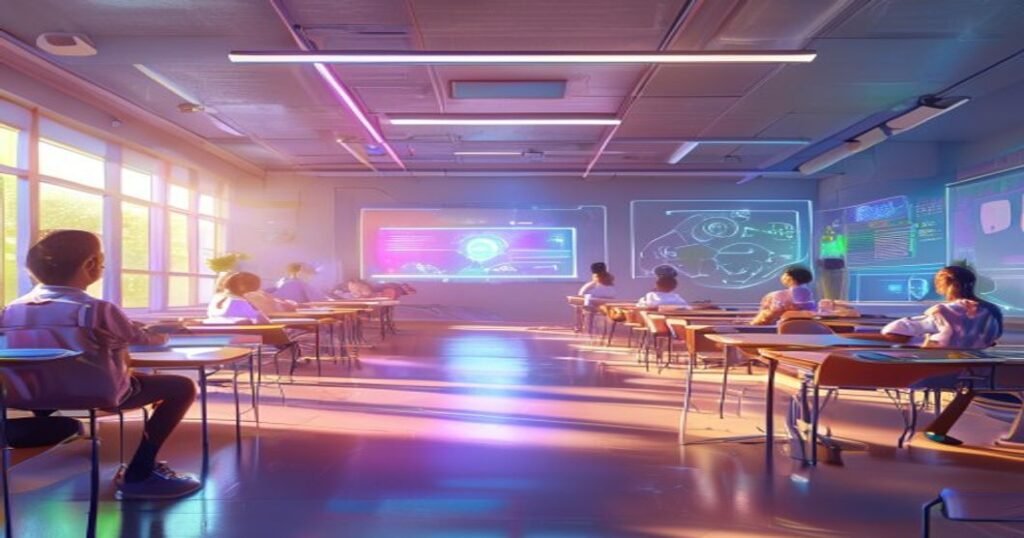

The AI Classroom Uprising: Why Personalized Learning is Here to Stay (And How It’s Reshaping Your Child’s Future)
Let’s be honest: the traditional classroom, with its one-size-fits-all approach, has always felt a little… outdated. We’ve all been there, either bored senseless because the pace was too slow, or completely lost because it was too fast. The system, designed for an industrial age, struggles to keep up with the unique needs and brilliant minds of every single student. But something profound is happening, a quiet revolution that promises to dismantle these limitations and usher in an era where learning truly becomes personal. I’m talking, of course, about Artificial Intelligence.
Forget the dystopian sci-fi movies; AI isn’t here to replace humanity, especially not in the nuanced world of education. Instead, it’s becoming the ultimate assistant, the tireless tutor, and the insightful analyst that every educator has dreamed of. If you’ve been paying attention, you’ll know that the AI avalanche isn’t coming; it’s already changed everything. And nowhere is its potential more transformative than in how we learn, teach, and grow.
The Inefficiency of the Status Quo: Why We Needed a Change
Think about it: 30 students, one teacher, one curriculum. How can that possibly cater to a child who grasps algebra in minutes, while another struggles with basic arithmetic? Or the budding artist stifled by an overemphasis on rote memorization? Our current systems, however well-intentioned, often leave significant gaps. Talented students become disengaged, struggling students fall further behind, and teachers, despite their heroic efforts, are stretched thin, unable to provide the individualized attention every child deserves.
This isn’t a criticism of teachers; it’s a recognition of systemic limitations. Teachers are superheroes, but even superheroes need advanced tools. And that’s precisely where AI steps in, not as a replacement, but as an amplification, a force multiplier for human educators.
AI: The Personalization Engine Education Has Always Needed
Imagine a learning journey custom-built for you. A curriculum that adapts in real-time to your strengths, shoring up your weaknesses, and even sparking curiosity in areas you never knew you’d love. This isn’t fantasy; it’s the core promise of AI in education, and it’s happening now.
Adaptive Learning Platforms: Your Personal Academic GPS
At the heart of this revolution are adaptive learning platforms. These aren’t just fancy e-books. They use sophisticated algorithms to track a student’s progress, identify learning patterns, and then dynamically adjust the content, pace, and even the teaching method. If a student is acing fractions, the platform might skip ahead to decimals. If they’re struggling with sentence structure, it will offer more exercises, different explanations, or even interactive games until mastery is achieved.
It’s akin to how AI is rewriting the future of personalized health – it’s about understanding individual needs at a granular level and responding with tailored solutions. In education, this means every student can learn at their optimal pace, in their preferred style, leading to deeper understanding and genuine engagement rather than surface-level memorization.
AI as a Superpower for Educators: Freeing Up Minds, Not Replacing Them
Perhaps the most exciting aspect of AI in education isn’t just what it does for students, but what it does for teachers. Think of the hours spent grading papers, preparing standardized tests, or compiling progress reports. AI can automate many of these tedious, time-consuming tasks with remarkable efficiency and accuracy.
- Automated Grading: From multiple-choice quizzes to essay analysis (yes, even essays!), AI can provide instant feedback, freeing teachers to focus on deeper pedagogical work.
- Personalized Feedback: AI tools can analyze student work and offer specific, constructive criticism, something a single teacher simply cannot do for 30+ students on a consistent basis.
- Identifying Learning Gaps: AI dashboards can highlight which concepts a class as a whole is struggling with, or which individual students need extra support, allowing teachers to intervene proactively and effectively.
- Content Curation: Need engaging resources for a specific topic? AI can sift through vast databases to find relevant articles, videos, and interactive simulations, saving teachers hours of search time.
This shift isn’t about replacing the teacher; it’s about elevating their role. With the administrative burden lightened, educators can finally dedicate more time to what truly matters: mentoring, inspiring, fostering critical thinking, and building meaningful relationships with their students. They become facilitators of learning, guides on personalized journeys, rather than mere dispensers of information.
Beyond the Textbook: AI for Creativity and Critical Thinking
The fear that AI will turn learning into a robotic, dehumanized process couldn’t be further from the truth. In fact, by automating the mundane, AI creates space for the truly human elements of education to flourish. AI tools can help students:
- Generate Ideas: Brainstorming prompts, story starters, or even scientific hypothesis generation.
- Refine Writing: Providing real-time grammar, style, and coherence suggestions.
- Explore Complex Concepts: Interactive simulations, virtual reality field trips powered by AI, allowing students to ‘experience’ history or complex scientific phenomena.
- Develop Future-Ready Skills: As AI silently rewrites our everyday lives, understanding how to leverage these tools becomes a vital skill for every student.
Imagine a student using an AI art generator to visualize a historical scene they’re studying, or employing an AI coding assistant to build a simple app to solve a problem in their community. These are not just academic exercises; they are real-world applications that foster creativity, problem-solving, and critical thinking.
The Challenges and the Ethical Compass
Of course, no major technological shift comes without its complexities. The integration of AI in education raises important questions:
- Data Privacy and Security: Student data is precious. Robust safeguards and clear ethical guidelines are paramount.
- Equity and Access: We must ensure that the benefits of AI are accessible to all students, regardless of socioeconomic status or geographical location. The digital divide cannot become an AI divide.
- Bias in Algorithms: AI models are only as good as the data they’re trained on. We need to be vigilant about identifying and mitigating potential biases that could unfairly impact certain student groups.
- Maintaining the Human Touch: While AI can augment, it cannot replicate the empathy, inspiration, and holistic development that only human interaction provides.
These are not roadblocks, but rather critical considerations that require thoughtful discussion, careful policy-making, and continuous iteration. The goal isn’t to replace the human element, but to enhance it. Just as your phone just got a brain, making advanced capabilities more accessible, AI tools are bringing sophisticated learning experiences to the fingertips of students and educators alike.
The Road Ahead: A Collaborative Future
The future of education, powered by AI, is not one of sterile machines and isolated learners. Instead, it’s a vibrant ecosystem where technology and human ingenuity converge. It’s a future where:
- Every student feels seen, understood, and challenged at their appropriate level.
- Teachers are empowered to be mentors, innovators, and guides, freed from administrative drudgery.
- Learning is an engaging, personalized adventure that equips students with the skills, knowledge, and critical thinking abilities needed to thrive in an ever-evolving world.
This isn’t just about making education ‘better’; it’s about making it profoundly more effective, more equitable, and more human. The AI classroom uprising isn’t a threat; it’s an invitation to reimagine what’s possible, and I, for one, am incredibly optimistic about the revolution that’s already underway. Our children’s future, quite literally, depends on it.


