
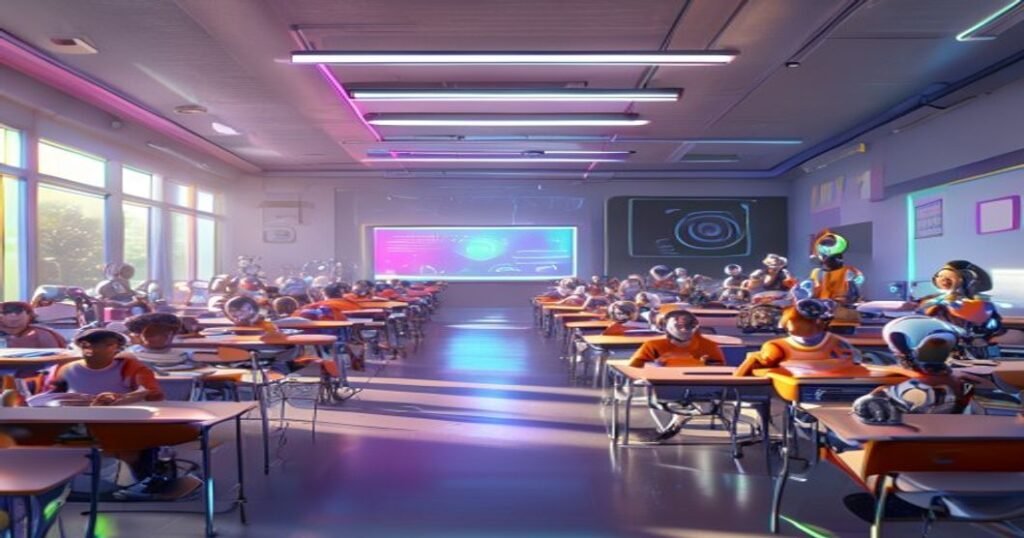

Remember that feeling of dread, staring at a textbook, convinced that the information just wasn’t sticking? Or perhaps the frustration of a one-size-fits-all lecture, even when your learning style screamed for something different? We’ve all been there. Education, for centuries, has largely operated on a model that, while effective for many, often left others behind. But what if I told you the classroom as we know it is undergoing a seismic shift, powered by an intelligence that learns, creates, and adapts at an astonishing pace? Welcome to the age of Generative AI in education, and trust me, it’s far more than just a fancy new gadget.
The Generative AI Explosion: Not Just a Buzzword, But a Blueprint for Learning
For a while now, we’ve heard whispers and shouts about artificial intelligence. From self-driving cars to algorithms predicting our next purchase, AI has been seeping into every corner of our lives. But the generative AI explosion, particularly, has thrown open the doors to possibilities that were, until very recently, confined to science fiction. We’re talking about AI that doesn’t just process information, but creates it—text, images, code, even music. And in the world of education, this isn’t just a fascinating development; it’s a potential game-changer that promises to redefine how we teach, learn, and even think about knowledge itself.
I’ve watched countless technological waves wash over the educational landscape, each promising to revolutionize everything. Some delivered, others faded. But Generative AI feels different. It’s not just another tool; it’s an intellectual companion, a tireless assistant, and a personalized tutor all rolled into one. It’s forcing us to ask profound questions about creativity, critical thinking, and the very purpose of human learning when machines can generate essays or solve complex problems in seconds.
Personalized Learning: The Holy Grail, Finally Within Reach?
One of the most enduring dreams in education has been true personalization. Imagine a curriculum that adapts to your pace, your preferred learning style, and your specific areas of struggle or strength. Generative AI makes this dream startlingly tangible. AI-powered platforms can now analyze a student’s performance, identify knowledge gaps, and then generate custom explanations, practice problems, or even entire lessons tailored precisely to that individual.
- Adaptive Content Generation: From creating simplified explanations for a struggling student to crafting advanced challenges for a gifted one, AI can dynamically generate content that meets the learner exactly where they are.
- Intelligent Tutoring Systems: Gone are the days of a single tutor stretched thin across many students. Conversational AI, which is part of the unseen revolution in human-computer interaction, allows for interactive, real-time feedback and explanation. Students can ask questions in natural language, and the AI can respond with clarity, patience, and endless examples, making learning a truly two-way street. Think of it as having a dedicated, infinitely patient teacher available 24/7.
- Skill-Based Learning Paths: Instead of rigid coursework, AI can identify the specific skills a student needs to master for a particular career or academic goal and then curate a personalized pathway of resources and activities.
This isn’t just about efficiency; it’s about equity. It means that every student, regardless of their background or previous academic performance, could potentially access a learning experience optimized just for them, helping to level the playing field in ways we could only fantasize about before.
Empowering Educators, Not Replacing Them
Let’s be clear: the idea that AI will replace teachers is a fearful misunderstanding. In my opinion, it’s quite the opposite. Generative AI is poised to become the ultimate teaching assistant, freeing up educators from the most time-consuming, repetitive, and often less fulfilling aspects of their job. Think about it:
- Automated Lesson Planning & Resource Creation: Teachers spend countless hours creating lesson plans, worksheets, and assessment materials. AI can generate drafts, suggest creative activities, and even source relevant articles or videos, giving teachers more time to focus on pedagogy and student interaction.
- Personalized Feedback at Scale: Providing detailed, constructive feedback to every student is a monumental task. AI can assist by analyzing student work, identifying common errors, and even suggesting areas for improvement, allowing teachers to refine and personalize that feedback rather than starting from scratch.
- Administrative Burden Reduction: From grading multiple-choice quizzes to managing schedules and communications, AI can automate numerous administrative tasks, reducing burnout and allowing teachers to dedicate more energy to their core mission: educating.
The role of the teacher will evolve, shifting from a disseminator of information to a facilitator, a mentor, a coach, and a guide. They will be better equipped to foster critical thinking, creativity, and socio-emotional development – skills that no AI can truly replicate.
The Elephant in the Room: Challenges and Ethical Considerations
Of course, no revolution comes without its complexities. The integration of Generative AI into education raises significant questions that we, as a society, must address head-on. As the AI revolution continues to rewrite our future, we must navigate these carefully:
- Academic Integrity: The ease with which AI can generate essays or solve problems presents an obvious challenge to traditional assessment methods. How do we ensure students are genuinely learning and not simply outsourcing their thinking? This requires a shift towards project-based learning, critical thinking assignments, and assessments that value process over product.
- Data Privacy and Bias: AI systems rely on vast datasets. Ensuring student data is protected and that the AI models themselves are free from inherent biases (which can perpetuate and amplify societal inequalities) is paramount.
- Digital Divide: Access to cutting-edge AI tools and reliable internet remains a challenge in many parts of the world. We must strive to ensure that AI in education doesn’t widen the existing gap between the privileged and the underserved.
- Over-reliance and Critical Thinking: While AI can be a powerful tool, an over-reliance on it could potentially hinder the development of fundamental critical thinking, problem-solving, and research skills. The goal isn’t to replace human intellect, but to augment it.
These aren’t insurmountable obstacles, but they require thoughtful policy-making, robust ethical frameworks, and ongoing dialogue between educators, technologists, policymakers, and parents. It’s about building a future where technology serves humanity, not the other way around.
Beyond the Screen: Redefining Learning Experiences
Generative AI isn’t confined to text and code. Its ability to create immersive environments and dynamic simulations opens up exciting avenues for experiential learning. Imagine students dissecting a virtual frog with hyper-realistic feedback, exploring ancient Rome in a fully interactive historical simulation, or conducting complex scientific experiments without the need for expensive lab equipment.
This merges with the broader trend where AI is not just changing entertainment but redefining reality itself. In education, this means going beyond passive consumption of information to active, engaging participation in learning worlds. Complex concepts, once abstract, can become tangible and experiential, fostering deeper understanding and retention.
My hope is that this capability will allow education to move past rote memorization and embrace a more holistic, hands-on, and curiosity-driven approach. It’s about bringing the world into the classroom, or better yet, bringing the classroom into the world.
The Future is Now: A Call to Embrace and Adapt
The question isn’t whether Generative AI will impact education; it’s how profoundly. We are standing at a pivotal moment, much like the invention of the printing press or the internet. Those who embrace these changes with an open mind, a critical eye, and a collaborative spirit will be the ones who shape the next generation of learners.
For students, it means cultivating adaptability, critical thinking, and ethical awareness – skills that will enable them to leverage AI as a co-pilot rather than a crutch. For educators, it means reimagining their roles, embracing new tools, and focusing on the uniquely human aspects of teaching. For institutions, it means investing in infrastructure, training, and ethical guidelines.
The traditional classroom model, with its standardized tests and rigid structures, feels increasingly like a relic of a bygone era. Generative AI offers us a chance to build something better: a dynamic, personalized, and deeply engaging learning ecosystem that prepares every individual not just for a job, but for a future constantly in flux. It’s an exciting, slightly daunting, but undeniably hopeful new dawn for education, and I, for one, am ready to witness its brilliance.


