
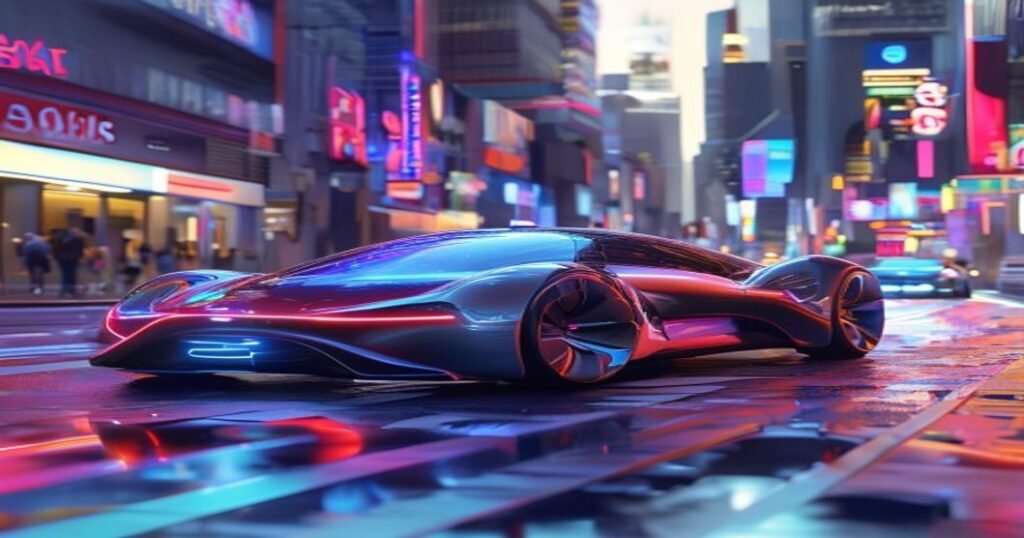

Remember when driving was just about, well, driving? You’d turn the key, press the pedal, and navigate the road yourself. Simple, straightforward, and for many, a deeply personal experience. But if you’ve been paying attention, you’ll know that era is rapidly becoming a quaint memory. We’re on the cusp of a revolution in the automotive world, one powered by an invisible force that’s rewriting every rule we thought we knew: Artificial Intelligence.
It’s no longer a question of if AI will change how we interact with our cars, but how deeply. And let me tell you, it’s profound. From the moment you step into a vehicle to how it communicates with the world around it, AI is the silent architect building the future of mobility. It’s truly like The Invisible Hand: How AI is Quietly Rewriting Every Aspect of Our Digital Lives, and the auto industry is arguably one of its most exciting playgrounds.
The Brain Behind the Brawn: Autonomous Driving and Beyond
The most talked-about application of AI in cars is, of course, autonomous driving. For years, it felt like science fiction, something out of a futuristic movie. Now, it’s on our roads, albeit in various stages of development. We’re not just talking about cruise control anymore; we’re talking about cars that can perceive their environment, make complex decisions, and navigate without human intervention.
Imagine this: Your car, equipped with an array of sensors – cameras, radar, lidar, ultrasonics – acts as its eyes and ears. This raw data is then fed into a sophisticated AI system, the car’s ‘brain.’ This brain processes millions of data points per second, identifying other vehicles, pedestrians, traffic signs, lane markings, and potential hazards. It predicts movements, calculates trajectories, and makes real-time decisions that would overwhelm even the most experienced human driver.
But AI’s role extends far beyond merely keeping the car in its lane. It’s about creating a truly intelligent co-pilot and, eventually, a completely self-sufficient vehicle. This involves:
-
Predictive Maintenance: The Car That Knows Itself
No one likes a breakdown. AI algorithms can analyze performance data from your car’s engine, transmission, brakes, and electrical systems. By recognizing subtle patterns and anomalies, they can predict potential failures long before they happen. Your car might literally tell you, ‘Hey, your brake pads will need replacing in about 1,000 miles, let’s book an appointment.’ This proactive approach saves time, money, and reduces roadside emergencies. It’s a game-changer for car owners and fleet managers alike.
-
Personalized In-Car Experience: Your Ride, Your Rules
Step inside a modern car, and you’ll immediately notice the screens, the connectivity, the voice assistants. AI is transforming the cabin into a personalized hub. It learns your preferences: your favorite driving routes, your go-to music genres, even your preferred temperature settings. Voice assistants powered by AI are becoming incredibly sophisticated, allowing you to control navigation, entertainment, and even communicate with smart home devices from your car. It’s a testament to how Your Phone Just Got Smarter: How AI is Rewriting the Smartphone Rulebook (And Why You’ll Love It), because our cars are essentially becoming giant, super-powered smartphones on wheels.
-
Enhanced Safety Systems: A Guardian Angel on Wheels
Advanced Driver-Assistance Systems (ADAS) are already commonplace. Think automatic emergency braking, lane-keeping assist, blind-spot monitoring, and adaptive cruise control. These systems, all powered by AI, act as an extra pair of eyes and a faster set of reflexes. They detect potential collisions, warn drivers, and in many cases, intervene automatically to prevent accidents or mitigate their severity. My take? These aren’t just features; they’re essential safety nets that are saving lives every single day by significantly reducing human error.
Beyond the Vehicle: AI and the Smart City Ecosystem
The impact of AI in auto isn’t confined to the individual vehicle; it extends to the entire transportation ecosystem. Smart cars need smart infrastructure to truly thrive. Vehicle-to-everything (V2X) communication, heavily reliant on AI, allows cars to talk to each other (V2V), to traffic lights and road infrastructure (V2I), and even to pedestrians’ smartphones (V2P).
This constant stream of data, processed by AI, enables:
-
Optimized Traffic Flow: No More Gridlock?
Imagine traffic lights that dynamically adjust their timing based on real-time traffic density, or navigation systems that don’t just tell you the shortest route, but the fastest, factoring in predicted congestion. AI-powered traffic management systems promise to significantly reduce jams, pollution, and commute times. This interconnectedness truly relies on robust communication networks, and it makes you think about The AI-Powered Telecom Tsunami: How Intelligence is Rewriting the Rules of Connectivity (And Why You Can’t Afford to Miss It), because without that backbone, the smart car revolution would stall.
-
New Mobility Services: A Paradigm Shift
Autonomous vehicles are poised to revolutionize ride-sharing and public transportation. Fleets of self-driving cars could offer on-demand mobility, reducing the need for individual car ownership, particularly in dense urban areas. This could lead to fewer parked cars, less traffic, and more efficient use of urban space. It’s a fascinating vision, challenging our long-held notions of personal freedom tied to car ownership.
The Road Ahead: Challenges and the Human Element
Of course, this transformative journey isn’t without its speed bumps. Ethical considerations, regulatory frameworks, and public acceptance are massive hurdles. Who is responsible in an accident involving an autonomous car? How do we ensure the AI systems are unbiased and make fair decisions? These are complex questions that require careful deliberation.
There’s also the impact on the job market. As autonomous technology advances, roles like professional drivers (taxis, trucks, buses) will undoubtedly face significant disruption. It makes us ponder The AI Earthquake: How Artificial Intelligence is Rocking the Job Market and How YOU Can Thrive, not just in auto but across various sectors. While some jobs may disappear, new ones in AI development, ethical oversight, and vehicle maintenance for complex systems will emerge. It’s a period of significant transition that requires foresight and adaptation.
And then there’s the human element. For many, driving isn’t just a chore; it’s a pleasure, a source of freedom, a skill to master. Will we lose that connection to the open road when AI takes over? I believe the answer is nuanced. While daily commutes might become automated, opening up valuable time for work or relaxation, the thrill of driving for leisure, on a scenic route, will likely remain – perhaps in purpose-built vehicles or designated ‘human-driven’ zones. The choice, I hope, will always be ours to make.
A Future, Not Just Faster, But Smarter
The integration of AI into the automotive industry is more than just an upgrade; it’s a fundamental reimagining of transportation. It promises safer roads, more efficient journeys, and a personalized experience that will make our current cars feel like relics from a bygone era. We’re moving towards a future where cars aren’t just machines that take us from A to B, but intelligent partners that enhance our lives, protect us, and seamlessly integrate into a smarter, more connected world.
The journey is just beginning, and while there are challenges to navigate, the potential rewards – a world with fewer accidents, less congestion, and greater accessibility – are immense. So buckle up, because the AI-powered future of driving is accelerating faster than you think, and it’s going to be an incredible ride.


