
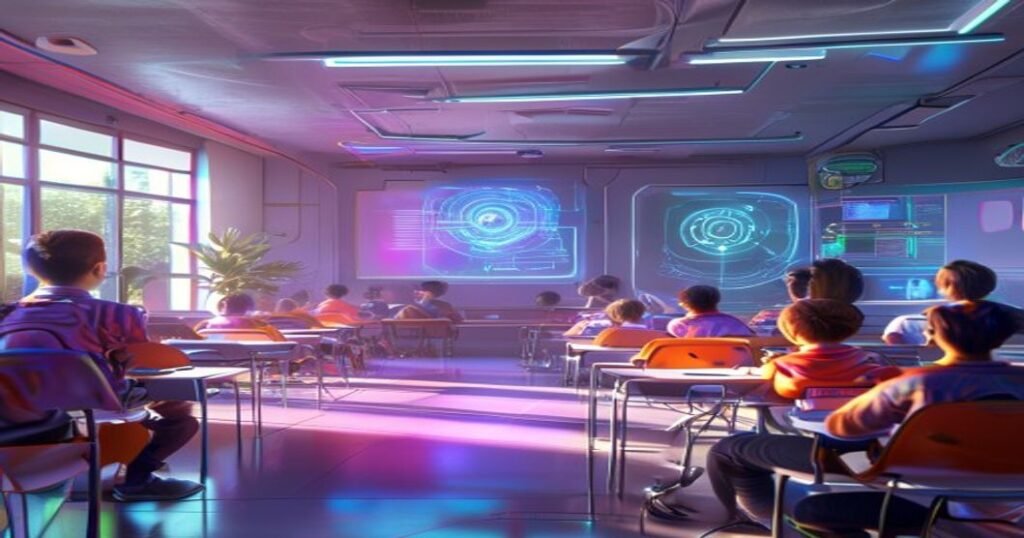

Alright, let’s talk about something truly groundbreaking, something that’s quietly yet profoundly changing the very fabric of how we learn: Artificial Intelligence in education. For too long, our classrooms, from kindergarten to university lecture halls, have largely followed models established centuries ago. Rows of desks, a teacher at the front, standardized tests – it’s a system designed for a different era. But let’s be real, the world outside those classroom doors has exploded with innovation. And now, the tools of that innovation, particularly AI, are finally making their way into the hallowed halls of academia. And frankly, it’s about time!
The Myth of One-Size-Fits-All Learning is Crumbling
Think about it: every student is unique. They have different learning styles, different paces, different interests, and different challenges. Yet, our traditional educational model often treats them like a homogeneous group, pushing everyone through the same curriculum at the same speed. It’s like trying to fit a square peg into a round hole, repeatedly. Some kids thrive, many struggle, and even more simply disengage because the material isn’t presented in a way that resonates with them.
This is where AI swoops in like a superhero with a personalized learning cape. I’m not talking about some dystopian future where robots replace teachers. No, this is about empowering educators and learners with intelligent systems that can truly adapt. Imagine a learning platform that understands your child’s strengths and weaknesses, their preferred way of processing information, and even their emotional state as they learn. It then tailors content, suggests resources, and provides feedback that is perfectly calibrated for them. This isn’t just a dream; it’s happening right now.
Personalized Pathways: The AI Advantage
AI-driven adaptive learning systems are perhaps the most exciting development. These platforms use complex algorithms to analyze a student’s performance in real-time. If a student is struggling with a particular concept, the system can offer additional explanations, different examples, or even alternative learning modules. If they’re excelling, it can accelerate them to more advanced topics or introduce new challenges to keep them engaged. This kind of dynamic, responsive learning environment was simply impossible on a large scale before AI.
- Intelligent Tutoring Systems: Think of a virtual tutor available 24/7, capable of explaining complex problems, correcting mistakes, and guiding students through difficult concepts with infinite patience.
- Content Curation & Creation: AI can sift through mountains of information to recommend the most relevant articles, videos, and exercises. It can even help generate new learning materials, making content more accessible and engaging.
- Predictive Analytics: By analyzing learning patterns, AI can identify students at risk of falling behind even before they do, allowing educators to intervene proactively.
Beyond the Textbook: Preparing for an AI-Driven World
The implications of AI extend far beyond just how we deliver content. It’s fundamentally shifting what we need to teach. The skills demanded by the workforce are changing at an incredible pace, and manual, repetitive tasks are increasingly being automated. This means education must pivot towards fostering uniquely human skills: critical thinking, creativity, complex problem-solving, emotional intelligence, and collaboration. It’s no longer enough to memorize facts; students need to learn how to learn, how to adapt, and how to innovate.
Consider the broader economic landscape. Nations everywhere are recognizing the pivotal role of AI in shaping their future. For a nation like Pakistan, with its vibrant youth population, embracing AI in education isn’t just an upgrade; it’s a necessity for securing its economic trajectory. The advancements in AI are not confined to academic research labs; they’re actively rewriting the economic future across various sectors. Education must be at the forefront of this transformation, equipping the next generation with the digital literacy and critical thinking skills needed to thrive.
We’re seeing this ‘silent revolution’ play out in countless industries. From how AI is rewiring telecom’s future with smart connections and predictive maintenance to how AI and Big Data are reshaping sports with advanced analytics and personalized training regimes, AI is everywhere. Our educational systems need to reflect this reality, preparing students not just to use AI, but to understand its implications, ethical challenges, and creative potential.
Fostering Future-Ready Skills
So, how does AI help us teach these crucial skills? By freeing up teachers from administrative burdens, AI allows them to focus more on mentorship, project-based learning, and facilitating deeper discussions. It provides data-driven insights that help identify skill gaps and design targeted interventions. Moreover, AI can introduce students to complex concepts and simulations that would be otherwise inaccessible, from virtual reality chemistry labs to AI-powered coding environments. Even understanding groundbreaking scientific fields like genetic engineering, as explored in articles like Unlocking Life’s Code: How CRISPR is Rewriting Our Future (And Why You Should Care!), becomes more accessible when AI tools can visualize complex molecular interactions or simplify dense research papers.
The Elephant in the Room: Challenges and Ethical Considerations
Of course, it’s not all sunshine and pedagogical rainbows. Like any powerful technology, AI in education comes with its own set of challenges that we absolutely cannot ignore:
- Data Privacy and Security: AI systems thrive on data. Student data is incredibly sensitive, and ensuring its privacy and security must be paramount. Clear policies and robust safeguards are non-negotiable.
- Algorithmic Bias: If the data used to train AI is biased, the AI itself will perpetuate and even amplify those biases. We need diverse teams designing and training these systems to ensure fairness and equity for all learners.
- The Digital Divide: Not every student has access to reliable internet or devices. Relying too heavily on AI tools risks widening the gap between those who have access to technology and those who don’t.
- Over-reliance and Deskilling: There’s a concern that students might become overly reliant on AI, potentially hindering the development of fundamental skills like critical thinking or problem-solving without assistance. We must ensure AI is a tool to augment learning, not replace cognitive effort.
- The Human Element: Education is fundamentally a human endeavor. The empathy, nuanced understanding, and personal connection a great teacher provides are irreplaceable. AI should never be seen as a replacement for human educators, but rather as a powerful assistant.
The Evolving Role of the Educator: From Sage to Guide
The rise of AI doesn’t mean the end of teachers; it means the evolution of their role. If AI can handle repetitive tasks like grading multiple-choice questions or providing basic instruction, teachers are freed up to do what they do best: mentor, inspire, facilitate deep learning, and address the individual emotional and social needs of their students. They become designers of learning experiences, curators of content, and coaches who guide students through personalized educational journeys.
I believe this shift is incredibly empowering for educators. Imagine having more time to engage with students on a personal level, to foster their passions, and to develop their socio-emotional skills. AI can provide the data and insights, but it’s the teacher who brings the wisdom, the empathy, and the human touch that truly transforms learning into growth.
The Future is Now: Embracing Lifelong Learning
The pace of change isn’t slowing down. Lifelong learning isn’t just a buzzword; it’s a necessity. AI tools can support this continuous learning by providing personalized recommendations for professional development, micro-credentialing platforms, and skill-upgrading courses. Education is no longer a phase that ends with a degree; it’s an ongoing journey.
The integration of AI into education is not a question of ‘if’, but ‘how’ and ‘when’. It’s an opportunity to create more equitable, engaging, and effective learning experiences for everyone. It’s about preparing our students not just for the jobs of today, but for a future we can only begin to imagine. As we embrace this technological wave, let’s do so thoughtfully, ethically, and with a clear vision: to empower every learner to reach their fullest potential in an ever-evolving world.
The revolution is here, and it’s in our classrooms. Let’s make sure we seize this moment to build an educational system that truly serves the needs of every student and prepares them to thrive in the digital age.


