
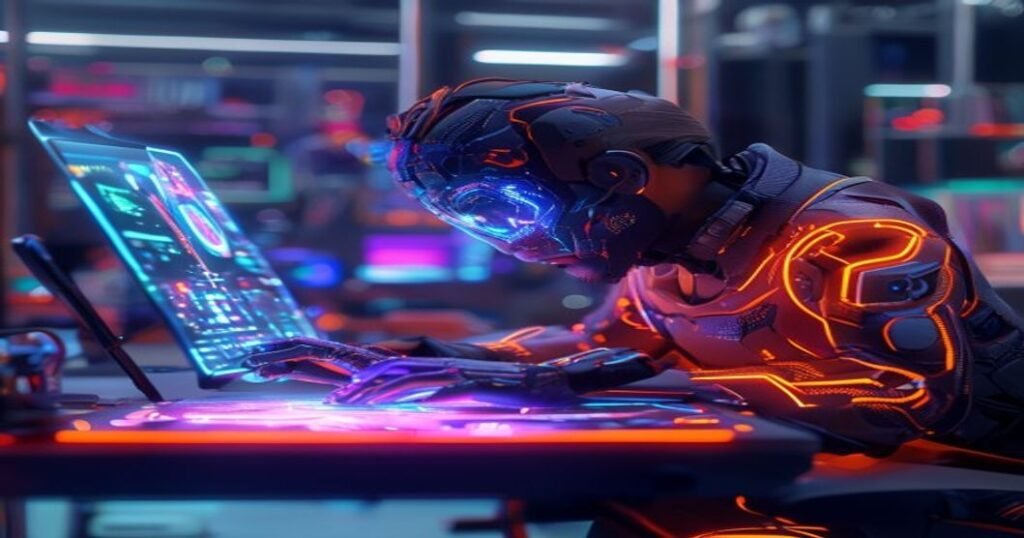

Unleashing the Creative Storm: How Generative AI Is Redefining Art, Work, and Our Future
Let’s be honest, for a long time, Artificial Intelligence felt like something from a sci-fi movie. A distant, abstract concept that might someday change our world, but wasn’t exactly knocking on our front door. Well, folks, that knock isn’t just a gentle tap anymore – it’s a full-blown thunderous roar, and it’s coming from the most unexpected place: creativity itself. We’re talking about Generative AI, and if you haven’t felt its tremors yet, you will very, very soon.
Think about it: just a short while ago, the idea of a machine writing a coherent blog post, composing a unique piece of music, or conjuring a photorealistic image from a few words seemed like pure fantasy. Now? It’s happening daily, in real-time, at an astonishing scale. This isn’t just another incremental tech upgrade; this is a paradigm shift, a genuine revolution that is not only reshaping industries but fundamentally altering our relationship with imagination and creation. And yes, it’s thrilling, terrifying, and utterly captivating all at once.
What Exactly Is This ‘Generative AI’ Everyone’s Talking About?
At its core, Generative AI refers to a category of AI models capable of producing novel content. Unlike older AI systems that might analyze data or perform specific tasks, generative models create. They learn patterns, styles, and structures from vast datasets – be it text, images, audio, or code – and then use that understanding to generate entirely new, original outputs. Imagine giving an AI millions of images of cats, and it doesn’t just recognize a cat; it draws a brand-new cat you’ve never seen before, complete with whiskers, a mischievous glint in its eye, and maybe even a tiny crown if you ask it to. That’s the magic!
From generating stunning artwork that blurs the line between human and machine, to crafting compelling marketing copy, to even designing new proteins for medical research, the capabilities are expanding at a breakneck pace. This isn’t just a fancy parlor trick; it’s a profound leap forward in machine intelligence, allowing AI to move beyond analysis and into true synthesis.
The Creative Renaissance (or Reckoning?): AI as the Ultimate Co-Pilot
For centuries, creativity has been seen as the exclusive domain of humanity, a sacred spark separating us from machines. Generative AI is challenging that notion in fascinating ways. Artists are using AI tools to explore new styles, generate concepts, and even augment their existing work. Writers are leveraging AI to brainstorm ideas, overcome writer’s block, and draft initial content faster than ever before. Musicians are experimenting with AI-generated melodies and harmonies. Designers are prototyping concepts with incredible speed.
Is this a threat to human creativity? I don’t think so. I see it as an unparalleled extension of it. Think of it less as an AI replacing the artist and more as an AI becoming an incredibly powerful co-pilot, a tireless assistant that can manifest ideas into tangible forms almost instantaneously. It’s about empowering individuals and small teams to achieve creative outputs that were once only possible with large budgets and extensive resources. This shift is part of a larger, profound change in how technology interacts with our daily lives, a silent revolution that is reshaping our world and unlocking human potential in ways we’re only just beginning to grasp.
Beyond the Art Studio: Practical Applications Reshaping Industries
The impact of Generative AI isn’t confined to the artistic realm. Its tentacles are reaching into nearly every sector, promising efficiency, innovation, and entirely new ways of working:
- Software Development: Imagine an AI that can write code snippets, debug errors, or even generate entire functions based on a natural language prompt. Developers are finding powerful allies in AI tools that accelerate their workflow, allowing them to focus on more complex architectural challenges and innovative solutions.
- Marketing & Content Creation: From crafting engaging social media posts and ad copy to generating personalized email campaigns and even entire blog articles, AI is becoming an invaluable asset for marketers. It can analyze trends, understand audience preferences, and produce high-quality content at scale, freeing human teams to focus on strategy and nuanced brand storytelling.
- Healthcare & Science: Generative AI is being used to design novel drug compounds, simulate molecular interactions, and even generate synthetic data for medical research, speeding up discovery and potentially leading to breakthroughs in personalized medicine.
- Education: This is an area ripe for transformation. Imagine AI tutors that can generate personalized learning materials tailored to a student’s individual pace and style, or tools that can create diverse examples and exercises on demand. This incredible potential is why many are discussing the AI classroom revolution and why education will never be the same (and that’s a good thing!). It’s about making learning more accessible, engaging, and effective for everyone.
- Design & Engineering: From architectural designs to product prototypes, generative AI can explore thousands of design variations based on specified constraints, helping engineers and designers optimize for efficiency, aesthetics, and functionality far faster than human teams alone could.
The Challenges and the Ethical Minefield
Of course, with such profound power comes significant responsibility and a host of challenges. We’re grappling with:
- Copyright & Ownership: Who owns the art or text generated by AI? What about the data used to train these models? These questions are at the forefront of legal and ethical debates.
- Misinformation & Deepfakes: The ability to generate hyper-realistic images, videos, and audio raises serious concerns about the spread of false information and the potential for misuse.
- Job Displacement vs. Evolution: While AI will undoubtedly automate certain tasks, it’s more likely to augment existing roles and create entirely new ones. The focus must be on re-skilling and up-skilling the workforce to collaborate effectively with AI.
- Bias in Data: Generative AI models learn from the data they’re fed. If that data contains societal biases, the AI will perpetuate and even amplify them, necessitating careful curation and ethical development practices.
Navigating these waters requires not just technological advancement but also thoughtful policy, ethical guidelines, and an ongoing public dialogue about the kind of future we want to build with AI.
The Human Element: What Remains Uniquely Ours?
In a world increasingly touched by generative AI, what will distinguish human contribution? I believe it will be our uniquely human traits: critical thinking, emotional intelligence, strategic vision, cultural nuance, empathy, and the ability to define purpose and meaning. AI can generate a thousand variations of an image, but it cannot intrinsically understand the human emotion behind a particular shade of blue or the cultural significance of a specific symbol without human guidance.
Our role shifts from merely executing tasks to defining the vision, setting the parameters, curating the outputs, and injecting the ‘soul’ into the creation. AI becomes the brush, but humanity remains the artist – the one who decides what story to tell, what emotion to evoke, and what message to convey.
Gazing into the (Near) Future: The Blurring Lines
As generative AI continues to evolve, expect deeply personalized experiences to become the norm. Imagine AI assistants that not only understand your preferences but can generate custom content, recommendations, and even virtual environments tailored precisely to your needs and mood. The lines between what’s real and what’s generated will continue to blur, especially as AI powers more immersive digital spaces.
Speaking of immersive digital spaces, the evolution of gaming and virtual realities is deeply intertwined with AI’s generative capabilities. From creating dynamic, evolving game worlds to generating unique avatars and interactive narratives, AI is pushing the boundaries of what’s possible in these digital realms. It’s a core driver in how gaming is forging the path to the metaverse and why you’re already there! Generative AI will be the engine that populates these virtual worlds with life, wonder, and endless possibilities.
The future isn’t about humans competing against AI; it’s about collaborating with it. It’s about leveraging these powerful tools to unlock levels of creativity and productivity we could only dream of before. The next decade won’t just be about AI; it will be about Human-AI synergy, a partnership that promises to redefine the very fabric of our innovation and imagination.
The Creative Frontier Awaits
Generative AI is more than a technological marvel; it’s a cultural phenomenon. It challenges our definitions of art, authorship, and intelligence. It presents us with incredible tools to amplify our abilities and tackle complex problems. But it also demands our thoughtful attention to ethics, equity, and responsibility.
Embrace it, experiment with it, and engage with the conversation. The creative storm is here, and it’s up to us to harness its power to build a future that is not just efficient, but also more imaginative, more expressive, and ultimately, more human. The canvas is limitless, and the brushes are more powerful than ever. What will you create?


