
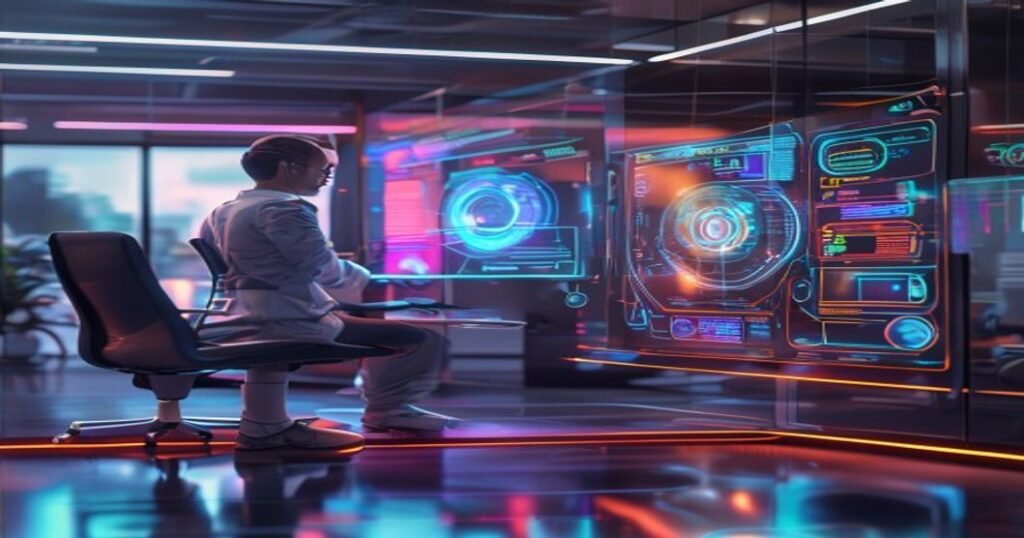

Your Job Isn’t Safe from AI, But That’s a Good Thing: The Skills You NEED Now to Future-Proof Your Career
Let’s be brutally honest for a moment. If you’re reading this, you’ve probably felt that subtle tremor beneath your feet, that low hum in the background that whispers one word: AI. It’s no longer a distant sci-fi fantasy; it’s here, it’s now, and it’s reshaping everything we thought we knew about work. The knee-jerk reaction for many is fear – fear of obsolescence, fear of replacement. But what if I told you that this revolution, while certainly disruptive, isn’t a death knell for your career, but rather an unprecedented opportunity? It’s a chance to shed the mundane, embrace your uniquely human capabilities, and build a career more resilient and rewarding than ever before.
For decades, we’ve heard predictions about automation taking over jobs. Those predictions, for the most part, felt like a distant threat. But the recent surge in AI capabilities, particularly in generative AI, has brought that future hurtling towards us at warp speed. Jobs that involve repetitive tasks, data processing, basic content creation, and even some analytical roles are already feeling the heat. This isn’t about AI being ‘better’ than humans; it’s about AI being able to perform specific, defined tasks with incredible speed and efficiency, often at a lower cost.
My take? The smartest thing you can do right now isn’t to bury your head in the sand, hoping it all blows over. It’s to lean in, understand the shifts, and proactively equip yourself with the skills that will not just survive, but thrive in this brave new world.
The Shifting Sands of Employment: AI’s Dual-Edged Sword
It’s true, some jobs will vanish. The data is clear on this. Think about roles that are primarily about processing information according to established rules. But here’s the often-overlooked upside: AI also creates entirely new categories of jobs and profoundly augments existing ones. We’re seeing a boom in demand for AI trainers, prompt engineers (people who are expert at communicating with AI to get the best results), ethical AI specialists, and data annotators. Furthermore, roles that previously involved heavy manual data entry or basic research are now being freed up to focus on higher-level strategic thinking and creative problem-solving, as AI handles the grunt work.
What AI Really Means for Your Day Job
For most of us, AI isn’t coming for our entire job, but for specific tasks within it. Picture this: A graphic designer using AI to generate multiple initial concepts in seconds, freeing them to refine the best ones with their unique artistic vision. A marketer leveraging AI to segment audiences and personalize content at scale, allowing them to focus on innovative campaign strategies. A programmer using AI code assistants to write boilerplate code, letting them tackle complex architectural challenges. This isn’t about replacement; it’s about augmentation. It’s about leveraging AI as a powerful co-pilot, not a competitor.
The question we should be asking isn’t ‘Will AI take my job?’ but ‘How can I integrate AI into my workflow to make myself indispensable?’ This requires a fundamental shift in mindset. We need to move from being tool users to being tool *masters* – understanding how to wield these powerful new capabilities to elevate our output and impact. This isn’t just a trend; it’s a fundamental recalibration of human-machine interaction, and as we ponder The AI Acceleration: Are We Ready for the Machine That Thinks (and Creates) Like Us?, it becomes clear that readiness isn’t about fighting AI, but embracing its potential responsibly.
The Skills Revolution: What You Need to Master, Not Just Know
So, if AI is handling the routine, what’s left for us? The answer lies in uniquely human attributes and a new layer of digital literacy.
Beyond Technical Prowess: The Power of Human-Centric Skills
These are the skills AI struggles with, and frankly, might never fully replicate:
- Critical Thinking & Complex Problem Solving: AI can analyze data and identify patterns, but it struggles with ill-defined problems, novel situations, and assessing nuance. Humans excel at connecting disparate ideas, asking the right questions, and evaluating solutions in complex, real-world contexts.
- Creativity & Innovation: While generative AI can produce content that *seems* creative, it’s often remixing existing data. True innovation, the spark of a truly original idea, the ability to think outside the box and imagine something entirely new – that’s our domain.
- Emotional Intelligence & Empathy: Understanding human emotions, navigating interpersonal dynamics, building rapport, motivating teams, providing compassionate service – these are irreplaceable human skills vital for leadership, customer service, sales, and any role requiring deep human interaction.
- Ethical Reasoning & Judgment: AI operates on algorithms. Humans must imbue those algorithms with ethical frameworks, make difficult judgment calls, and navigate the moral complexities that technology often creates.
- Adaptability & Resilience: The pace of change is accelerating. The ability to learn new tools, adapt to new workflows, and bounce back from setbacks will be paramount.
- Communication & Storytelling: AI can generate reports, but conveying complex information clearly, persuasively, and with genuine human connection – that’s a skill that will only grow in value.
The New Technical Literacy: Speaking AI’s Language (Even If You Don’t Code)
While deep coding skills might be less universal, a new form of technical literacy is emerging:
- AI Literacy: Understanding what AI is, how it works at a high level, its capabilities, and its limitations. Knowing which AI tools are relevant to your industry and how to integrate them into your workflow.
- Prompt Engineering: This is a surprisingly powerful skill. Learning how to formulate clear, precise, and effective prompts to get the best possible output from generative AI models is becoming a core competency in many creative and knowledge-based roles.
- Data Interpretation & Verification: AI can produce mountains of data and insights. The human skill lies in interpreting that data, verifying its accuracy, understanding its context, and translating it into actionable strategies.
- Digital Collaboration Tools: Proficiency in collaborative platforms, project management software, and communication tools will remain essential, especially as teams become more distributed and reliant on technology.
Embracing Lifelong Learning: Your Career’s Best Investment
The days of ‘set it and forget it’ careers are over. In an AI-driven world, continuous learning isn’t just a nice-to-have; it’s a non-negotiable. The skills you master today might be augmented by AI tomorrow, so the ability to ‘learn, unlearn, and relearn’ is your most valuable asset. Look for online courses, micro-credentials, workshops, and industry certifications. Stay curious, experiment with new AI tools, and engage with communities that are exploring the cutting edge of your field. Your career isn’t a destination; it’s a perpetual journey of growth.
The Digital Well-being Imperative in an AI-Driven World
As we integrate more powerful AI tools into our professional lives, the lines between work and personal life can blur even further. The promise of AI is greater efficiency, but the reality can often be an increased demand on our cognitive load as we manage complex tools and ever-present digital notifications. This is precisely why Reclaiming Our Minds: Why Digital Well-being Isn’t Just a Trend, It’s a Necessity. Working with AI means being ‘on’ more often, processing more information, and making more rapid decisions based on AI-generated insights. This intensity can lead to burnout if not managed proactively.
Creating boundaries, practicing mindful technology use, and ensuring dedicated time away from screens are crucial. We need to be deliberate about when and how we engage with AI tools, just as we are with email and social media. This might mean scheduling specific ‘AI work blocks’ and then stepping away, allowing our brains to process and rest. The irony is that as technology becomes more intelligent, our need to consciously cultivate human intelligence – through rest, reflection, and real-world engagement – becomes even greater. After all, what’s the point of hyper-efficiency if it comes at the cost of our mental and physical health? This is why we’re also seeing a growing movement towards The Great Unplug: How Modern Lifestyles Are Ditching Digital Overload for Deeper Living, a vital counter-balance to the always-on demands of the AI age.
Navigating the Future: A Proactive Approach
So, what’s your action plan? Here are a few thoughts:
- Self-Assessment: Honestly evaluate your current skills. Which of your tasks are repetitive? Which require uniquely human judgment?
- Identify AI Tools: Research AI tools relevant to your industry. Can ChatGPT, Midjourney, Github Copilot, or specialized AI analytics platforms enhance your work? Start experimenting!
- Upskill Strategically: Focus on developing those human-centric skills and new technical literacies. Enroll in a course, read books, follow thought leaders.
- Network & Collaborate: Talk to colleagues and peers about how they’re adapting. Share knowledge, form study groups, and learn from each other.
- Embrace the Entrepreneurial Mindset: Even if you work for a large company, think like an entrepreneur. How can you leverage AI to create new value, streamline processes, or offer innovative solutions within your role?
Conclusion: Your Future Is What You Make It
The AI revolution isn’t just happening to us; it’s an invitation to participate in shaping the future of work. Yes, it’s unsettling, but it’s also incredibly exciting. It’s an opportunity to offload the drudgery, to amplify our creative potential, and to focus on the truly human aspects of our professions. Your job might not be ‘safe’ in the traditional sense, but your career can be more dynamic, more impactful, and more uniquely yours than ever before. It’s time to stop fearing the machines and start mastering the art of collaboration with them. The future of work isn’t about humans vs. AI; it’s about humans *with* AI, achieving things we could only dream of before. Are you ready to seize that future?


