
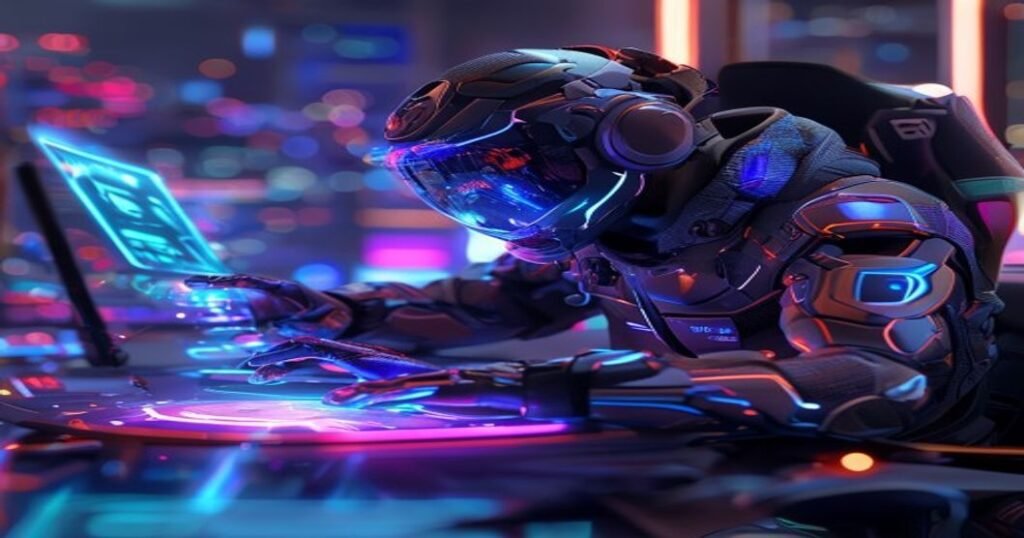

The Silent Revolution: How AI is Secretly Reshaping Every Game You Play (And Why You’ll Love It!)
Let’s be honest, we’ve all been there. You’re deep into an epic RPG, battling a menacing boss, only for their AI to get stuck on a piece of environmental geometry, flailing wildly as you deliver the final, unearned blow. Or maybe you’re playing a stealth game, and a guard spots you from across the map despite being visually obstructed, because their ‘vision cone’ is just… broken. For years, AI in video games has been a mixed bag – sometimes brilliant, often hilariously flawed, and almost always a topic of heated discussion among players.
But something profound is happening, quietly, behind the scenes of your favorite digital worlds. Artificial Intelligence isn’t just getting ‘better’; it’s undergoing a silent revolution, subtly reshaping the very fabric of game design and the experiences we have. We’re not just talking about smarter enemies anymore; we’re talking about dynamic narratives, infinitely replayable worlds, and companions who genuinely feel like they’re learning with you. And trust me, it’s going to make gaming more immersive, challenging, and personal than ever before.
Beyond Scripted Routines: The Dawn of Truly Dynamic NPCs
For decades, game AI was largely a series of ‘if-then’ statements. An enemy would patrol a pre-defined path, react to sound within a certain radius, or attack with a specific pattern. While this allowed for complex encounters, it often led to predictable behavior. We learned to exploit these patterns, finding the ‘cheese’ spots and breaking the illusion of intelligence.
Now, AI is starting to break free from these rigid scripts. Developers are leveraging machine learning to create Non-Player Characters (NPCs) that don’t just follow orders but exhibit emergent behaviors. Imagine a game where:
- Enemies adapt to your playstyle: If you’re a stealth player, they might set up ambushes or patrol more rigorously in dark areas. If you favor melee, they might try to keep their distance or coordinate flanking maneuvers.
- Companions learn from your decisions: Your AI partner remembers how you prefer to approach combat, what weapons you favor, and even your moral choices, leading to more personalized dialogue and tactical assistance.
- Crowds feel alive: NPCs in bustling cities don’t just walk in circles; they react to events, have simulated daily routines, and even engage in conversations that evolve based on the game’s unfolding narrative.
This isn’t just about making games harder; it’s about making them feel more authentic, more responsive, and less like a meticulously choreographed play. It’s about experiencing a world that truly reacts to your presence, not just triggers pre-recorded responses.
Worlds Without Limits: Generative AI and Infinite Possibilities
One of the most exciting frontiers for AI in gaming is its ability to create. Procedural generation has been around for a while, giving us vast, random landscapes, but generative AI takes this to an entirely new level. We’re talking about AI that can design entire levels, craft unique quests, write dialogue, or even compose dynamic soundtracks on the fly.
Imagine a space exploration game where every planet is not just randomly generated, but intelligently designed by an AI that understands ecosystem balance, geological formations, and alien civilization patterns. Or a rogue-lite where every dungeon feels handcrafted, yet you know it’s something no player has ever seen before, and will never see again. This isn’t just about saving developer time; it’s about unleashing an unprecedented level of content, ensuring that no two playthroughs are ever truly identical.
The implications for game development are staggering. Just as Generative AI is revolutionizing our very idea of work in industries far beyond gaming, it’s set to transform how virtual worlds are conceived, built, and experienced. Developers can focus on core mechanics and narrative arcs, leaving the Herculean task of populating vast worlds to intelligent algorithms, leading to richer, more diverse games.
The Game That Knows You: Adaptive Experiences and Personalized Challenges
Have you ever wished a game could just know what you wanted? AI is getting eerily good at exactly that. Adaptive difficulty is evolving beyond simply scaling enemy health or damage. Modern AI can monitor your performance, identify your strengths and weaknesses, and adjust the game experience in real-time to keep you engaged, but not frustrated.
This could manifest as:
- Dynamic story branching: Your choices, combat performance, and even how quickly you solve puzzles could subtly influence narrative paths, character relationships, and quest outcomes, creating a truly unique story for every player.
- Intelligent tutoring: Struggling with a particular mechanic? The game’s AI might introduce a mini-tutorial, offer contextual hints, or even subtly adjust enemy patterns to help you grasp it, without making you feel like you’re being spoon-fed.
- Personalized content delivery: Imagine an open-world game where the AI observes your preferred activities (e.g., exploring, combat, crafting) and subtly directs you towards quests, items, or areas that align with those interests.
This level of personalization blurs the line between developer and player, creating a dialogue where the game responds to you as an individual, rather than a generic user. It feels less like playing a game and more like interacting with a living, breathing entity that understands your preferences and challenges.
AI’s Broader Impact: From Pixels to Pakistan’s Progress
The advancements we see in gaming AI aren’t isolated; they’re part of a much larger global surge in artificial intelligence. From self-driving cars to medical diagnostics, AI is transforming industries and daily routines across the board. The computational power and algorithmic innovations driving smarter NPCs and dynamic game worlds are often leveraging the same underlying research and technologies that are impacting everything else around us. It’s a fascinating example of how cutting-edge research in one field can quickly ripple out and redefine others.
Indeed, AI is secretly and overtly transforming your daily routine, often in ways you don’t even perceive. The very algorithms recommending your next show, optimizing your travel route, or even filtering your spam emails are cousins to the AI making your in-game enemies smarter. This technological wave isn’t confined to established tech hubs either. Emerging economies are also seizing these opportunities. For instance, countries like Pakistan are seeing their own tech revolution, rewriting their future by embracing digital innovation, which includes everything from software development to leveraging AI in various sectors, potentially even contributing to the global gaming landscape.
The Road Ahead: Challenges and Ethical Quandaries
Of course, this revolution isn’t without its challenges. There’s a fine line between a challenging AI and one that feels unfair or omniscient. Developers must master the art of creating AI that is intelligent but also has believable limitations, lest players feel cheated or that their agency is undermined. The ‘perfect’ AI that always wins isn’t fun; it’s frustrating.
There are also ethical considerations. As AI becomes more sophisticated, how much autonomy should we give it in content creation? Could we reach a point where AI-generated content becomes so prevalent that it diminishes the value of human artistic input? And what about the potential for AI to learn and adapt to player vulnerabilities, perhaps even exploiting addictive tendencies? These are not easy questions, and the answers will evolve as the technology does.
My Take: An Exciting, Imperfect Future
As someone who’s spent countless hours immersed in virtual worlds, I can confidently say that the advancements in AI are, on balance, overwhelmingly positive for gamers. The days of predictable patterns and dumb NPCs are slowly fading, replaced by dynamic, responsive, and truly intelligent opponents and allies. While the thought of a game that learns and adapts to my every move can feel a little bit like Big Brother is watching, the potential for deeply personal, endlessly replayable, and genuinely surprising gaming experiences is too exciting to ignore.
We’re on the cusp of a golden age where games won’t just be beautifully rendered worlds; they’ll be intelligent ecosystems that react to us, learn from us, and surprise us in ways we never thought possible. So, the next time you marvel at an enemy’s cunning maneuver or a companion’s timely advice, take a moment to appreciate the silent revolution unfolding. AI isn’t just playing games; it’s fundamentally changing them, and honestly, I can’t wait to see what it learns next.

