
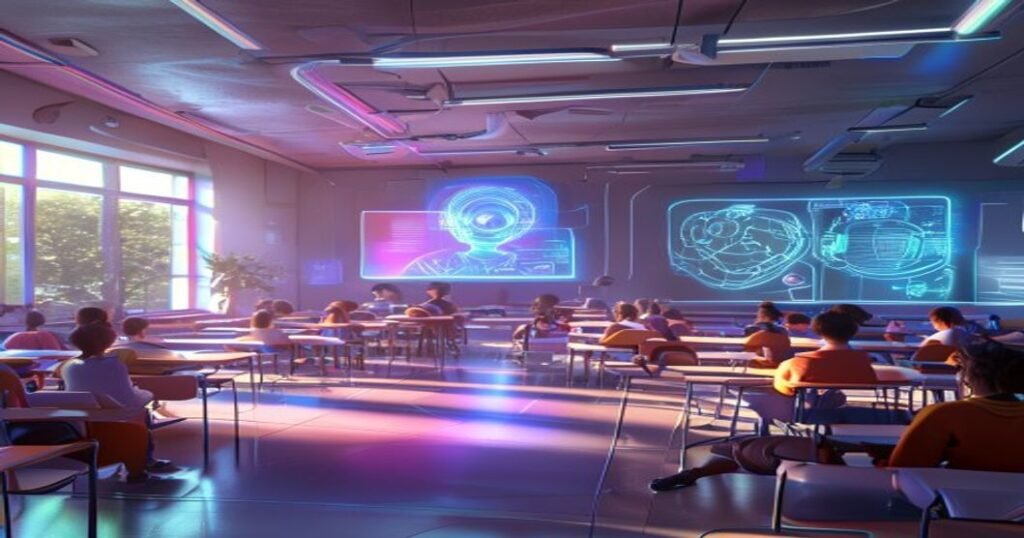

Let’s be honest: for centuries, education has largely been a one-size-fits-all endeavor. A teacher stands at the front, delivers a lecture, and every student in the room is expected to absorb it at the same pace, in the same way. It’s a model that has served humanity for a long time, but it’s also profoundly inefficient, often leaving bright minds bored and struggling students frustrated. But what if I told you that we’re on the cusp of a genuine learning revolution, one where every student’s journey is as unique as their fingerprint? Enter Artificial Intelligence, and trust me, it’s not just hype – it’s a profound game-changer for how we learn, teach, and grow.
The End of One-Size-Fits-All: Why Traditional Education Was Always Flawed
Think back to your own schooling. Did you ever feel like you were racing ahead in one subject but constantly behind in another? Or perhaps you learned best by doing, while your classmates thrived on reading? The inherent flaw in traditional education is its inability to cater to this vast spectrum of individual needs, learning styles, and paces. We’ve pushed students through a standardized curriculum, hoping that enough of it would stick. The result? Talent undiscovered, potential unfulfilled, and a significant portion of learners feeling alienated by a system that wasn’t built for them.
It’s a problem that educators have grappled with for generations, dreaming of a world where they could truly reach every single student. That dream, once a utopian vision, is now rapidly becoming a reality, thanks to the relentless march of technological innovation, particularly in the realm of AI.
AI’s Grand Promise: Education Tailored Just For You
Imagine a learning system that understands your strengths, identifies your weaknesses, knows your preferred learning style, and even adapts to your mood and engagement levels in real-time. This isn’t science fiction; it’s the core promise of AI in education. AI algorithms can process vast amounts of data – from how quickly you answer questions to which types of explanations resonate most with you – to create a truly personalized learning path.
Adaptive Learning Platforms: Your Personal Academic GPS
At the heart of this revolution are adaptive learning platforms. These aren’t just fancy quizzing tools. They are sophisticated systems that use AI to dynamically adjust curriculum and content based on a student’s performance and engagement. If you ace a concept, it moves you forward. If you struggle, it offers different explanations, more practice, or even remedial content. It’s like having a dedicated tutor who knows exactly what you need, when you need it.
- Personalized Pacing: No more waiting for others or feeling rushed. You move at your optimal speed.
- Tailored Content: AI can recommend videos, articles, interactive simulations, or even games based on what works best for you.
- Real-time Feedback: Immediate insights into areas needing improvement, preventing misconceptions from solidifying.
- Engagement Tracking: Some systems can even analyze facial expressions or eye movements (with consent, of course) to gauge engagement and adjust accordingly.
The Rise of the AI Tutor and Mentor
Beyond adaptive platforms, AI is also giving birth to intelligent tutoring systems. These AI companions can answer questions, explain complex topics, provide examples, and even simulate conversations to help students practice language or critical thinking skills. They offer an ‘always-on’ learning resource, free from the limitations of human availability.
But it’s not just about drills and answers. AI is evolving to become a genuine mentor, guiding students not just in what to learn, but how to learn. It can suggest study strategies, help manage time, and even flag potential learning plateaus before they become major roadblocks. This proactive support system is invaluable, especially for students who might lack access to human tutors or mentors.
Beyond Rote: Developing Critical Skills for an AI-Powered World
Perhaps the most profound impact of AI in education isn’t just in making learning more efficient, but in freeing up human educators to focus on what truly matters: fostering creativity, critical thinking, problem-solving, and emotional intelligence. When AI handles the repetitive tasks of grading, assessment, and basic instruction, teachers can become true facilitators, mentors, and guides.
Think about it: instead of spending hours grading papers, a teacher can spend that time designing engaging project-based learning experiences, leading stimulating discussions, or providing one-on-one mentorship to students struggling with socio-emotional challenges. The human element of teaching, the inspiration, the empathy, the complex nuance – these become the core focus.
In an era where technology is reshaping industries at an unprecedented pace, understanding the foundational principles of AI is no longer optional. It’s a survival skill. Students today aren’t just learning to use AI; they’re learning to think with it, to collaborate with it, and to leverage its capabilities to solve problems. This is why every aspiring innovator, every future leader, needs to grasp the fundamental mechanics and implications of this technology. It’s not just about coding; it’s about understanding the paradigm shift. In fact, if you’re a startup founder or aspiring to be one, you absolutely need to grasp this concept, as explored in The AI Gold Rush: Why Every Startup Founder Needs to Understand the Machine Now (Before It’s Too Late).
The Creative Spark: How AI Unlocks New Avenues for Learning and Expression
When people hear ‘AI,’ they often think of cold, calculating machines. But the reality is that generative AI, in particular, is proving to be an incredible catalyst for human creativity. In education, this means students can use AI tools to brainstorm ideas, draft initial creative works, explore different artistic styles, or even generate complex simulations for scientific experiments.
Imagine a student learning about ancient Egypt using an AI to generate a historically accurate 3D model of a pyramid they can virtually explore, or writing a story with an AI co-writer, prompting it for plot twists or character development. This isn’t cheating; it’s leveraging powerful tools to amplify imagination and bring ideas to life faster and more vividly than ever before. It’s about empowering students to become creators, not just consumers, of information. This transformative power of AI in fostering human ingenuity is a fascinating topic, and you can delve deeper into it with The Soul of the Machine: How Generative AI is Unleashing a New Era of Human Creativity (and What It Means for YOU).
Navigating the New Frontier: Challenges and Ethical Considerations
Of course, no revolution comes without its challenges. The integration of AI into education raises important questions that we must address thoughtfully:
- Data Privacy and Security: AI thrives on data. Protecting student information and ensuring ethical data practices are paramount.
- Bias in Algorithms: AI systems are only as unbiased as the data they’re trained on. We must actively work to mitigate algorithmic bias to ensure fair and equitable learning experiences for all.
- The Digital Divide: Unequal access to technology and high-speed internet could exacerbate existing educational inequalities if not addressed proactively.
- Maintaining the Human Touch: While AI can personalize learning, it can never fully replace the empathy, emotional connection, and nuanced guidance of a human teacher. The goal is augmentation, not replacement.
- Defining ‘Learning’ in the AI Era: How do we assess true understanding when AI can do so much? What skills become most valuable when rote memorization is obsolete?
These aren’t insurmountable obstacles, but they require careful planning, robust policy, and ongoing dialogue among educators, technologists, policymakers, and parents. The conversation about AI’s impact isn’t limited to education; it’s rewriting the rules across industries, from how we market products to how we understand search engines. The profound changes brought about by generative AI, for instance, are radically altering fields like digital marketing and SEO – a seismic shift you truly can’t afford to overlook, as highlighted in The AI Seismic Shift: How Generative AI is Rewriting the Rules of Digital Marketing & SEO (And Why You Can’t Afford to Ignore It).
The Educator’s Evolving Role: From Lecturer to Learning Architect
Far from making teachers obsolete, AI actually elevates their role. No longer primarily purveyors of information, teachers become designers of learning experiences, diagnosticians of individual student needs, and facilitators of deep engagement. They will be equipped with AI-powered insights into each student’s progress, allowing them to intervene precisely where needed and focus their precious human energy on mentorship, complex problem-solving, and fostering crucial soft skills that AI cannot replicate.
The classroom transforms from a lecture hall into a dynamic workshop, where AI provides the personalized scaffolding, and the teacher orchestrates collaborative projects, critical discussions, and creative endeavors. It’s a more challenging, yet ultimately more rewarding, role for educators who are passionate about nurturing every student’s potential.
Preparing for the AI-Powered Future of Work
The implications of personalized, AI-driven education extend far beyond the classroom walls. By tailoring learning to individual needs, we are better preparing students for a rapidly evolving job market where adaptability, continuous learning, and specialized skills are paramount. Students who experience personalized learning develop a greater sense of agency over their education and learn how to learn, a skill that will serve them throughout their lives as industries transform and new roles emerge.
The workforce of tomorrow won’t just need people who can recall facts; it will need creative problem-solvers, critical thinkers, and ethical innovators who can collaborate with intelligent machines. An education system enhanced by AI is perfectly positioned to cultivate these essential human skills, ensuring that the next generation isn’t just ready for the future, but actively shaping it.
The Startup Opportunity in EdTech
For entrepreneurs and innovators, the AI-driven education space is bursting with opportunity. From developing specialized adaptive learning modules for niche subjects to creating AI tools that help teachers with administrative tasks, the market for solutions that enhance the learning experience is enormous and growing. Startups that can effectively blend cutting-edge AI with a deep understanding of pedagogy and human psychology will be the ones to truly make a difference in this exciting new frontier. The potential for impactful, scalable solutions is immense.
Conclusion: A Brighter Future for Learning
The journey to truly personalized education has been a long one, filled with aspirations and limitations. But with the advent of sophisticated AI, we are finally seeing the pieces come together. While challenges remain, the vision of an education system that truly caters to every individual, unlocking their unique potential, is no longer a distant dream. It’s becoming our present reality. This isn’t just about making learning more efficient; it’s about making it more equitable, more engaging, and ultimately, more human. The learning revolution is here, and it promises a brighter, more adaptive future for generations to come. Are you ready to embrace it?


