
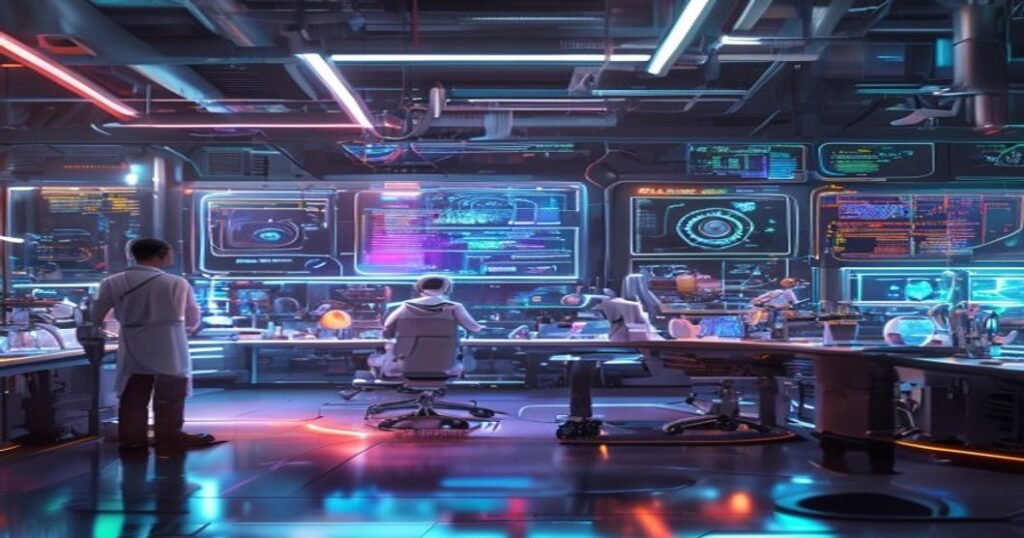

Remember the days when scientific breakthroughs felt like the sole domain of brilliant lone wolves toiling away in dimly lit labs, perhaps muttering ‘Eureka!’ after years of painstaking trial and error? Well, those days aren’t entirely gone, but a seismic shift is underway. Today, the ‘Eureka!’ moment is increasingly shared with an unlikely, incredibly powerful partner: Artificial Intelligence. I’m not just talking about AI as a fancy calculator; I’m talking about it as a co-pilot, a hyper-efficient research assistant, and sometimes, even the lead investigator in unlocking humanity’s most profound scientific mysteries.
It’s my strong belief that we are living through nothing short of a scientific renaissance, powered by intelligent machines. This isn’t just an incremental improvement; it’s a fundamental reimagining of how discovery happens, promising to accelerate our understanding of the universe, ourselves, and everything in between at a pace previously unimaginable. Frankly, if you’re not paying attention to how AI is rewriting the rules of science, you’re missing The AI Earthquake: Why Your World Just Got Rewired, and How to Thrive in the Intelligent Era. It’s truly that significant.
The Data Deluge: A Problem Only AI Could Solve
For decades, scientists have been grappling with an ever-growing tsunami of data. From genomics to astrophysics, from climate modeling to materials science, the sheer volume of information being generated has surpassed human capacity to process, analyze, and synthesize it. We’ve built bigger telescopes, more powerful sequencers, and faster supercomputers, but the bottleneck often remained the human brain’s ability to spot patterns, correlations, and anomalies hidden within petabytes of raw data. This is precisely where AI swoops in like a superhero.
Imagine a research team trying to discover a new drug. Traditionally, this involves synthesizing thousands, sometimes millions, of compounds and testing them laboriously. It’s a process fraught with dead ends and immense costs. Now, picture an AI system sifting through vast databases of chemical structures, protein interactions, and disease pathways, predicting which molecules are most likely to be effective, and even designing novel compounds from scratch. This isn’t science fiction; it’s happening right now. AI can perform in hours what would take human researchers years, drastically slashing discovery timelines and costs.
From Lab Benches to Digital Discoveries: AI’s Impact Across Disciplines
-
Medicine and Biology: The Intelligent Path to Healing
Perhaps nowhere is AI’s impact more immediately felt than in health and medicine. Think about personalized medicine: tailoring treatments based on an individual’s unique genetic makeup. AI algorithms are crunching massive datasets of patient histories, genetic profiles, imaging scans, and drug responses to identify biomarkers, predict disease progression, and recommend the most effective therapies. The possibilities here are truly staggering, from more accurate diagnoses to creating bespoke drugs. In fact, if you want to understand the full scope, you should read about The AI Doctor Will See You Now: Why Intelligent Tech is Revolutionizing Health (And Why You Should Care). From accelerating vaccine development to deciphering the complexities of protein folding, AI is a game-changer.
-
Materials Science: Designing the Future Atom by Atom
The quest for new materials – stronger, lighter, more conductive, more sustainable – is fundamental to technological progress. AI is revolutionizing this field by predicting the properties of hypothetical materials, guiding experiments, and even suggesting new synthetic pathways. Imagine AI designing a perfect battery material, a self-healing polymer, or a superconductor that works at room temperature. This isn’t just about tweaking existing formulas; it’s about exploring an almost infinite ‘materials space’ that would be impossible for humans to navigate alone.
-
Astrophysics and Cosmology: Unveiling the Universe’s Secrets
Our cosmic neighborhood is a data goldmine, but also a challenge. Telescopes like the James Webb Space Telescope generate petabytes of images and spectroscopic data. AI is indispensable for processing this information, identifying exoplanets, classifying galaxies, detecting gravitational waves, and even looking for signs of extraterrestrial life. It helps us sift through cosmic noise to find the faint signals that whisper clues about the universe’s origins and future. Without AI, much of this invaluable data would remain uninterpreted, locked away in digital archives.
-
Climate Science: Understanding and Predicting Our Planet’s Future
Modeling complex climate systems, predicting extreme weather events, and understanding the intricate web of environmental factors are monumental tasks. AI is empowering climate scientists to create more accurate models, identify subtle trends in vast climate datasets, and even simulate the impact of various interventions. This analytical power is absolutely crucial as we strive to understand and mitigate the challenges facing our planet.
The New Paradigm: Human-AI Collaboration at Scale
It’s tempting to think of AI replacing scientists, but that’s a misinterpretation of its role. Instead, AI is amplifying human ingenuity. It’s taking over the tedious, computationally intensive tasks, allowing human researchers to focus on what they do best: asking profound questions, formulating creative hypotheses, and interpreting the deeper meaning of AI-generated insights. It’s a synergistic relationship where AI handles the heavy lifting of data crunching and pattern recognition, freeing up human minds for conceptual breakthroughs and ethical considerations.
This intelligent transformation is not just a trend; it’s a fundamental shift that is reshaping our global future. If you haven’t considered the broader implications, you’re missing out on The Great AI Remake: How Intelligent Transformation is Rewiring Our Global Future – And Why You Can’t Afford to Miss It. The ability to collaborate with systems that can process information orders of magnitude faster and identify connections invisible to the human eye opens up entirely new avenues of inquiry.
Challenges and the Road Ahead
Of course, this powerful new tool isn’t without its challenges. Issues of data bias, the ‘black box’ problem (where we don’t always understand *how* an AI reached its conclusions), and ethical considerations surrounding its application are all critical areas of ongoing research and discussion. Ensuring transparency, accountability, and fairness in AI systems is paramount to harnessing their full potential responsibly. We must also continue to invest in educating the next generation of ‘AI-fluent’ scientists who can effectively wield these tools.
Moreover, the infrastructure required to support these AI-driven scientific endeavors is immense. From powerful computing resources to robust data pipelines, the demand for advanced technology continues to grow. This is why discussions around The Unholy Trinity: How 5G, AI, and Edge Computing Are Rewiring Telecom – And Your Entire World are so crucial; the underlying technological advancements are what enable this scientific acceleration.
The Future is Intelligently Discovered
My take? The future of science isn’t just about bigger labs or more funding; it’s about smarter tools. AI is transforming every facet of the scientific process, from hypothesis generation and experimental design to data analysis and publication. It’s allowing us to tackle problems once deemed intractable, from curing complex diseases to understanding the very fabric of reality. The ‘Eureka!’ moments are coming faster, with greater precision, and often with the quiet, powerful assistance of our intelligent machine partners.
We are at the cusp of an era where humanity, augmented by AI, will unlock discoveries that were previously the stuff of dreams. The boundaries of what we can know are expanding at an unprecedented rate, and it’s a thrilling time to be a part of this journey. So, buckle up. The age of intelligent discovery is here, and it’s rewriting science as we know it.


