
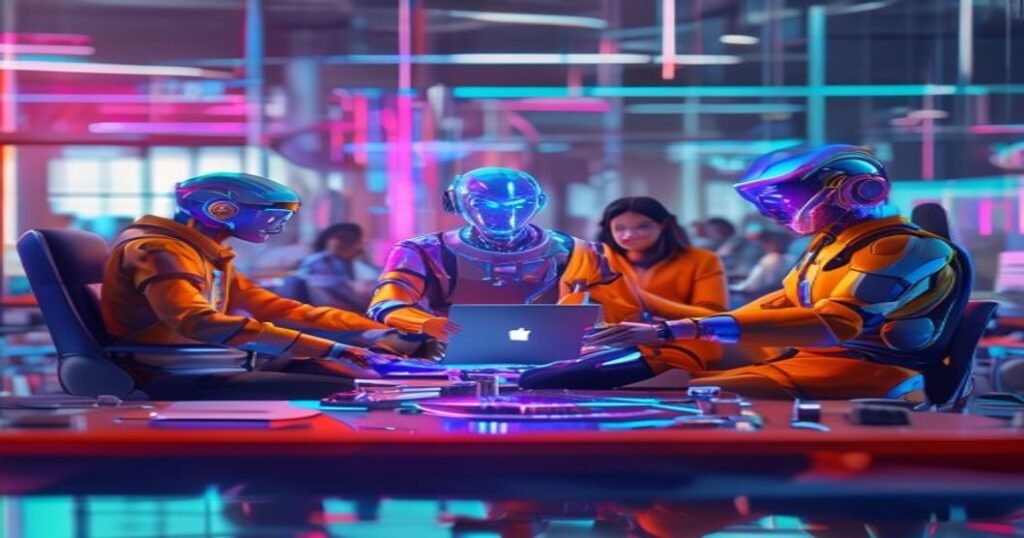

Remember those sci-fi movies where robots take all the jobs, leaving humanity to ponder its existence? Well, for many, that dystopian vision feels less like fiction and more like an impending reality as Artificial Intelligence (AI) rapidly integrates into every facet of our lives. The whispers of ‘AI taking our jobs’ have grown into a roar, sparking anxiety in boardrooms and living rooms alike. But what if I told you that the narrative isn’t just about displacement, but about profound transformation? What if the future of work isn’t a zero-sum game between humans and machines, but a synergistic dance?
The AI Revolution: It’s Not Coming, It’s Here
Let’s be unequivocally clear: The AI Revolution Isn’t Coming, It’s Here: How Intelligent Algorithms Are Reshaping Our Global Future. It’s not a distant storm on the horizon; it’s the weather we’re living in right now. From automating repetitive tasks to powering complex analytics, AI is already an integral part of operations in nearly every industry. This isn’t just about manufacturing robots on an assembly line anymore; it’s about intelligent algorithms writing code, drafting marketing copy, diagnosing illnesses, and even designing new products. This seismic shift is understandably causing jitters, making us question the very foundation of our professional lives. You might be wondering, ‘Is my job safe?’ or ‘What do I do to prepare?’ These are valid concerns, and ignoring them would be naive.
Beyond the Hype: Dispelling the Myths of Job Apocalypse
While it’s easy to get swept up in the doomsday predictions, a more balanced perspective reveals a different picture. AI is fantastic at optimizing, processing vast amounts of data, and executing defined tasks with incredible speed and accuracy. But it still largely lacks uniquely human qualities: empathy, intuition, creativity (true, generative creativity, not just pattern-based generation), complex moral reasoning, and the ability to navigate ambiguous, unstructured situations. Think of AI as an incredibly powerful tool, not a replacement for the entire toolkit. Instead of eradicating jobs wholesale, AI is often transforming them, creating new roles, and elevating human potential by offloading the mundane. My opinion? The biggest mistake we can make is to view AI as a competitor rather than a powerful assistant.
The ‘AI Quake’ and the Rise of New Opportunities
Indeed, this is no less than The AI Quake: How Intelligent Algorithms Are Shattering and Rebuilding Our Global Future. Old industries are being reshaped, and entirely new ones are emerging from the digital ether. As AI takes over routine and predictable tasks, humans are freed up to focus on higher-value activities that require uniquely human attributes. This isn’t about less work; it’s about different work. It’s about leveraging AI to augment our capabilities, pushing the boundaries of what’s possible. It’s about being the conductor of an AI orchestra, not just a single instrument.
So, What Are These ‘New’ Jobs That Are Emerging?
- AI Trainers & Prompt Engineers: People who teach AI models, refine their outputs, and craft the perfect prompts to get desired results. It’s a blend of technical understanding and creative communication, and frankly, it’s a fascinating new field.
- AI Ethicists & Governance Specialists: Ensuring AI is developed and used responsibly, fairly, and without bias. This is crucial for trust and societal acceptance, and a role that demands deep human insight.
- Data Scientists & Analysts: As AI relies on vast amounts of data, the demand for professionals who can collect, clean, interpret, and leverage data continues to skyrocket. Someone has to make sense of the digital deluge.
- Human-AI Interaction Designers: Crafting intuitive and effective ways for humans to work alongside AI, making complex tools accessible and productive. Think about how seamless your phone is – that’s the kind of magic these folks create.
- Robotics Engineers & Technicians: Designing, building, and maintaining the physical manifestations of AI. The robots aren’t building themselves yet!
- Cybersecurity Specialists: With more systems connected and reliant on AI, securing them from threats becomes paramount. The digital frontier needs its guardians.
These are just a few examples, but they illustrate a clear trend: the future of work involves humans managing, guiding, and collaborating with intelligent machines. It’s a shift from manual labor to mental orchestration, from repetitive tasks to strategic oversight.
The Essential Skills for Thriving in the AI Age
If AI is handling the algorithms and data crunching, what’s left for us? A lot, actually. The skills that were once considered ‘soft skills’ are rapidly becoming the most critical ‘power skills’ of the modern workforce. They are the bedrock of human advantage.
Your AI Survival Kit: Indispensable Skills
- Critical Thinking & Complex Problem-Solving: AI can offer solutions, but humans need to frame the problems, evaluate the AI’s output, and apply context and judgment. It’s about asking the right questions, not just getting answers.
- Creativity & Innovation: While AI can generate ideas based on existing patterns, true innovation—breaking new ground, connecting disparate concepts, artistic expression—remains a uniquely human domain. Your imagination is your ultimate superpower.
- Emotional Intelligence & Empathy: Customer service, team leadership, negotiation, mentoring – these roles are built on understanding and responding to human emotions, something AI struggles with. People still want to connect with people.
- Adaptability & Lifelong Learning: The pace of change is accelerating. The ability to unlearn, learn new skills, and embrace new technologies is no longer optional; it’s foundational. Consider yourself a perpetual student.
- Digital Literacy & AI Fluency: You don’t need to be a programmer, but understanding how AI works, its capabilities, and its limitations is vital for effective collaboration. Speak its language, even if you don’t write its code.
This emphasis on human-centric skills underlines a profound truth: the more advanced our technology becomes, the more valuable our humanity becomes. It’s an ironic, yet beautiful, twist.
The Great Digital Reset: Reclaiming Our Human Edge
In a world where algorithms can mimic human speech and generate captivating art, the true value of our unique human spirit comes into sharper focus. This isn’t just about work; it’s about how we live. We’re seeing a growing recognition of the need for The Great Digital Reset: Reclaiming Our Sanity in a Hyper-Connected World. It’s about consciously choosing when and how to engage with technology, protecting our mental space, and nurturing those irreplaceable human connections. For professionals, it means leveraging AI to free up time, not to become enslaved by notifications or endless digital tasks. It’s about using technology to empower, not overwhelm. It’s about finding balance and ensuring we don’t lose ourselves in the digital noise.
Pakistan’s Youth: A Blueprint for the AI Age
Consider a region like Pakistan, where a burgeoning youth population is rapidly embracing digital technologies. This demographic dividend, coupled with a growing tech ecosystem, positions them uniquely to navigate the AI-driven future. Pakistan’s Secret Weapon: The Youth-Led Tech Boom Igniting a New Era is not just about leveraging existing skills but about proactively cultivating a generation that is ‘AI-native.’ They are less burdened by old paradigms and more open to rapid learning and adaptation – a critical trait for anyone looking to thrive in this evolving landscape. This isn’t just a regional story; it’s a global lesson in proactive adaptation and investment in human capital. It shows us that with the right mindset and resources, a young, ambitious population can turn technological disruption into a springboard for growth.
Embracing the Hybrid Workforce: The Future is Collaborative
The future isn’t human versus AI; it’s human with AI. Imagine an architect using AI to generate hundreds of design variations in minutes, then applying their creative judgment to refine the best options. Or a doctor leveraging AI for rapid diagnostic insights, then using their empathy and experience to communicate with and treat the patient. This hybrid model, where AI handles the data and automation, and humans provide the judgment, creativity, and emotional intelligence, promises unprecedented levels of productivity and innovation. It means less time on grunt work and more time on the truly impactful, fulfilling aspects of our professions. This isn’t about replacing doctors; it’s about creating superhuman doctors. It’s about empowering every professional to do more, better, faster.
Preparing for Tomorrow, Today: Your Action Plan
So, what’s your next step? Don’t wait for the future to arrive; actively shape your place within it. The time to act is now.
- Invest in Lifelong Learning: Whether it’s an online course, a certification, or simply dedicating time to understanding new AI tools, continuous learning is non-negotiable.
- Hone Your Human Skills: Actively seek opportunities to develop your creativity, critical thinking, emotional intelligence, and communication abilities. These are your superpowers – nurture them!
- Embrace AI as a Tool: Experiment with AI tools in your current role. Understand their strengths and weaknesses. The more you engage, the less intimidating they become. Think of it as a new, powerful software suite.
- Network and Share Knowledge: Connect with others navigating these changes. Shared insights and collaborative learning are invaluable. Build your tribe.
The narrative of AI stealing jobs is compelling, but it overlooks the incredible potential for augmentation, creation, and human flourishing that this technology also brings. We are at a pivotal moment, where conscious choices about skill development, education, and ethical implementation will define the future of work for generations to come.
The Unwritten Chapter: Your Role in the AI Future
The future of jobs isn’t a pre-written script; it’s a dynamic, evolving story we are all co-authoring. While some roles will undoubtedly fade, many more will transform, and entirely new, exciting opportunities will emerge. By embracing a mindset of continuous learning, honing our uniquely human capabilities, and learning to collaborate intelligently with AI, we can move beyond fear and step confidently into an era of unprecedented human-machine synergy. The greatest asset in the AI age isn’t a complex algorithm; it’s the adaptable, creative, and empathetic human mind. Let’s make sure ours are ready to write the next, exciting chapter.


