
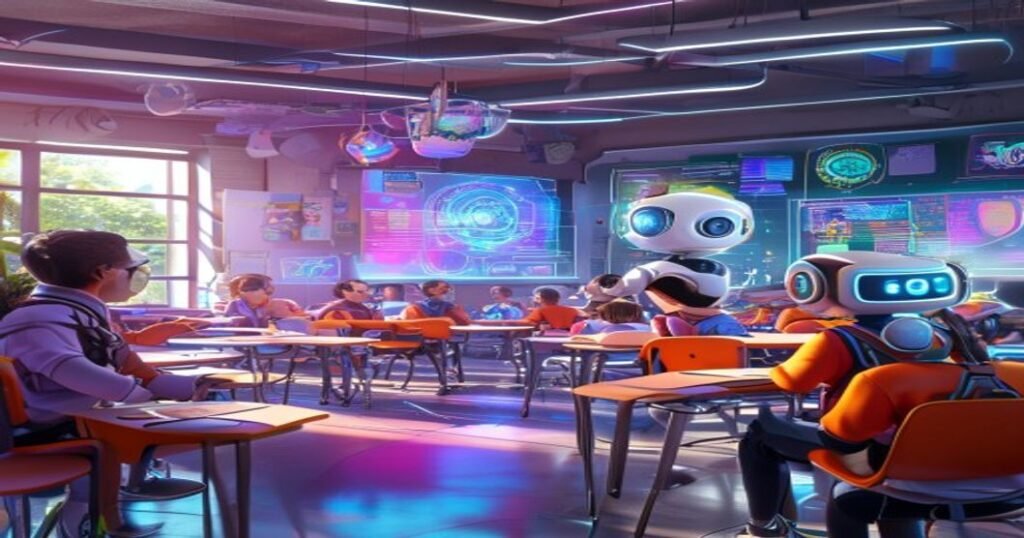

Remember school? The rows of desks, the chalk dust, the teacher at the front, delivering wisdom like a seasoned orator? Well, buckle up, because that familiar scene is rapidly becoming a relic of the past. We’re not just talking about smartboards or online classes anymore; we’re witnessing a seismic shift, nothing short of a revolution, driven by Artificial Intelligence. And frankly, if you’re involved in education, as a student, parent, or professional, you absolutely need to understand what’s happening.
For too long, education has struggled with a fundamental challenge: how do you cater to 30 unique minds in one classroom, each with different strengths, weaknesses, learning styles, and paces? The answer, for decades, was a compromise. A one-size-fits-all approach that inevitably left some behind and others unchallenged. But now, AI is stepping in, not to replace the human element, but to augment it, personalize it, and make learning more effective, engaging, and equitable than ever before.
The Unstoppable March of Personalized Learning
This, for me, is where AI truly shines in the educational landscape. Imagine a tutor who knows your every strength and struggle, understands how you best absorb information, and adapts every lesson plan specifically for you. That’s the promise of AI-powered personalized learning. It’s not just a fancy algorithm; it’s a fundamental rethinking of how we acquire knowledge.
AI as Your Personal Learning Companion
AI can analyze a student’s performance data, identify learning gaps with astonishing precision, and then recommend tailored resources, exercises, and even learning pathways. Think of an intelligent tutoring system that patiently explains a complex math problem using an analogy you understand, provides practice questions specifically targeting your weaknesses, and only moves on when you’ve truly mastered the concept. This isn’t just about speed; it’s about depth of understanding. No more rushing ahead when you’re struggling, and no more boredom when you’re ready for more advanced material.
Tailoring the Learning Path for Every Journey
Beyond individual lessons, AI can help map out entire learning journeys. For vocational training, it can identify the most in-demand skills in a specific industry and suggest courses that align a student’s interests with market needs. For university students, it can recommend interdisciplinary studies that might spark new passions. This adaptive approach ensures that education isn’t just about consuming information, but about constructing a unique, meaningful path for each learner.
Reshaping Assessment and Feedback
Let’s be honest, grading is often a teacher’s least favorite task, and for students, feedback can be too little, too late, or too generic. AI is a game-changer here, too.
Instant Insights, Smarter Strategies
AI-powered assessment tools can grade essays, analyze coding projects, and even evaluate presentations with remarkable speed and consistency. But it goes deeper than just assigning a score. These systems can provide immediate, granular feedback – pointing out specific grammatical errors, logical fallacies in arguments, or inefficiencies in code. This instant feedback loop is invaluable; students don’t have to wait days or weeks to understand where they went wrong, allowing them to correct mistakes while the material is still fresh in their minds. It transforms assessment from a post-learning judgment into an active part of the learning process itself.
Empowering Educators, Not Replacing Them
One of the biggest misconceptions about AI in education is that it’s here to take jobs. I couldn’t disagree more. AI isn’t coming for our teachers; it’s coming to liberate them from the drudgery and unleash their true potential.
From Lecturers to Learning Facilitators
With AI handling personalized content delivery, basic question answering, and much of the grading, educators are freed up to do what they do best: inspire, mentor, and foster critical thinking. They can spend more time on one-on-one interactions, facilitating collaborative projects, discussing complex ethical dilemmas, and addressing the social-emotional needs of their students. The role shifts from ‘sage on the stage’ to ‘guide on the side,’ a much more impactful and human-centric approach to teaching.
Automating the Mundane
Think of all the administrative tasks that bog down teachers: scheduling, attendance tracking, report card generation, even designing basic lesson plans. AI tools can automate much of this, giving teachers precious hours back to focus on actual teaching and student engagement. This reduction in administrative burden isn’t just a time-saver; it can significantly reduce teacher burnout and enhance job satisfaction.
Preparing for an AI-Powered World
It’s not enough for education to adopt AI; it must also prepare students for a world fundamentally reshaped by it. We are already seeing The Generative AI Earthquake: How AI is Not Just Transforming, But Redefining Our Reality across every sector, from creative industries to scientific research. Our education systems must reflect this transformation.
New Skills for a New Era
Rote memorization and easily automatable tasks are becoming less valuable. What is valuable are skills like critical thinking, complex problem-solving, creativity, emotional intelligence, and digital literacy. AI in education can foster these by creating environments where students learn to collaborate with AI, understand its limitations, and ethically leverage its power. We need to move beyond simply consuming information to generating new ideas, critically evaluating AI outputs, and understanding the algorithms that shape our world.
Beyond Rote Learning
Imagine students using AI to simulate complex scientific experiments they couldn’t otherwise access, or collaborating with AI tools to brainstorm innovative solutions to global challenges. This kind of experiential, hands-on learning, supercharged by AI, is the key to developing the skills that truly matter in the current landscape.
Navigating the Ethical Maze
Of course, no technological revolution comes without its challenges, and AI in education is no exception. We must proceed with caution and thoughtfulness.
Bias, Privacy, and the Human Touch
Concerns around algorithmic bias (if AI is trained on biased data, it can perpetuate those biases), student data privacy, and the potential for over-reliance on technology are legitimate. We need robust ethical frameworks, transparent AI systems, and ongoing human oversight. Moreover, while AI can personalize learning, it can never replace the empathy, emotional connection, and nuanced judgment that a human educator provides. The ‘human touch’ remains indispensable for holistic student development.
The Future is Now: Embracing the AI Classroom
The pace of change is dizzying. What was science fiction yesterday is educational reality today. We’re living through The AI Tsunami: How Artificial Intelligence is Not Just Reshaping Tech, But Rewriting Our World, and education is right in its path. Ignoring it is not an option; neither is a knee-jerk rejection. Instead, we must engage thoughtfully, strategically, and with an open mind.
From helping students grasp fundamental concepts to accelerating breakthroughs in advanced research, as discussed in The AI Alchemist: How Artificial Intelligence is Not Just Assisting, But Accelerating the Very Fabric of Scientific Discovery, AI’s potential in education is vast. And it’s not just in dedicated learning platforms; even The Brain in Your Pocket: How AI is Not Just Smartening Up Your Phone, But Rewiring Your Entire Digital Life means educational tools are more accessible than ever before, turning every smartphone into a potential learning supercomputer.
Education is about empowering individuals, fostering growth, and preparing the next generation for whatever challenges and opportunities lie ahead. AI, when implemented thoughtfully and ethically, is not just a tool; it’s a powerful ally in this noble endeavor. It promises to unlock human potential in ways we’ve only dreamed of, making learning more effective, accessible, and exciting for everyone. The revolution is here, and it’s time for us all to be active participants in shaping education’s thrilling next chapter.


