
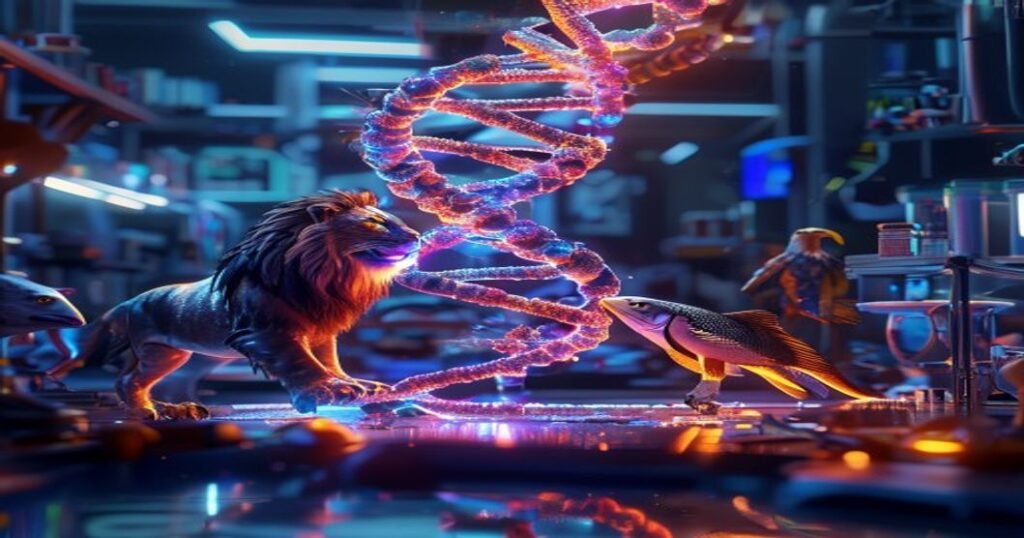

Alright, let’s talk about something truly audacious, something that feels ripped straight from the pages of a sci-fi novel, but is happening right now in labs around the world: the ability to rewrite the very code of life itself. Specifically, how a technology called CRISPR is fundamentally changing our relationship with the animal kingdom, from the smallest bacteria to the largest mammals. It’s not just about tweaking a gene here or there; it’s about a profound shift in how we understand, interact with, and even design the creatures that share our planet. And trust me, you’re going to want to hear about this.
What Even *Is* CRISPR, and Why Does It Matter So Much for Animals?
Think of CRISPR as the ultimate biological word processor. Before it, editing genes was like trying to correct a typo in a massive, ancient scroll with a blunt chisel – incredibly difficult, imprecise, and often damaging. CRISPR, on the other hand, is like having a perfect search-and-replace function. It allows scientists to precisely cut and paste DNA sequences, turning specific genes on or off, or even inserting entirely new ones, with unprecedented accuracy and ease.
Originally discovered as a bacterial defense mechanism, CRISPR has rapidly evolved into the most powerful gene-editing tool humanity has ever possessed. And its implications for animals are nothing short of mind-boggling. We’re no longer just observing evolution; we’re actively participating in it, with a level of control that was unimaginable just a couple of decades ago. This isn’t just a new tool in the biologist’s kit; it’s a paradigm shift, and its echoes are already reverberating through conservation efforts, agriculture, and even our pets.
A Double-Edged Sword: The Promise of Conservation
Let’s start with the good, the truly hopeful side of this revolution. Our planet’s biodiversity is under immense pressure, with countless species teetering on the brink of extinction. Climate change, habitat loss, and novel diseases are relentless threats. Here, CRISPR offers a glimmer of hope, acting as a potential biological shield. Imagine editing the genes of a critically endangered coral species to make it resistant to rising ocean temperatures or deadly bleaching events. Think about engineering amphibians to withstand the devastating chytrid fungus, or creating gene drives that could eradicate invasive species wreaking havoc on delicate island ecosystems.
This isn’t just theoretical. Scientists are actively exploring these avenues. We’re talking about potentially bringing back extinct species, or at least creating proxies. The idea of de-extinction, perhaps even bringing back woolly mammoths (or at least elephant-mammoth hybrids) to restore ancient ecosystems, is no longer pure fantasy. It’s a complex, ethically fraught endeavor, but the biological capability is increasingly within our grasp. It truly exemplifies how The CRISPR Revolution: Are We Ready to Rewrite Humanity’s Blueprint? because when we talk about editing the blueprints of animals, we’re fundamentally altering our planet’s biological tapestry.
Enhancing Animal Welfare and Agriculture
Beyond the wild, CRISPR is poised to transform our domesticated animal companions and livestock. In agriculture, we could engineer disease resistance into pigs to protect them from devastating viruses like PRRS (Porcine Reproductive and Respiratory Syndrome), significantly reducing animal suffering and reliance on antibiotics. Imagine chickens naturally immune to avian flu, or cattle that are more resilient to heat stress. These advancements could lead to healthier animals, more sustainable farming practices, and a more secure global food supply.
And then there are our beloved pets. While highly controversial, the potential exists for creating hypoallergenic cats or dogs, or even engineering pets to be less susceptible to common genetic diseases. The ethical lines here are blurry, but the capability is undeniable. The notion of ‘designing’ an animal to better suit human needs or preferences opens up a Pandora’s Box of considerations, but also highlights the incredible power we now wield.
The Ethical Tightrope Walk: Playing God or Playing Helper?
Now, let’s get real. With great power comes, well, you know the drill. The ability to fundamentally alter the genetic makeup of animals raises profound ethical questions that we, as a society, are only just beginning to grapple with. Are we ‘playing God’ by manipulating species in ways previously thought impossible? Or are we simply using our intelligence to help life adapt and survive in a world we’ve already significantly altered?
The Ghost in the Machine: Unforeseen Consequences
- Ecological Disruption: What happens when we release a genetically modified organism into the wild? Could a disease-resistant coral outcompete native species? Could a gene-driven pest eradication inadvertently harm beneficial insects or lead to unforeseen ecological cascades? The interconnectedness of ecosystems means even small changes can have massive, unpredictable ripple effects.
- Animal Welfare: While some applications aim to improve animal health, others might lead to animals optimized for human gain in ways that compromise their welfare. Where do we draw the line between enhancement and exploitation?
- The ‘Naturalness’ Debate: Many people feel an intrinsic discomfort with altering the natural world in such a profound way. Is a genetically modified animal still ‘natural’? Does it matter? These are deeply philosophical questions with no easy answers.
- Slippery Slope: If we start designing animals for specific traits, where does it end? The potential for designer pets, or even more concerning, the application of similar technologies to humans, creates a very real ‘slippery slope’ argument that needs careful consideration.
Beyond CRISPR: The Broader Tech Convergence
It’s crucial to understand that CRISPR doesn’t operate in a vacuum. It’s one incredibly powerful tool within a much larger ecosystem of rapidly advancing technologies. We’re seeing an unprecedented convergence of bioinformatics, artificial intelligence, and biotechnological innovation. The data generated from gene sequencing, protein folding, and ecological modeling is immense, and it’s being processed and analyzed by sophisticated AI systems that can identify targets for gene editing, predict outcomes, and even design new genetic constructs.
This broader tech revolution means that the pace of discovery and application is accelerating. Just as AI is driving autonomous vehicles or hyper-personalized travel experiences, it’s also fueling the biotech industry. The sheer speed and scale at which we can now understand, predict, and manipulate biological systems is staggering. In many ways, what we’re seeing in gene editing is part of a larger trend, a profound transformation often referred to as The AI Renaissance: Why Generative Tech Isn’t Just a Tool, It’s a Revolution Reshaping Our World (And Your Future). It’s not just about what CRISPR *can* do, but what it can do when supercharged by AI, machine learning, and vast computational power.
The control and precision offered by these technologies are truly revolutionary. Think about it: a precise snip in a gene, guided by algorithms, much like the precision with which The Mind Behind the Wheel: How AI is Driving the Autonomous Vehicle Revolution (And Why It Matters to You) is orchestrating complex road scenarios. This level of intentional design and control over natural processes is something humanity has only dreamed of until now.
The Future Is Wild: What’s Next for Our Furry, Scaly, and Feathered Friends?
So, where does this leave us? The CRISPR revolution in the animal kingdom is here, and it’s not going away. We’re facing a future where the lines between natural and engineered will become increasingly blurred. We will likely see more examples of gene-edited animals in agriculture, more targeted efforts to save endangered species, and almost certainly, more heated ethical debates.
My take? We stand at a critical juncture. The potential for good – for preventing suffering, for combating extinction, for creating more sustainable systems – is immense. But the potential for unintended consequences, for ecological hubris, and for deepening ethical dilemmas, is equally vast. We absolutely need to proceed with caution, with robust scientific oversight, and with broad public discourse. This isn’t just a scientific problem; it’s a societal one.
The future of our animal kingdom, and indeed, our planet, will be shaped by the choices we make regarding technologies like CRISPR. Will we be wise stewards, using this incredible power to heal and protect? Or will we push boundaries without fully understanding the repercussions? The answers to these questions will define not just the fate of countless species, but also our own.


