
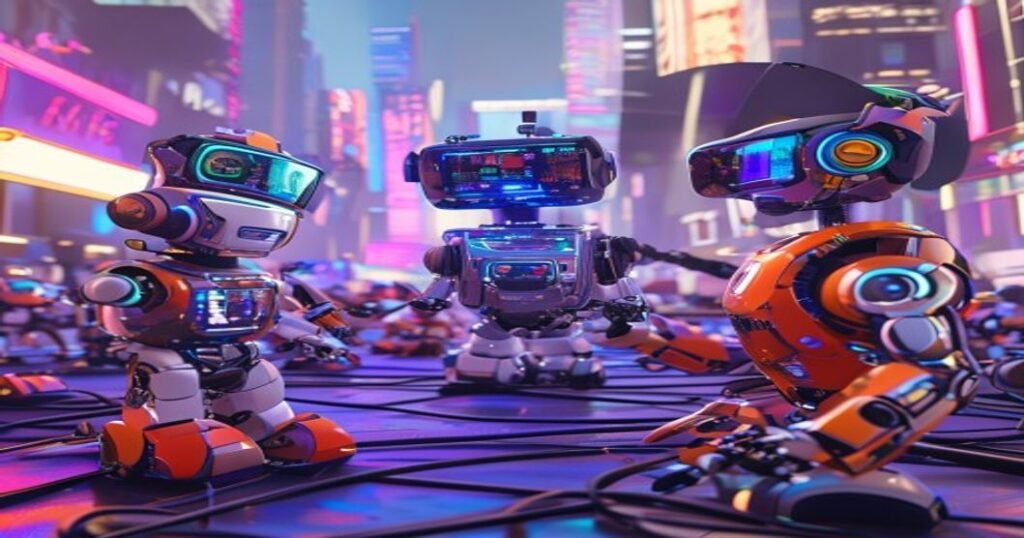

Remember a time when entertainment felt… static? You bought a movie ticket, watched the show, and that was it. Or you popped in a game cartridge, played the story, and moved on. Well, buckle up, because that era is rapidly becoming a quaint memory. We’re living through an entertainment revolution, and the quiet, often unseen maestro behind it all is Artificial Intelligence. It’s not just a buzzword; it’s genuinely transforming how stories are told, games are played, and even how we discover our next obsession. And honestly, it’s both thrilling and a little bit mind-bending.
The Creative Spark: AI in Content Creation
Think about the sheer creative horsepower needed to produce a blockbuster film or a sprawling open-world game. Scripts, concept art, music scores, visual effects, character animations – it’s a gargantuan undertaking. But what if a significant portion of that heavy lifting could be augmented, or even initiated, by an intelligent partner? This isn’t science fiction anymore. We’re seeing Generative AI: The Unstoppable Creative Force Reshaping Our World (And Your Future) emerge as a game-changer for creators. Imagine AI systems analyzing countless scripts to identify successful narrative structures, then proposing new plot twists or character arcs. Picture an artist using AI tools to quickly generate dozens of concept variations for a fantastical creature or an alien landscape, saving weeks of manual work. Composers are experimenting with AI to create intricate musical scores that adapt in real-time to a film’s mood or a game’s action. The beauty here isn’t about replacing human creativity, but amplifying it, freeing artists from tedious tasks to focus on the truly innovative sparks. It’s like having an impossibly fast, endlessly imaginative intern who never sleeps.
Leveling Up: AI’s Impact on Gaming
Nowhere is the impact of AI more palpable than in the gaming world. From the moment you pick up a controller, AI is shaping your experience. Forget predictable enemy patterns; modern game AI learns from your play style, adapting difficulty on the fly, making antagonists smarter and more challenging. Think about the sprawling, incredibly detailed worlds of your favorite RPGs. Many elements, from terrain generation to side quests, are often procedurally generated with AI, creating unique experiences for every player. This isn’t just about making games harder; it’s about making them smarter, more immersive, and endlessly replayable. NPCs (Non-Player Characters) are evolving beyond simple scripts, with AI giving them more believable behaviors, reactions, and even dynamic conversations. The lines between what’s pre-programmed and what’s emergent are blurring, creating a richer, more unpredictable tapestry of play.
Your Personal Curator: AI in Content Consumption & Personalization
But AI’s magic isn’t confined to the creation studios. It’s right there in your pocket, on your smart TV, guiding your choices. Remember scrolling endlessly through a streaming service, overwhelmed by options? AI is the invisible hand that makes sense of that chaos. Recommendation algorithms, powered by sophisticated AI, analyze your viewing history, your likes, your skips, and even how long you pause on a particular thumbnail, to suggest content you’re genuinely likely to enjoy. It’s why your streaming service seems to ‘know’ you so well, often better than your closest friends know your taste in documentaries or obscure indie films. This level of personalization extends beyond just recommendations. With the power of The Brain in Your Pocket: How AI is Redefining What a Smartphone Can Be (And Why You’re Already Hooked), your mobile device becomes a gateway to an entirely tailored entertainment universe. From hyper-personalized news feeds to adaptive content experiences in apps, AI ensures that the entertainment coming to you feels almost custom-made. It’s an incredibly powerful tool for discovery, but also raises interesting questions about algorithmic echo chambers – are we only seeing what AI thinks we want to see, or is it genuinely expanding our horizons?
Beyond the Screen: The Rise of Interactive Entertainment
Beyond just personalization, AI is turbocharging the trend towards interactive entertainment. We’re moving away from passive consumption and towards active participation. Think about interactive films where your choices genuinely alter the storyline, or live streams where AI analyzes chat sentiment to influence the content in real-time. Virtual reality (VR) and augmented reality (AR) experiences, often heavily reliant on AI for seamless immersion and adaptive environments, are becoming more sophisticated and accessible. The metaverse, while still in its nascent stages, promises entirely new forms of entertainment – persistent virtual worlds where AI-driven characters, objects, and experiences respond to your presence. We’re no longer just watching a story; we’re often stepping inside it, influencing its direction, or even becoming a character within it. This shift empowers the audience in unprecedented ways, making every entertainment experience potentially unique.
The Fine Print: Challenges and Ethical Considerations
Of course, with such transformative power come significant responsibilities and challenges. The entertainment industry, a bedrock of human creativity, is grappling with questions about job displacement. If AI can write scripts, compose music, and generate art, what does that mean for human writers, musicians, and artists? It’s a valid concern, and one that requires thoughtful consideration. My personal take is that AI, at its best, is a collaborator, not a replacement. It takes away the mundane, amplifies the brilliant, and creates new roles we haven’t even conceived of yet. However, we must ensure fair compensation and new training pathways for those whose roles are directly impacted. Then there are the ethical quagmires: deepfakes, copyright issues surrounding AI-generated content, algorithmic bias perpetuating stereotypes, and the potential for AI to create highly addictive, manipulative experiences. These aren’t minor footnotes; they’re fundamental questions that the industry, technologists, and policymakers need to address proactively.
The Future is Now: What’s Next?
Looking ahead, the integration of AI into entertainment will only deepen and diversify. We’re likely to see hyper-realistic virtual actors who can portray any role, eliminating the need for expensive reshoots or even certain casting choices. Personalized narratives could become even more granular, with AI crafting entire storylines unique to a single viewer based on their preferences, mood, and even biometric data. Imagine a film where the pacing, the music, and even character dialogue subtly adjust to your heart rate or emotional response. This isn’t just about making things ‘cool’; it’s about pushing the boundaries of immersive storytelling to entirely new levels. Education, too, stands to benefit, blurring the lines between learning and entertainment in ways we’ve only begun to explore. The entertainment landscape will continue to evolve at breakneck speed, powered by these incredible advancements.
The Show is Just Getting Started
So, where does this leave us, the eager consumers and passionate creators? In an age of unprecedented opportunity. AI isn’t just a tool; it’s a co-creator, a curator, and a catalyst. It’s making entertainment more accessible, more personalized, and undeniably more exciting. While the ethical debates and challenges are real and demand our attention, the overarching trend is clear: AI is not just reshaping entertainment; it is redefining what entertainment is. It’s inviting us into worlds we once only dreamed of, tailored precisely for us, and crafted with a precision and scale that were previously unimaginable. Get ready, because the show is just getting started, and you’re going to have a front-row seat to a spectacle unlike anything we’ve ever witnessed.


