
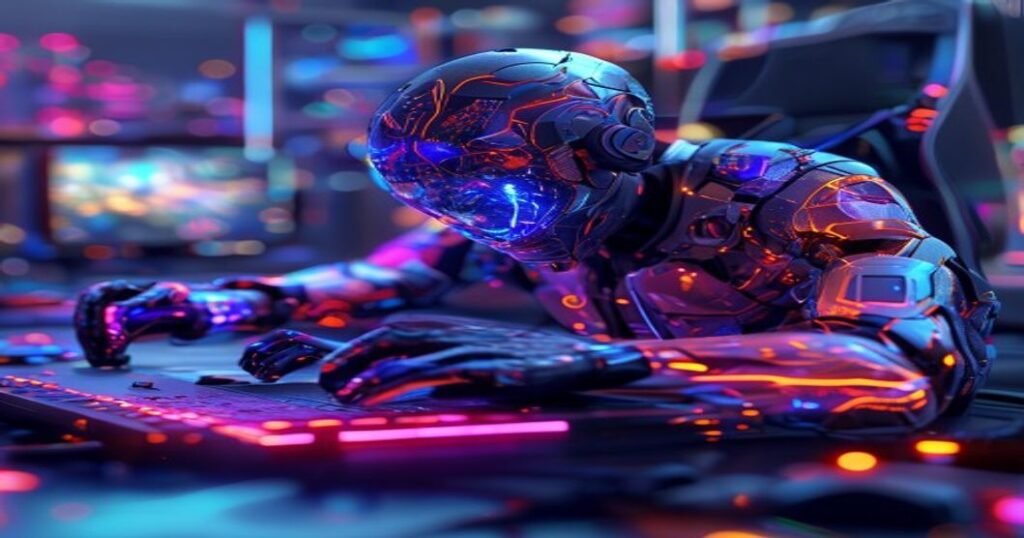

Remember the days when game AI was, well, a bit… predictable? Enemies would patrol in rigid patterns, NPCs would spout the same three lines of dialogue, and challenges felt less like genuine obstacles and more like thinly veiled puzzles designed by a bored developer. Frankly, those days are over. We’re standing on the precipice of a gaming revolution, and the force driving it isn’t just better graphics or faster processors; it’s Artificial Intelligence, and it’s not just playing the game – it’s rewriting the very rules of what a game can be.
As a lifelong gamer and someone deeply engrossed in the tech world, I’ve watched the evolution of AI with a mix of awe and trepidation. For years, AI in games was mostly a clever illusion – elaborate scripts that mimicked intelligence. But now? We’re talking about true, adaptive, learning AI that is transforming every facet of the gaming experience, from the characters we interact with to the worlds we explore and even how games are made. It’s an exhilarating time to be a part of this digital frontier.
The Dawn of Truly Intelligent NPCs: More Than Just Cardboard Cutouts
Let’s start with the most obvious impact: Non-Player Characters (NPCs). Gone are the days of sterile, repetitive interactions. Imagine an NPC who remembers your past actions, holds grudges or develops affections based on your choices, and even adapts their combat strategy on the fly. This isn’t science fiction anymore; it’s becoming the new standard. Advanced AI models are enabling NPCs to have more complex emotional states, dynamic dialogue systems that go beyond pre-recorded lines, and even emergent behaviors that aren’t hard-coded by designers.
Think about the implications: a quest giver who truly sounds distressed and reacts dynamically to your successes or failures, a vendor who remembers your favorite items, or an enemy faction whose leaders learn from your tactics and adapt their defenses in subsequent encounters. This level of depth breathes life into game worlds, making them feel less like digital playgrounds and more like living, breathing realities. It elevates the narrative from a passive experience to a truly interactive story where your actions genuinely ripple through the digital fabric.
Worlds Without Limits: Generative AI and Procedural Content
Perhaps one of the most mind-bending applications of AI in gaming is its ability to generate content. We’ve seen procedural generation before – think endless landscapes or randomly arranged dungeons. But Beyond the Buzzwords: Why Generative AI Isn’t Just a Trend, It’s Rewiring Our World (and Your Future), isn’t just about random placement; it’s about intelligent creation. AI can now design entire levels, craft unique puzzles, generate intricate lore, and even compose soundtracks tailored to the player’s current mood or situation.
This capability fundamentally changes game design. Developers can set parameters and allow AI to populate vast, unique worlds that would take human artists and designers centuries to craft. Imagine an open-world RPG where every cave, every forest, every city feels hand-crafted yet is entirely unique to your playthrough. This is not just about making bigger games; it’s about making infinitely replayable games where surprise and discovery are constant companions. The ‘Generative AI Gold Rush’ is certainly on for game developers, offering unprecedented tools to create, innovate, and expand digital universes.
The Personalized Game: AI as Your Digital Dungeon Master
Beyond content creation, AI is becoming the ultimate personalization engine. Modern AI can analyze your playstyle – your preferred weapons, your strategic leanings, your skill level – and dynamically adjust the game experience to match. Too easy? The AI subtly ramps up the difficulty, introduces new enemy types, or throws more complex challenges your way. Struggling? It might offer hints, provide extra resources, or even tone down enemy aggression without making the game feel condescending.
This adaptive difficulty isn’t just about keeping you engaged; it’s about tailoring an experience that feels perfectly tuned to you. It’s like having a brilliant Dungeon Master who knows exactly how to challenge and entertain you, ensuring you’re always in that ‘flow state’ where the game is neither too frustrating nor too boring. This level of personalized engagement is, in my opinion, the holy grail of interactive entertainment, promising experiences that resonate deeper and last longer.
Streamlining Development: More Games, Faster, Better
The impact of AI isn’t limited to the player’s screen; it’s profoundly transforming the development pipeline itself. AI-powered tools are automating mundane tasks like asset generation, animation rigging, and even bug testing. Imagine an AI that can analyze thousands of lines of code for potential errors or generate dozens of variations of a tree model with a few simple prompts. This frees up human developers, artists, and writers to focus on the truly creative, high-level work – crafting compelling narratives, designing innovative mechanics, and injecting the ‘soul’ into the game.
This isn’t just about efficiency; it’s about unleashing creativity on an unprecedented scale. Smaller indie studios can now leverage tools previously only available to AAA giants, democratizing game development and leading to an explosion of unique and diverse titles. It’s part of The Generative AI Gold Rush: Navigating the Tsunami of Innovation (and How to Strike It Rich) across all industries, and gaming is certainly at the forefront.
The Ethical Crossroads and the Human Element
Of course, with such profound power comes responsibility. The rise of AI in gaming isn’t without its challenges. There are legitimate concerns about job displacement in certain areas of game development, the potential for AI-generated content to feel soulless or generic if not carefully guided, and even the ethical implications of highly persuasive or addictive AI. As humanity navigates The Great AI Crossroads: Humanity’s Global Journey Through Tech’s New Frontier, the gaming industry must lead by example, ensuring AI serves to augment human creativity, not replace it.
My take? While AI is an incredible tool, the human touch remains irreplaceable. The unique spark of imagination, the nuanced storytelling, the unexpected design choices – these are the elements that give games their enduring magic. AI will undoubtedly handle the heavy lifting and provide endless possibilities, but it will always need the guiding hand of human creators to imbue it with purpose and passion. The new landscape requires developers to adapt, focusing on different skills, as highlighted by discussions around The AI Revolution: Thriving in the New Job Market – Skills, Strategies, and the Entrepreneurial Gold Rush.
What’s Next? Glimpses into an AI-Powered Future
Looking ahead, the possibilities are genuinely staggering. Imagine entire narrative arcs that adapt dynamically based on your dialogue choices, moral compass, and even your emotional responses captured by biofeedback. Picture game worlds that evolve and persist even when you’re offline, run by autonomous AI agents that continue to live their lives, engage in commerce, and shape the world. We could see games that learn from global player data to identify common frustrations and self-patch, or even generate new challenges specifically designed to foster community interaction and collaboration.
The concept of ‘meta-games’ where AI manages multiple concurrent storylines across different players, perhaps even influencing their individual experiences to weave into a grander, shared narrative, is no longer purely speculative. The lines between developer and player will blur further, with AI empowering players to create and share their own intelligent content with unprecedented ease.
The Game Has Changed
The integration of AI into gaming isn’t just another tech fad; it’s a fundamental shift, a paradigm change that redefines what we expect from our digital entertainment. It promises deeper immersion, infinite replayability, unparalleled personalization, and a future where games aren’t just played, but truly lived. As a gamer, I’m more excited than ever about the boundless creativity and unexpected experiences that AI is bringing to our screens. Get ready, because the future of gaming is here, and it’s smarter, more dynamic, and utterly transformative.


