
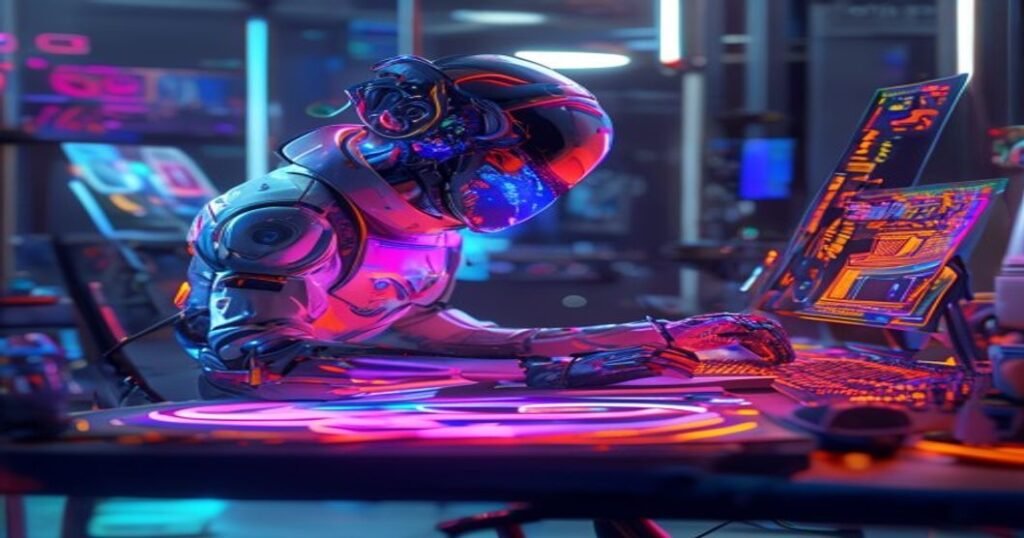

Alright, let’s talk about something that’s not just a buzzword, but a genuine seismic shift rumbling beneath the very foundations of how we create, innovate, and even perceive reality. I’m talking about Generative AI. For years, AI was about analyzing data, recognizing patterns, and making predictions. Useful, absolutely. But ‘creative’? ‘Generative’? That felt like science fiction, a distant dream nestled comfortably in Hollywood scripts.
Well, wake up, because that dream is now sprinting at us with the force of a digital hurricane. This isn’t just another incremental tech upgrade; this is a fundamental redefinition of human-machine interaction, an AI earthquake that’s reshaping industries, innovation, and your future in ways we’re only just beginning to grasp. And honestly? It’s exhilarating, terrifying, and utterly fascinating all at once.
What Exactly is Generative AI (Beyond the Hype Machine)?
At its core, Generative AI isn’t just processing information; it’s *creating* it. Think about that for a second. Instead of identifying a cat in a picture, it can *draw* a cat. Instead of translating a human-written sentence, it can *write* an entire article, a poem, or even a line of code from a simple prompt. It’s essentially a master apprentice, trained on unimaginable quantities of existing data – text, images, audio, code – and then given the magical ability to produce brand-new, original content that often indistinguishable from human-made work.
We’re talking about Large Language Models (LLMs) that can compose symphonies of words, image generators that conjure breathtaking visuals from a few descriptive phrases, and AI tools that can design architectural marvels or realistic human faces. The sheer breadth of its capabilities is astounding, touching everything from the mundane to the magnificent. It’s no longer about what AI can *understand*, but what it can *imagine* and then *manifest*.
The Creative Renaissance or a Pandora’s Box? My Honest Take.
Now, here’s where my opinion comes in. Is Generative AI a benevolent muse, unlocking unprecedented creative potential for everyone? Or is it a digital Pandora’s Box, threatening to blur the lines between reality and fabrication, potentially even devaluing human artistry? My answer is… both, and neither, simultaneously. It’s the most powerful tool humanity has ever wielded for creative output, which means its impact will be entirely dependent on how we choose to wield it.
On one hand, it’s democratizing creativity. Suddenly, you don’t need years of art school to create a stunning visual for your blog, or a hefty budget for a copywriter to draft compelling marketing material. Small businesses, independent creators, and even hobbyists can now produce high-quality content that was once the exclusive domain of large agencies or highly skilled professionals. This is a game-changer, fostering a new wave of innovation and entrepreneurship.
On the other hand, the ethical considerations are monumental. The potential for misinformation through deepfakes, the questions around copyright for AI-generated works, and the very real concern about job displacement for certain creative roles are not trivial. These aren’t distant problems; they are challenges we face *now*. But to shy away from Generative AI because of these challenges would be like refusing to invent the printing press because some might print lies. The solution isn’t avoidance, but responsible development, robust ethical frameworks, and an ongoing societal conversation.
Reshaping Industries, One Pixel and Word at a Time
Marketing & Content Creation: From Manual to Magical
Forget the days of staring at a blank page, battling writer’s block for hours. Generative AI can draft blog posts, social media updates, ad copy, and even personalized email campaigns in minutes. It can analyze trends, predict what resonates with an audience, and then craft content tailored for maximum impact. This doesn’t replace the human strategist, but it supercharges their output, allowing them to focus on high-level strategy and creativity rather than repetitive tasks.
Software Development: The Coding Co-Pilot
Developers are finding Generative AI to be an indispensable co-pilot. It can write boilerplate code, suggest functions, debug existing programs, and even translate code between different languages. This dramatically accelerates development cycles, reduces errors, and frees up engineers to tackle more complex, innovative problems. It’s like having an infinitely patient, incredibly knowledgeable junior developer on demand.
Design & Art: Beyond Human Imagination
From generating concept art for video games and movies to designing unique product prototypes and architectural blueprints, Generative AI is pushing the boundaries of visual creation. Artists are using it as a tool to explore new aesthetics, create variations of their work, and even overcome creative blocks. It’s not about replacing the artist, but providing them with an unimaginable palette and brush.
Healthcare & Science: Accelerating Discovery
Imagine AI designing novel protein structures for drug discovery, synthesizing new materials with specific properties, or even generating personalized treatment plans based on a patient’s unique genetic makeup. These are not futuristic fantasies; they are active areas of research and development *right now*, promising to revolutionize medicine and scientific inquiry.
The Invisible Hand: How Generative AI Touches Your Daily Life
You might not even realize it, but Generative AI is already becoming the invisible revolution that’s quietly reshaping your daily life and supercharging your lifestyle. When your smart assistant crafts a coherent response to your complex query, it’s often Generative AI at play. When a streaming service recommends a movie or music track that perfectly fits your mood, a generative model might have helped synthesize that suggestion based on nuanced patterns in your viewing history.
It’s in the personalized news feeds that curate content just for you, in the smart replies that auto-complete your emails, and even in the sophisticated filters that enhance your photos. As these models become more sophisticated, they’ll weave themselves even deeper into the fabric of our digital existence, making interactions more intuitive, personalized, and efficient. We are rapidly moving towards a world where our devices don’t just respond to our commands, but anticipate our needs and creatively assist us in countless ways.
The Entrepreneur’s Imperative: Surfing the Generative AI Wave
For any startup looking to make its mark, Generative AI isn’t an optional extra; it’s a fundamental operating principle. The efficiencies it offers, the new product categories it unlocks, and the sheer speed of iteration it enables are too significant to ignore. Early adopters are already seeing massive competitive advantages.
Consider the explosion of AI-powered tools for everything from marketing copy and code generation to video editing and customer service. Startups that integrate these capabilities aren’t just doing things better; they’re doing entirely *new* things. They can operate with leaner teams, iterate on ideas faster, and deliver hyper-personalized experiences that larger, slower incumbents simply can’t match. This isn’t just about efficiency; it’s about redefining what’s possible for a lean, agile business. As I’ve said before, the AI tsunami is crashing, and every startup must surf this wave or risk being swept away.
Key Opportunities for Startups:
- Content at Scale: Rapidly generate high-quality content for marketing, product descriptions, and user documentation.
- Personalized Experiences: Create bespoke user journeys, recommendations, and interactive content.
- Product Innovation: Design new products, features, and services that leverage generative capabilities (e.g., AI-powered design tools, personalized learning platforms).
- Operational Efficiency: Automate creative tasks, streamline development workflows, and enhance customer support.
Challenges and Ethical Dilemmas: The Uncomfortable Truths
Of course, with great power comes great responsibility. The very nature of Generative AI, its ability to create something from nothing, raises profound ethical questions that we *must* address head-on:
- Misinformation & Deepfakes: The ease with which realistic fake images, audio, and video can be generated poses a significant threat to truth and trust.
- Copyright & Originality: If AI creates a piece of art, who owns it? If it’s trained on copyrighted material, does its output infringe on those rights? These legal quandaries are still being fiercely debated.
- Bias Reinforcement: AI models learn from the data they’re fed. If that data contains societal biases, the AI will not only replicate them but often amplify them in its generations.
- Job Displacement: While Generative AI creates new roles and augments existing ones, it will undoubtedly automate certain creative and administrative tasks, leading to shifts in the job market. This isn’t a doomsday prediction, but a reality we need to prepare for with education and reskilling initiatives.
Ignoring these issues would be a grave mistake. The long-term success and ethical integration of Generative AI depend on proactive engagement with these challenges by developers, policymakers, and society at large.
My Take: A Future Co-Authored by Humans and Machines
I believe Generative AI isn’t here to replace human creativity, but to augment it. It’s a tool, albeit an incredibly powerful one. Think of it as a super-powered assistant that can handle the heavy lifting of creation, allowing human artists, writers, designers, and innovators to focus on the truly unique aspects of their craft: imagination, empathy, critical thinking, and vision. It allows us to go further, faster, and explore possibilities that were previously beyond our reach.
The future, as I see it, isn’t one where machines independently create our culture, but one where humans and machines co-author it. We provide the intent, the direction, the spark of genius, and the ethical guardrails. The AI then becomes our tireless collaborator, bringing our wildest ideas to life with unparalleled efficiency and breadth. This synergy promises an era of unprecedented creativity and innovation.
The Revolution is Now. Are You Ready?
Generative AI is not just a trend; it’s a fundamental shift in how we interact with technology and how we approach creation. It demands our attention, our understanding, and our responsible engagement. For individuals, it’s an opportunity to amplify personal output and explore new creative avenues. For businesses, especially startups, it’s an imperative for survival and growth in an increasingly competitive landscape.
The time to understand, experiment, and integrate Generative AI is not tomorrow, but today. The questions are profound, the ethical dilemmas are real, but the potential for positive transformation is simply too immense to ignore. Let’s embrace this creative revolution, with open minds and a steady hand, and collaboratively shape a future where human ingenuity is amplified by the incredible power of artificial intelligence.


