
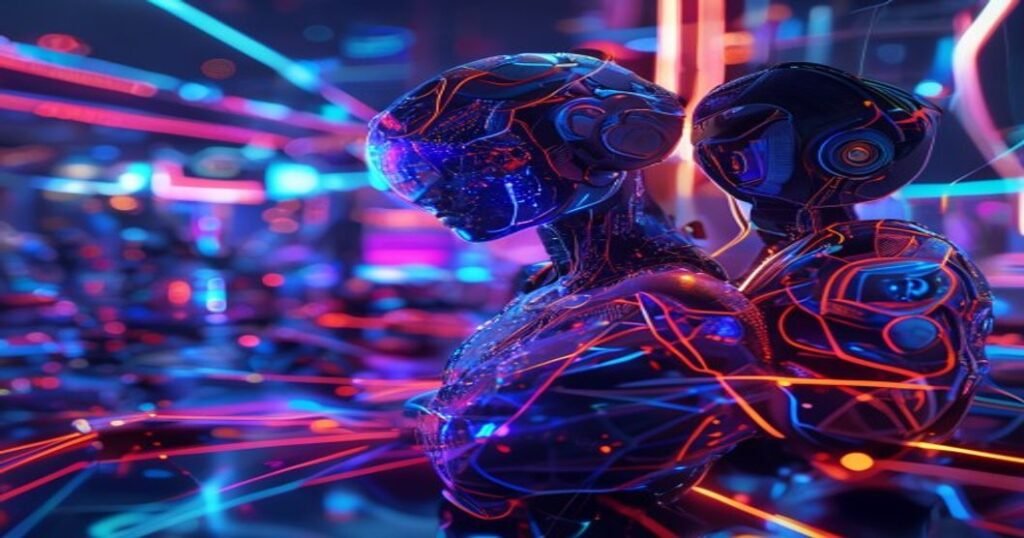

Alright, fellow gamers and tech enthusiasts, let’s talk about something truly groundbreaking that’s been quietly, and not-so-quietly, reshaping the digital playgrounds we love: Artificial Intelligence. For decades, AI in games meant predictable enemy patterns or simple pathfinding. But if you think that’s still the case, you’re living in a different gaming era. What we’re witnessing now isn’t just an evolution; it’s a full-blown revolution, making games more dynamic, personal, and frankly, jaw-droppingly immersive than ever before. And trust me, as someone who’s been glued to screens for a significant chunk of my life, this isn’t just hype – it’s the real deal.
Beyond Scripted Foes: The Dawn of Truly Intelligent Worlds
Remember those classic games where you could find a ‘safe spot’ to exploit enemy AI? Or where NPCs would repeat the same lines over and over, breaking immersion? Those days are rapidly becoming relics of the past. Modern AI, powered by machine learning and deep learning algorithms, is transforming how characters behave, how worlds generate, and even how stories unfold.
NPCs That Think, React, and Remember
The most visible impact of advanced AI is undoubtedly in our non-player characters (NPCs). We’re moving away from pre-programmed scripts to NPCs that can analyze situations, learn from player actions, and even develop unique personalities. Imagine a game where an enemy commander remembers your tactics from a previous encounter and sets up an ambush tailored just for you. Or a companion who genuinely adapts to your playstyle, offering assistance exactly when you need it, based on your past preferences.
- Dynamic Adversaries: Enemies learning to counter your strategies, adapting their attack patterns, and even coordinating complex maneuvers.
- Living Companions: NPCs developing relationships with players, remembering dialogue choices, and reacting emotionally to in-game events.
- Emergent Storytelling: AI systems influencing narrative paths based on player decisions and the evolving world state, leading to truly unique playthroughs.
This isn’t just about making games harder; it’s about making them feel alive. It’s about creating believable inhabitants for our virtual worlds, characters who feel less like glorified props and more like active participants in your journey. This shift fundamentally alters the player’s engagement, deepening the connection and making every interaction feel meaningful.
The Creative Co-Pilot: AI in Game Development
But AI’s magic isn’t confined to the player’s screen; it’s a powerful force behind the scenes too, fundamentally changing how games are made. Game development has always been a notoriously labor-intensive and expensive endeavor. However, AI is stepping in as an invaluable co-pilot, streamlining processes and unlocking creative possibilities previously unimaginable.
Procedural Content Generation (PCG) on Steroids
Think about vast open-world games. Creating every single tree, rock, or building by hand is an monumental task. This is where AI-driven procedural content generation shines. While PCG isn’t new, AI supercharges it, allowing for the creation of incredibly detailed, believable, and diverse landscapes, cities, and dungeons with far less manual intervention. AI can learn what makes a ‘good’ level design, a ‘realistic’ forest, or an ‘engaging’ quest structure, and then generate endless variations.
- World Building: Generating vast, detailed environments, from realistic terrain to intricate urban sprawls.
- Asset Creation: Designing textures, 3D models, character variations, and animations, significantly cutting down on artist workload.
- Quest Generation: Crafting dynamic quests and side missions that feel organically integrated into the game world.
This isn’t just about speed; it’s about freeing up human designers to focus on the big picture, on core mechanics, and on crafting truly unique, hand-tuned experiences, while the AI handles the heavy lifting of populating the world. Game studios that embrace this are not just getting an edge; they’re redefining their operational capabilities. Indeed, The AI Business Revolution: Why Your Strategy Needs a Reboot Now (Or Get Left Behind) isn’t just a catchy title; it’s a stark reality for every industry, and game development is no exception. Ignoring these advancements is akin to bringing a knife to a gunfight in today’s fiercely competitive market.
Optimizing Performance and Player Experience
Beyond content creation, AI is a wizard when it comes to game optimization. It can analyze massive datasets of player behavior to identify bugs, balance gameplay mechanics, and even predict player churn. AI-powered testing can run through countless scenarios in minutes, catching issues that would take human testers weeks to uncover. This leads to smoother launches, better-balanced games, and ultimately, a more satisfying experience for us, the players.
Personalization and Immersion: Gaming Tailored to YOU
One of the most exciting, and perhaps slightly unsettling, aspects of AI in gaming is its ability to personalize the experience to an unprecedented degree. Imagine a game that understands your playstyle, your preferences, and even your emotional responses, and then adjusts itself in real-time to maximize your enjoyment.
Adaptive Difficulty and Dynamic Narratives
AI can now monitor your performance and adjust the difficulty on the fly, ensuring you’re always challenged but never overwhelmed. If you’re struggling, the game might subtly offer more resources or weaker enemies. If you’re breezing through, it might throw tougher challenges your way. This keeps engagement high for a wider range of players. Similarly, dynamic narratives can branch and adapt based on your choices, skill level, and even how long you’ve been playing, creating a story that feels uniquely yours.
The Future of Discovery and Engagement
AI is also changing how we find games and how games keep us engaged. Recommendation engines in digital storefronts are becoming increasingly sophisticated, using AI to suggest titles you’ll genuinely love, based on your past purchases, playtime, and even reviews. Once in a game, AI can personalize advertisements (if applicable), suggest community events, or even tailor daily challenges to your specific preferences and availability. In this new landscape, The Algorithmic Revolution: Why AI Isn’t Just a Tool, It’s the New DNA of Digital Marketing perfectly encapsulates how AI is fundamentally altering how games connect with their audience, from discovery to sustained engagement.
The Specter and the Promise: Challenges and Ethical Considerations
Of course, with such profound change comes a host of questions and concerns. The rise of AI in gaming isn’t without its potential pitfalls.
Creative Control vs. AI Autonomy
One major debate revolves around the role of human creativity. If AI can generate entire worlds, characters, and even narratives, what does that mean for human artists, writers, and designers? Will AI eventually replace these roles, or will it merely augment them, allowing for more ambitious projects? The current consensus leans heavily towards augmentation, seeing AI as a powerful tool to free up human creativity rather than replace it. But it’s a conversation that needs to be had.
The Uncanny Valley and Player Trust
There’s also the ‘uncanny valley’ effect – where AI-generated content or behavior can be almost human-like but just ‘off’ enough to be unsettling. Achieving true, believable intelligence without feeling artificial or even creepy is a huge hurdle. Furthermore, as AI learns from players, concerns about data privacy and how our gaming habits are being used will undoubtedly grow. Building and maintaining player trust will be paramount.
It’s clear that the broader implications of this technological wave extend far beyond our gaming consoles. The AI Tipping Point: How Global Intelligence is Redefining Our World (and Why You Can’t Afford to Miss It) underscores a critical truth: AI is not just a niche tool; it’s a foundational technology that is reshaping industries, economies, and our daily lives. Gaming, being at the forefront of technological adoption, offers a fascinating microcosm of these global shifts.
The Future is Now: What’s Next for AI in Gaming?
So, what does the horizon hold? Frankly, it’s hard to predict the exact trajectory, but the trend is undeniable. We’re hurtling towards a future where AI isn’t just a feature but an intrinsic part of the gaming experience.
- Truly Adaptive Game Masters: Imagine an AI that acts as a Dungeon Master, dynamically creating quests, challenges, and stories on the fly, tailored to your group of players in a co-op RPG.
- AI-Powered Voice Acting: While human performance remains irreplaceable for many, AI is already generating highly realistic and emotionally nuanced voiceovers, opening doors for more expansive dialogue options and localization.
- Hyper-Realistic Graphics and Physics: AI can optimize rendering, enhance visual fidelity, and simulate complex physics in real-time, pushing the boundaries of realism even further.
- Cloud Gaming Enhancement: AI will play a huge role in optimizing cloud streaming, reducing latency, and delivering personalized experiences even over vast network infrastructures.
We are truly at the precipice of something spectacular. The integration of AI into game development and play is no longer a futuristic fantasy; it’s happening right now, shaping the games we play and how we interact with them. Developers who fail to adapt to this new paradigm risk being left behind, just as players who dismiss its impact will miss out on the most innovative experiences coming our way. As the world continues to integrate these advanced intelligent systems into every facet of our lives, The AI Reckoning: Why You Can’t Afford to Ignore Artificial Intelligence Anymore becomes less of a warning and more of an imperative, especially for an industry as dynamic and forward-thinking as gaming.
The Bottom Line: Embrace the Evolution
For me, as a lifelong gamer, this isn’t just about technological marvels; it’s about deeper immersion, more personalized adventures, and ultimately, more fun. AI isn’t here to replace human creativity or the joy of playing; it’s here to amplify it. It’s unlocking new genres, new gameplay loops, and new ways to tell stories within our interactive worlds. So, next time you’re battling a cunning AI enemy or exploring a procedurally generated world, take a moment to appreciate the silent revolution happening under the hood. The future of gaming is intelligent, adaptive, and utterly exhilarating. And honestly, I can’t wait to see what brilliant, AI-enhanced adventures await us next.


