
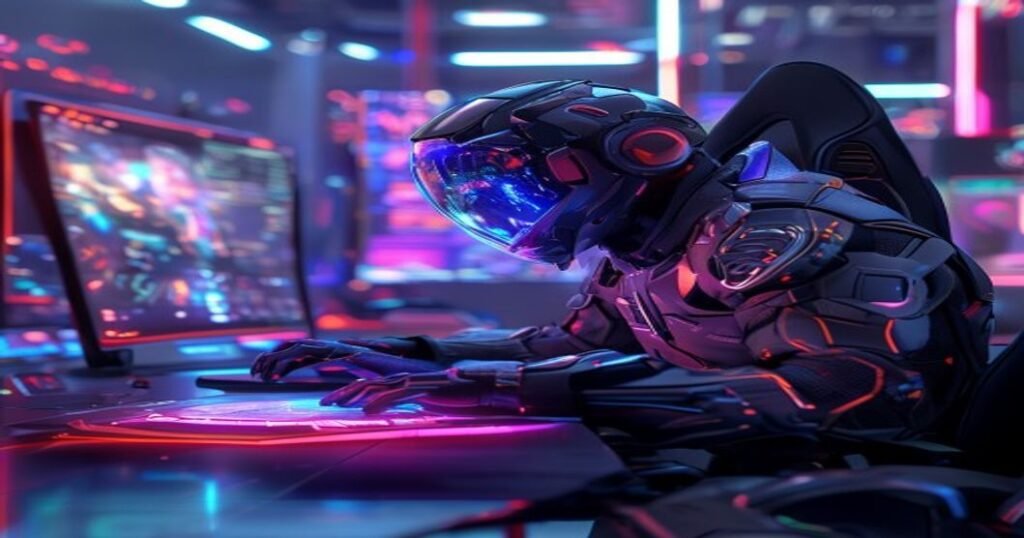

Remember the ‘good old days’ of gaming? Pixels were chunky, storylines were linear, and every NPC (Non-Player Character) was essentially a glorified script following a predetermined path. If you’d told me a decade ago that we’d be playing games where the world evolves dynamically around our choices, where characters learn from our actions, and where entire narratives are woven on the fly, I might have chuckled. Yet, here we are. The revolution isn’t coming; it’s already here, and it’s powered by Artificial Intelligence, fundamentally changing not just how we play, but how games are even made.
The Silent Evolution: From Dumb Bots to Digital Brains
For a long time, AI in games meant simple pathfinding algorithms, basic enemy attack patterns, and quest givers repeating the same lines. We called it AI, but let’s be honest, it was more like sophisticated automation. The illusion of intelligence was just enough to keep us engaged, but it rarely felt truly organic. Think about it: how many times did you outsmart an enemy by simply kiting them around an obstacle, or exploit a boss’s predictable pattern?
But the landscape has dramatically shifted. Today’s AI isn’t just following rules; it’s learning them, adapting them, and sometimes, even creating new ones. We’re talking about AI that can observe player behavior, predict their next move, and adjust difficulty on the fly to provide a genuinely challenging, yet fair, experience. This isn’t just about making enemies harder; it’s about making them smarter, more tactical, and less predictable. Imagine an enemy AI that studies your combat style – do you prefer stealth, direct confrontation, or ranged attacks? – and then customizes its own tactics to counter yours. That’s not just a game; that’s a sparring partner.
Personalized Universes: Games That Know You
One of the most thrilling applications of modern AI in gaming is the creation of hyper-personalized experiences. Forget ‘choose your own adventure’ books; we’re moving into ‘the adventure chooses you.’ AI can analyze vast amounts of player data – your playstyle, preferences, successes, failures, and even your emotional responses – to tailor everything from quest lines to item drops. Suddenly, the game world isn’t a static stage; it’s a living, breathing entity that reacts uniquely to you.
Have you ever wished a game could truly understand what you’re looking for? AI is making that a reality. It can generate bespoke content, modify existing narratives, and even suggest new challenges based on what it knows you enjoy (or what you need to improve). This level of dynamic adaptation means no two players will have the exact same journey, transforming gaming from a shared experience into a deeply personal odyssey. This personalization isn’t just about tweaking numbers; it’s about crafting an emotional connection, making you feel truly seen and understood by the digital world you inhabit. This transformative power of smart technology isn’t confined to gaming; it’s quietly reshaping countless industries, proving that The AI Revolution: Beyond the Headlines, How Smart Tech is Quietly Rewiring Our World in ways we’re only just beginning to grasp.
The Art of the Impossible: Generative AI and Infinite Worlds
Perhaps one of the most mind-boggling advancements is the rise of generative AI in game development. Historically, crafting vast, detailed open worlds was an incredibly labor-intensive process, demanding countless hours from level designers, artists, and writers. Now, generative AI is stepping into the spotlight, capable of creating entire landscapes, dungeons, creatures, and even lore with unprecedented speed and scale. We’re talking about algorithms that can design unique geological formations, architectural styles, and ecological systems based on a few parameters, reducing development time and opening up possibilities for truly massive and varied game worlds that were previously unimaginable.
Imagine a game where every forest, every cave, every alien planet is uniquely generated, offering fresh exploration even after hundreds of hours. This isn’t just about randomizing elements; it’s about intelligent generation that adheres to design principles, artistic styles, and narrative coherence. This ability to conjure unique content out of thin air is why many are calling this period The AI Gold Rush: Why Generative AI is the Startup Catalyst You Can’t Ignore, as it promises to democratize content creation and unlock incredible creative potential for indie developers and AAA studios alike. This technology isn’t just a fancy tool; it’s a fundamental shift in how we approach world-building and content delivery, pushing the boundaries of what’s possible in digital entertainment.
NPCs with Souls: More Than Just Dialogue Trees
Beyond environments, AI is injecting genuine personality into Non-Player Characters. We’re moving away from rigid dialogue trees towards AI companions and adversaries that can engage in natural language conversations, express emotions, and even remember past interactions. Imagine an NPC who recalls your previous deeds, offers relevant advice based on your playstyle, or even holds a grudge if you wronged them.
This level of dynamic interaction fosters a deeper sense of immersion and emotional investment. Characters aren’t just quest givers; they become integral parts of your journey, feeling less like digital puppets and more like genuine inhabitants of the game world. This capability opens doors for richer storytelling, complex character arcs that evolve with your input, and emergent narratives that spring from the interactions between players and AI. It’s truly Unleashing the Digital Muse: How Generative AI is Rewriting the Rules of Creation and Innovation, allowing games to tell stories that are not just experienced, but co-created in real-time.
The AI Assistant: Empowering Game Developers
It’s not just players who are benefiting from this AI boom; game developers are finding their creative processes amplified. AI tools are becoming invaluable assistants, handling mundane tasks like texture generation, animation rigging, playtesting, and bug detection. This frees up human talent to focus on what they do best: conceptualizing, storytelling, and refining the core gameplay experience.
Consider AI that can rapidly prototype game mechanics, suggest optimal level layouts, or even assist in writing dynamic narrative branches. By automating the more tedious and time-consuming aspects of development, AI empowers smaller teams to create games of incredible scope and complexity, leveling the playing field and fostering an unprecedented era of innovation in the industry. It’s like having an army of highly efficient, tireless assistants working alongside human creators, pushing the boundaries of what a small studio can achieve.
The Ethics of Digital Divinity: Where Do We Draw the Line?
Of course, with great power comes great responsibility. The rise of sophisticated AI in gaming isn’t without its ethical considerations. As AI becomes more advanced, questions about player agency, algorithmic bias, and even the potential for AI to create ‘addictive’ experiences become increasingly relevant. If an AI can perfectly tailor a game to keep you engaged indefinitely, what does that mean for free will and healthy boundaries?
There are also concerns about job displacement in creative fields. While AI currently assists developers, could it eventually replace certain roles entirely? These are crucial conversations that the industry, and indeed society, needs to have as AI continues its rapid ascent. Balancing innovation with ethical oversight will be key to ensuring that AI serves to enhance, rather than diminish, the human experience of gaming.
The Future is Now: What Lies Ahead?
Looking ahead, the possibilities are nothing short of breathtaking. Imagine games where AI-driven NPCs run their own simulations when you’re not around, living complex lives that continue regardless of your presence. Picture entire virtual economies managed by AI, reacting to player actions and global events in real-time. Envision games that teach you new skills, adapt to your learning style, and evolve endlessly, offering truly unique experiences every single time you log in.
We are just scratching the surface of what AI can do for gaming. From hyper-realistic simulations to deeply emotional and reactive narratives, AI is the engine driving the next wave of innovation. It’s transforming games from static pieces of entertainment into dynamic, intelligent ecosystems where every decision, every interaction, and every moment feels uniquely yours. Get ready, because the future of play is smarter, more personal, and more expansive than we ever dared to dream.
This isn’t just an upgrade; it’s a paradigm shift. And honestly, as a lifelong gamer, I couldn’t be more excited to see where this incredible journey takes us next.


