

Let’s be honest, for too long, the narrative around our planet’s incredible wildlife has felt like a slow, agonizing dirge. News of dwindling populations, habitat destruction, and the relentless march of poaching has often left us feeling helpless, as if we’re simply bystanders watching a tragedy unfold. But what if I told you there’s a revolutionary force stepping into the ring, turning the tide, and offering a genuine glimmer of hope? I’m talking about Artificial Intelligence (AI), and it’s not just transforming our workplaces or automating mundane tasks; it’s becoming a guardian for the wild, rewriting the future of animal conservation.
For me, the sheer scale of the challenges faced by conservationists has always been overwhelming. Vast, remote landscapes, cunning poachers, and the sheer impossibility of individually monitoring every creature or corner of a protected area. It’s a logistical nightmare, a David versus Goliath struggle where Goliath often has the latest tech – until now. The truth is, AI is changing this equation fundamentally, providing a suite of tools that are both intelligent and scalable, offering eyes and ears where humans simply cannot be.
The Unseen Sentinels: AI in Tracking and Monitoring
Think about it: how do you keep tabs on a pride of lions across thousands of acres, or track the migratory path of a rare bird species through dense forests? Traditionally, it meant arduous fieldwork, expensive collaring, and often, educated guesswork. Today, AI is turning science fiction into everyday reality for conservationists.
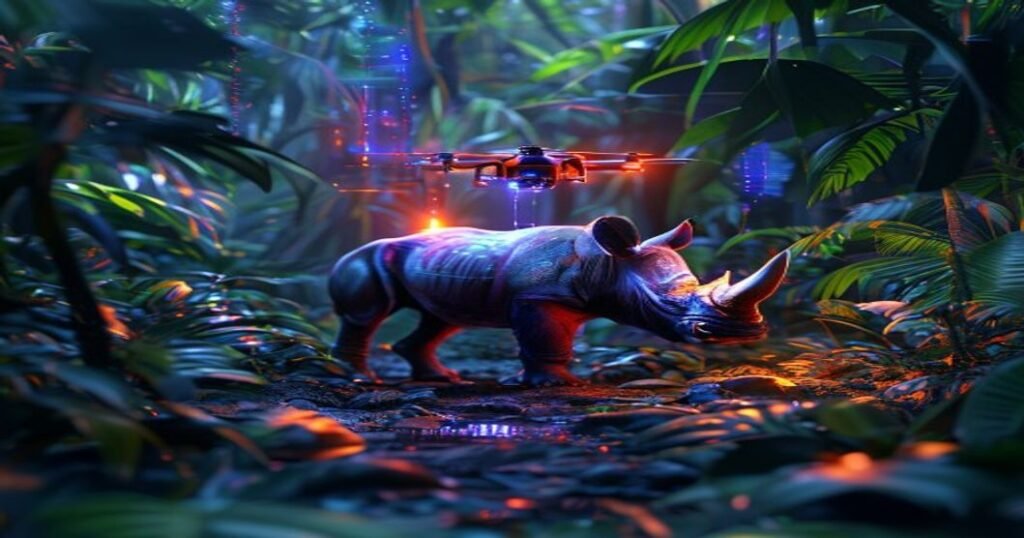
Drones equipped with AI-powered cameras are now soaring over national parks, autonomously identifying animals, counting populations, and even detecting signs of distress or illness. Imagine a drone recognizing a specific elephant from its tusk patterns, or a particular tiger by its stripes – all thanks to sophisticated algorithms. This isn’t just cool tech; it’s critical data, allowing researchers to understand population dynamics, health, and behavior with unprecedented accuracy. The amount of data generated, from thermal imaging to acoustic sensors, would be impossible for humans to process manually. This is where AI truly shines, sifting through the noise to find the signals that matter. It’s truly a The AI Revolution in Science: How Intelligent Machines Are Unlocking Humanity’s Next Great Discoveries, extending our reach and understanding of the natural world.
Combating the Shadowy Scourge: AI Against Poaching
Poaching remains one of the most brutal threats to endangered species, driven by illicit markets and organized crime. For years, rangers have risked their lives in a cat-and-mouse game, often outgunned and outnumbered. This is where AI steps in as a silent, ever-vigilant protector.
Predictive analytics, powered by AI, can analyze historical poaching data, weather patterns, moon phases, and even economic indicators to forecast where and when poaching is most likely to occur. This allows park rangers to deploy their limited resources strategically, intercepting poachers before they can strike. Furthermore, AI-enabled acoustic sensors hidden in remote areas can distinguish between natural forest sounds and the tell-tale signs of human intruders, vehicle engines, or gunshots, sending real-time alerts to command centers. Coupled with advanced surveillance systems that can identify human forms or vehicles in challenging terrain, the playing field is finally being leveled. This combination of advanced monitoring, real-time data processing, and rapid communication, often relying on technologies like 5G and edge computing, showcases how The Unholy Trinity: How 5G, AI, and Edge Computing Are Rewiring Telecom – And Your Entire World, creating a robust shield for our precious wildlife.
Habitat Restoration and Climate Resilience: AI’s Broader Brush
Conservation isn’t just about protecting individual animals; it’s about safeguarding entire ecosystems. Climate change, deforestation, and pollution are altering habitats at an alarming rate. Here too, AI offers powerful solutions.
- Ecological Modeling: AI can process vast datasets on climate, geography, and species distribution to predict how different ecosystems will respond to environmental changes. This allows conservationists to prioritize areas for protection or restoration, and even model future migration corridors for species adapting to shifting climates.
- Disease Monitoring: By analyzing health data from animal populations and environmental factors, AI can help predict and prevent outbreaks of diseases that could decimate endangered species. Early warning systems are crucial in preventing widespread loss.
- Smart Reforestation: AI-powered drones can precisely map areas needing reforestation, analyze soil conditions, and even plant seeds with incredible accuracy, accelerating the arduous process of restoring degraded lands.
It’s clear that AI is not just a tool; it’s a seismic shift in how we approach conservation. This isn’t just another incremental improvement; it’s a fundamental change that The AI Earthquake: Why Your World Just Got Rewired, and How to Thrive in the Intelligent Era is bringing to every sector, including the critical fight to preserve our planet’s biodiversity.
The Human Element: Empowering Conservationists and Citizens
While AI provides the analytical muscle, it’s crucial to remember that it empowers, not replaces, human conservationists. Rangers, biologists, and community leaders are now equipped with better information, allowing them to make more informed decisions and act with greater impact.
Moreover, AI is fostering a new wave of citizen science. Mobile apps that use image recognition allow everyday people to identify species, report sightings, and contribute to massive datasets that AI can then analyze. This democratizes conservation, turning every nature enthusiast into a potential data gatherer, and every smartphone into a valuable research tool. This collaborative approach multiplies our efforts, making the fight for wildlife a collective endeavor.
Challenges and the Road Ahead
Of course, no technology is a silver bullet. The deployment of AI in remote, challenging environments comes with its own set of hurdles: reliable power sources, internet connectivity (though satellite solutions are helping), and the need for skilled personnel to interpret the data and maintain the systems. There are also ethical considerations, such as the potential for AI surveillance to impact local human communities, which must be carefully navigated with transparency and respect.
But these challenges are not insurmountable. The rapid pace of innovation in AI, coupled with a growing global awareness of the biodiversity crisis, means that solutions are constantly emerging. What we’re witnessing is nothing short of The AI Tsunami: Are We Ready for the Tidal Wave of Change Hitting Society Now?, and in the realm of conservation, it feels like a wave of hope rather than an impending disaster.
My Take: A Future Reimagined for Wildlife
As someone who has followed the environmental beat for years, I admit I often felt a profound sense of pessimism. The odds seemed stacked against us, and the scale of loss was truly heartbreaking. But seeing the practical applications of AI in real-world conservation projects has ignited a powerful optimism within me. It’s not a magic wand, but it’s the closest thing we have to a genuine game-changer.
AI offers us the chance to move beyond reactive conservation – responding to crises as they happen – to proactive, preventative strategies. It’s giving a voice to the voiceless, eyes to the unseen, and a fighting chance to species teetering on the brink. We have a moral imperative to protect the incredible biodiversity that enriches our planet, and with AI, we now have an unprecedented technological partner in that noble quest.
The journey is far from over, but for the first time in a long time, the future for endangered species and their habitats feels a little less grim, a little more full of possibility. And that, for me, is a story worth telling.


