
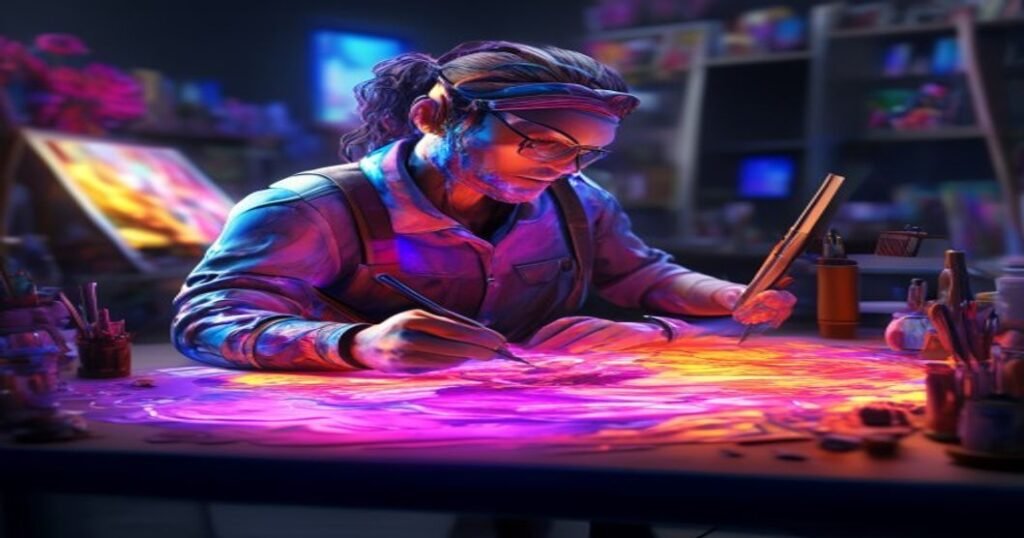

The Canvas Expands: A New Dawn for Creativity with Generative AI
Remember when the act of creation felt like a solitary struggle, a dance between human genius and the blank page or empty canvas? For centuries, this was the undisputed truth. Artists, writers, musicians, designers – they toiled, envisioned, and painstakingly brought their ideas to life. But what if I told you that the very definition of ‘creation’ is being rewritten, not by humans alone, but by a collaboration with machines? Welcome to the electrifying, sometimes bewildering, world of Generative Artificial Intelligence (AI).
It’s no longer a futuristic fantasy; it’s our vibrant reality. From composing symphonies that could fool seasoned critics to designing stunning visuals that evoke powerful emotions, Generative AI is doing more than just assisting; it’s actively participating in the creative process. And honestly, it’s exhilarating, terrifying, and utterly fascinating all at once. It’s forcing us to ask fundamental questions: What is art? What does it mean to be a creator? And perhaps most importantly, what does this seismic shift mean for us, the audience, the consumers, and the aspiring creators?
Beyond Algorithms: Understanding the Magic of Generative AI
At its core, Generative AI isn’t just about processing existing data; it’s about creating entirely new data. Think of it less like a calculator and more like an imaginative apprentice who’s studied every masterpiece, read every book, and heard every song, and can now produce something novel based on that vast knowledge. These aren’t just clever programs; they’re sophisticated neural networks trained on unimaginable datasets – billions of images, trillions of words, countless hours of audio.
When you type a prompt into an AI image generator like Midjourney or Stable Diffusion, it doesn’t just pull up a pre-existing image. It synthesizes, blends, and invents, pixel by pixel, based on patterns it learned from its training data. The same goes for large language models like ChatGPT, which can write essays, code, poetry, or even entire screenplays, not by copying, but by generating coherent and contextually relevant text. It’s a mind-boggling leap, a true testament to the power of machine learning, and it’s radically democratizing access to powerful creative tools.
The AI Artist, Writer, and Composer: A New Era of Collaboration
For me, one of the most exciting aspects of Generative AI is its potential to be the ultimate creative partner. Imagine a graphic designer struggling with a specific visual concept. Instead of hours of sketching, they can prompt an AI, iterate rapidly, and arrive at a multitude of options to refine. Writers facing a dreaded block can use AI to brainstorm ideas, generate plot points, or even draft initial paragraphs. Musicians can experiment with new melodies or instrumentations suggested by an AI.
- Visual Arts: Designers are using AI to generate mood boards, create unique textures, and even conceptualize entire architectural structures. The speed and sheer volume of ideation are unprecedented.
- Writing & Content Creation: From marketing copy and blog posts to screenplays and novels, AI is becoming an indispensable tool for accelerating content pipelines and overcoming creative hurdles.
- Music & Sound Design: AI can compose unique scores for films, generate background music for videos, or even help musicians explore new harmonic progressions.
- Fashion & Product Design: AI is being employed to create innovative clothing designs, generate prototypes, and predict consumer trends, pushing the boundaries of aesthetics and functionality.
This isn’t about replacing human creativity; it’s about augmenting it. It’s about offering a megaphone to voices that might otherwise be unheard, providing tools to those who lack traditional skills, and accelerating the output of seasoned professionals. It’s a paradigm shift, moving from creation as a solitary act to creation as a collaborative journey with an incredibly powerful, if artificial, intelligence.
The Ethical Canvas: Navigating the Murky Waters
Of course, with great power comes great responsibility, and Generative AI is no stranger to controversy. The ethical questions are immense and urgent. Who owns the copyright to AI-generated art? What about the artists whose work was used to train these models without their explicit consent or compensation? The rise of ‘deepfakes’ – highly realistic AI-generated images or videos that can be used to mislead or defame – highlights the darker side of this technology. We’re grappling with:
- Copyright and Ownership: Is AI-generated content truly original? Who gets credit, and more importantly, who profits?
- Bias and Representation: AI models learn from existing data, which often reflects societal biases. This can lead to AI generating content that is stereotypical, offensive, or perpetuates harmful narratives.
- Job Displacement: Will AI make certain creative professions obsolete? While I believe in augmentation over replacement, the economic impact on certain sectors is a valid concern.
- Authenticity and Truth: In a world flooded with AI-generated content, discerning what is real from what is fabricated becomes increasingly difficult.
These aren’t easy questions, and the answers are still evolving. But it’s crucial that we, as a society, engage in these discussions now, to shape a future where Generative AI serves humanity responsibly, rather than becoming an uncontrollable force.
AI’s Invisible Hand: Beyond the Creative Studio
While we marvel at AI’s creative output, it’s worth remembering that artificial intelligence is already intricately woven into the fabric of our daily lives, often in ways we don’t even consciously perceive. From personalized streaming recommendations to predictive text on our phones, AI is constantly at work, shaping our experiences. It’s why when you think about how tech is constantly evolving to make our lives smoother, more connected, and undeniably more convenient, you’re already witnessing The AI Revolution in Your Living Room: How Tech is Rewriting the Rules of Modern Lifestyle (And Why You’re Already Hooked). It’s in our smart speakers, our health trackers, and even our home security systems, silently performing tasks and offering insights.
But the impact stretches far beyond personal convenience. AI is a profound disruptor, challenging established norms and creating entirely new industries. Consider the seismic shift we’re witnessing in transportation. The idea of vehicles navigating our streets without human input, driven by sophisticated AI, was once pure science fiction. Now, we’re seeing real progress, raising fascinating questions about safety, ethics, and infrastructure. It makes you wonder: is it a Driverless Dream or Autonomous Nightmare? The Road Ahead for Self-Driving Cars is a complex journey, but one entirely paved by advancements in AI.
The Local Landscape: Seizing the Future
The global race to harness AI is not just for tech giants and developed nations. For emerging economies, particularly those with a burgeoning youth population and a vibrant startup ecosystem, this moment presents an unparalleled opportunity. Investing in AI research, fostering AI talent, and integrating AI into various sectors can be a game-changer for national development and global competitiveness. It’s a pivotal moment, a genuine crossroads. We must ask ourselves if Pakistan’s AI Crossroads: Will We Seize the Digital Future (or Be Left Behind)? The answer depends on our collective will, our investment in education, infrastructure, and an enabling environment for innovation. It’s not merely about adopting technology; it’s about shaping it, contributing to it, and making it work for our unique challenges and opportunities.
Looking Ahead: The Limitless Horizon
The journey with Generative AI has only just begun. We’re at the very early stages of understanding its full potential and managing its complexities. It’s a technology that promises to redefine creativity, transform industries, and fundamentally alter our relationship with machines. The future isn’t about whether AI will create; it’s about how we, as humans, will collaborate with it, guide it, and leverage its power to build a more innovative, expressive, and perhaps, even more beautiful world.
My take? Embrace it. Learn it. Understand it. The best way to navigate this creative revolution isn’t to resist it, but to become an active participant. The blank canvas is bigger than ever, and now, we have an incredibly powerful new set of brushes at our disposal. What will you create?


