
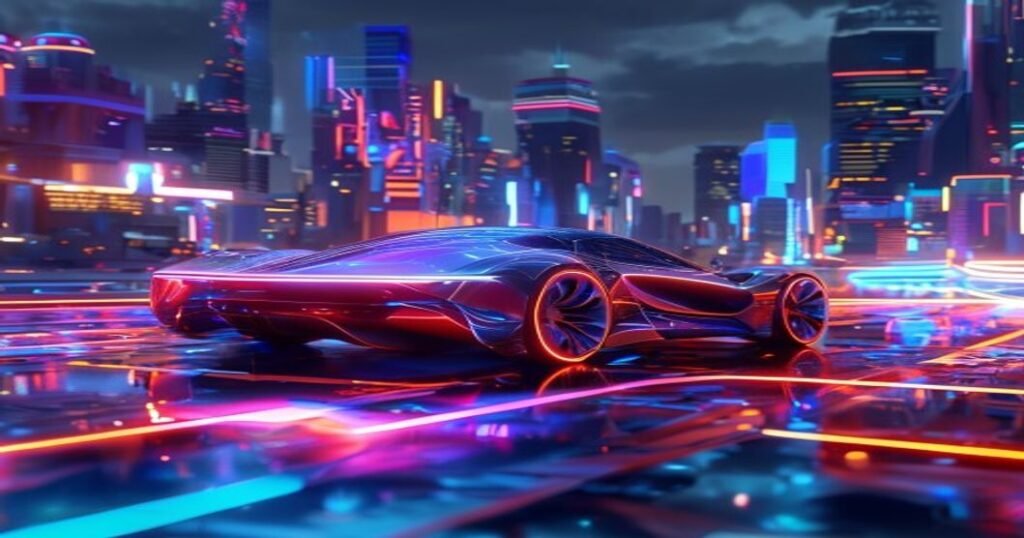

Remember when cars were just, well, cars? A metal box with an engine, four wheels, and a steering wheel? Those days, my friends, are rapidly fading into the rearview mirror. We’re not just witnessing a shift in how we power our vehicles, but a fundamental reimagining of what a car is. It’s no longer just about horsepower or torque; it’s about intelligence, connectivity, and an experience that feels plucked from a sci-fi movie. And at the heart of this exhilarating transformation? Artificial Intelligence.
It’s hard to overstate the impact AI is having across every industry, and the automotive world is no exception. In fact, you could argue that few sectors are being reshaped as profoundly. From the factory floor to the open road, AI isn’t just optimizing existing processes; it’s creating entirely new paradigms. If you’ve been following the broader tech landscape, you’ll know that The AI Tsunami: How Artificial Intelligence is Not Just Reshaping Tech, But Rewriting Our World is a real phenomenon, and the auto industry is right in the eye of that storm.
The Intelligence Under the Hood: More Than Just an Engine
For decades, automotive innovation was primarily mechanical. Faster engines, smoother transmissions, better suspension. While those advancements continue, the real revolution now is digital. Modern vehicles are essentially supercomputers on wheels, bristling with sensors, processors, and intricate software. AI is the brain that makes sense of all this data, turning a collection of parts into a truly ‘smart’ machine.
Autonomous Driving: The Dream We’re Still Chasing
Let’s talk about the big one: self-driving cars. This is the holy grail, isn’t it? The promise of a world where traffic jams are a distant memory, where commutes become productive relaxation time, and road accidents are drastically reduced. Companies like Waymo, Cruise, and even traditional automakers are pouring billions into this. It’s a colossal challenge, requiring AI to perform feats of perception, prediction, and decision-making that still push the boundaries of what’s possible.
- Perception: Cameras, radar, lidar, ultrasound – these are the ‘eyes and ears’ of an autonomous vehicle. AI algorithms process this raw data in real-time to identify other cars, pedestrians, cyclists, traffic lights, road signs, and even potholes.
- Prediction: Once the AI ‘sees’ its environment, it needs to predict what everything else in that environment will do next. Will that pedestrian step into the road? Is that car going to change lanes? This requires sophisticated behavioral models and lightning-fast computation.
- Decision-making: Based on perception and prediction, the AI decides what action to take: accelerate, brake, steer, change lanes, or wait. This is where the ‘driver’s intuition’ is replaced by complex, rule-based, and learning-based algorithms.
My take? Fully Level 5 autonomous vehicles – ones that can drive themselves anywhere, anytime, under any condition – are still a ways off for widespread public adoption. The edge cases, the unpredictable human element, and the sheer complexity of our chaotic road environments make it incredibly difficult. But don’t despair! We’re seeing rapid advancements in Level 2 and Level 3 systems (think advanced adaptive cruise control, lane-keeping assistance, and even ‘hands-off’ highway driving) that are already making driving safer and less stressful.
Electric Vehicles & AI Synergy: A Match Made in Automotive Heaven
The rise of Electric Vehicles (EVs) isn’t just about emissions; it’s about a complete architectural shift in the car. EVs, by their very nature, are more digital, more connected, and more amenable to AI integration than their internal combustion counterparts. And honestly, the future of sustainable personal transport absolutely hinges on this powerful combination.
Optimizing Every Watt and Mile
AI plays a critical role in making EVs practical and efficient:
- Battery Management Systems (BMS): These AI-powered systems constantly monitor battery health, temperature, and charging cycles to maximize range, extend battery life, and prevent overheating. Without sophisticated AI, EV batteries wouldn’t be nearly as reliable or long-lasting.
- Range Prediction & Route Optimization: Worried about ‘range anxiety’? AI algorithms analyze your driving style, terrain, weather conditions, and available charging stations to provide highly accurate range predictions and suggest optimized routes that minimize charging stops.
- Smart Charging: AI can learn your driving habits and integrate with your home’s energy grid to charge your EV during off-peak hours when electricity is cheaper, or even when renewable energy sources are most abundant.
This synergy is crucial. The greener future of transportation isn’t just about zero-emission tailpipes; it’s about a holistic approach where every component is optimized for efficiency and sustainability. In many ways, the scientific and engineering challenges solved by AI in this space are akin to the work highlighted in The AI Alchemist: How Artificial Intelligence is Not Just Assisting, But Accelerating the Very Fabric of Scientific Discovery, transforming complex data into tangible benefits.
The Connected Car: Your Digital Co-Pilot
Beyond driving itself, AI is transforming the in-car experience. Remember simple radios? Now we have sophisticated infotainment systems that are more powerful than your home computer from a decade ago.
Personalization and Predictive Maintenance
AI learns your preferences. It remembers your favorite music genres, your preferred cabin temperature, and even your common routes. This allows for an increasingly personalized experience, where the car anticipates your needs. But it’s not just about comfort:
- Voice Assistants: Natural language processing (a branch of AI) allows you to control navigation, music, calls, and even climate settings with your voice, keeping your hands on the wheel and eyes on the road.
- Predictive Maintenance: Sensors continuously monitor hundreds of data points, from tire pressure to engine diagnostics. AI analyzes this data to predict potential failures before they happen, alerting you to a needed service or part replacement, saving you from costly breakdowns.
- Over-the-Air Updates (OTA): Just like your smartphone, your car can receive software updates wirelessly, improving performance, adding new features, and patching security vulnerabilities without a trip to the dealership. This mirrors how The Brain in Your Pocket: How AI is Not Just Smartening Up Your Phone, But Rewiring Your Entire Digital Life has changed our personal tech.
Ethical Dilemmas and the Human Factor
While the advancements are thrilling, we can’t ignore the ethical quagmire and human element. Who is responsible in an accident involving a self-driving car? How much data should our vehicles collect about us, and how is it secured? What happens to the millions of people whose livelihoods depend on driving for a living?
These are not trivial questions. They demand thoughtful consideration from policymakers, engineers, and society as a whole. The transition to an AI-driven automotive future won’t be without its bumps, and navigating these challenges will be just as important as perfecting the technology itself. We’re moving towards a future where cars might be safer, more efficient, and incredibly convenient, but we must ensure they remain fair, transparent, and respectful of individual privacy.
The Road Ahead: What to Expect Next
So, what’s next for the automotive world, supercharged by AI? I envision a future where:
- Vehicle-to-Everything (V2X) Communication: Cars will talk to each other, to traffic lights, to infrastructure, and even to pedestrians’ smartphones, creating a truly interconnected ecosystem that dramatically improves traffic flow and safety.
- Mobility as a Service (MaaS): Car ownership might become less common, replaced by on-demand, autonomous electric fleets that pick you up, drop you off, and optimize routes for entire communities.
- Augmented Reality Dashboards: Imagine your windshield becoming an interactive display, overlaying navigation, points of interest, and safety warnings directly onto your view of the road.
- Even Deeper Personalization: Cars will become extensions of our digital lives, seamlessly integrating with our smart homes, work calendars, and personal wellness data.
The convergence of AI, electrification, and connectivity is not just changing cars; it’s redefining the very concept of transportation. It’s an exciting, slightly daunting, and utterly transformative period for anyone who cares about getting from point A to point B. Hold on tight, because the ride is just getting started!


