
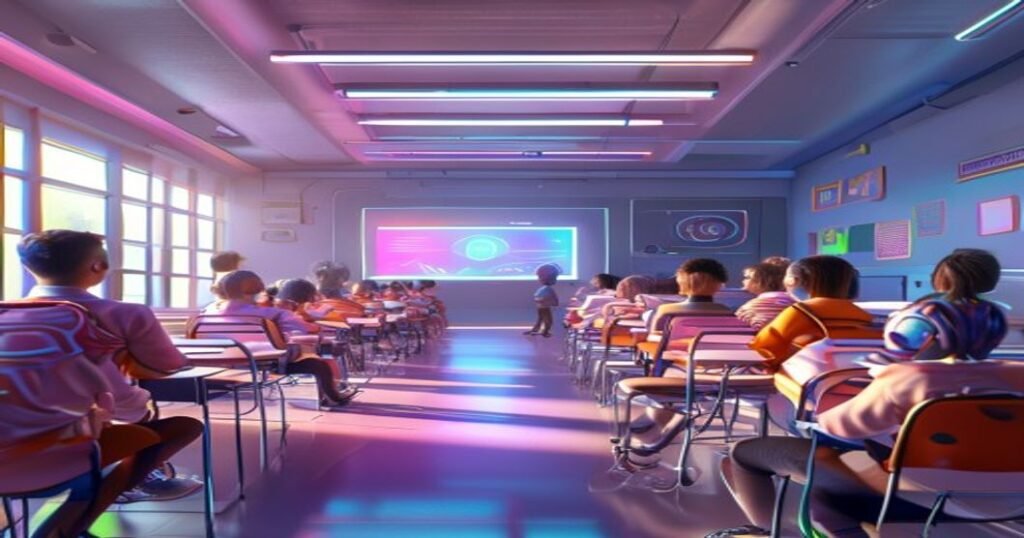

Goodbye One-Size-Fits-All: The AI-Powered Future of Education is Here, And It’s Personal
For generations, the dream of truly personalized education felt like a distant utopian fantasy. Imagine a learning experience crafted just for you, adapting to your pace, understanding your unique struggles, and nurturing your specific talents. For too long, our educational systems, while well-intentioned, have largely operated on a ‘one-size-fits-all’ model – a model that, let’s be honest, often leaves many students feeling left behind, unchallenged, or simply disengaged.
But what if I told you that this long-held dream is no longer a fantasy? What if the revolutionary force quietly transforming nearly every industry is now, decisively, turning its gaze towards our classrooms, our lecture halls, and our personal learning journeys? I’m talking, of course, about Artificial Intelligence (AI), and its impact on education is nothing short of a paradigm shift. This isn’t just about smart whiteboards or digital textbooks; this is about fundamentally reshaping how we learn, teach, and grow throughout our lives.
The End of Average: Why Personalization Matters More Than Ever
Think about it. In a traditional classroom, a teacher faces a diverse group of 20, 30, or even more students. Each one comes with their own background, their own learning style (visual, auditory, kinesthetic), their own prior knowledge, and their own unique set of strengths and weaknesses. Expecting a single lesson plan, delivered at a uniform pace, to equally serve all these individuals is, frankly, an impossible task for even the most dedicated educator. Some students grasp concepts quickly and get bored; others struggle silently, fearing to ask questions and fall further behind.
This is where AI steps in as the ultimate game-changer. Imagine an AI system that can:
- Assess your baseline knowledge with remarkable precision.
- Identify your preferred learning methods through interactions.
- Pinpoint exactly where you’re struggling and why, perhaps even predicting future difficulties.
- Curate and deliver content that is not just relevant, but perfectly tailored to your needs, in real-time.
- Offer immediate, constructive feedback that helps you course-correct before bad habits set in.
This isn’t about replacing the human element; it’s about amplifying it. It’s about empowering every learner, regardless of their starting point, to reach their full potential. Just as AI is quietly rebuilding our global future, brick by digital brick across various sectors, it’s meticulously constructing a more equitable and effective educational future for us all.
AI as Your Personal Learning Co-Pilot: More Than Just a Smart Tool
The beauty of AI in education lies in its ability to be a relentless, patient, and infinitely knowledgeable learning companion. Gone are the days of waiting for a teacher’s limited office hours to get a question answered. With AI-powered tutors and chatbots, students can receive instant explanations, detailed breakdowns of complex topics, or even practice problems generated on the fly, customized to their current level of understanding.
But it goes deeper than just answering questions. AI can analyze a student’s performance over time, detecting patterns that human observation might miss. Is a student consistently struggling with a specific type of math problem, even if they get the overall answer right? AI can identify that root cause and provide targeted interventions. Are they excelling in creative writing but hesitant in public speaking? AI can suggest resources or even virtual environments to practice. This isn’t just about improving grades; it’s about fostering a deeper, more resilient understanding.
And let’s not forget the portability of this intelligence. We’re already seeing a massive shift towards processing power moving closer to the user, with your phone getting a brain as on-device AI becomes the next big thing. Imagine your personal learning assistant, a truly intelligent agent, living right there in your pocket, accessible anytime, anywhere. This kind of omnipresent, personalized support transforms every moment into a potential learning opportunity.
Empowering Educators: Freeing Teachers to Teach
If you’re an educator, you might be reading this with a mix of excitement and perhaps a touch of apprehension. Will AI replace teachers? Absolutely not. In fact, I believe AI will do the opposite: it will liberate teachers from the most tedious, repetitive, and time-consuming aspects of their jobs, allowing them to focus on what they do best – connecting with students, inspiring creativity, fostering critical thinking, and nurturing socio-emotional development.
Consider the administrative burden: grading papers, tracking progress, creating differentiated assignments for individual needs. These are tasks that consume countless hours. AI can automate much of this, providing teachers with incredibly detailed analytics on each student’s performance and learning journey. Imagine getting real-time insights into which concepts the class as a whole is struggling with, or which specific students need extra attention, all without having to manually sift through dozens of assignments. This newfound efficiency means teachers can dedicate more time to mentorship, engaging classroom discussions, project-based learning, and addressing the unique human needs of their students.
It’s about making teachers super-teachers, equipped with data and tools that were once unimaginable. This also means their role evolves from primarily being information dispensers to becoming facilitators, coaches, and mentors – roles that are far more rewarding and impactful.
Lifelong Learning: The Imperative of Our Time
In our rapidly evolving world, the idea that education stops after a degree is utterly obsolete. The skills needed today might be irrelevant tomorrow, and continuous learning isn’t just a good idea; it’s a survival imperative. This is another area where AI is proving to be invaluable. It can help individuals identify skill gaps, recommend personalized learning paths for career advancement, and even curate micro-credentials or short courses to keep professionals relevant.
Whether you’re looking to pivot careers, upskill in your current role, or simply explore a new passion, AI can act as your personal career advisor and learning curator. It understands your existing knowledge, your goals, and the demands of the market, guiding you efficiently through the ever-expanding universe of online courses and resources. It’s no longer about simply consuming information; it’s about strategically building knowledge and expertise tailored to an ever-changing professional landscape. In essence, your phone isn’t just smart anymore; it’s becoming psychic, anticipating your learning needs and connecting you with the knowledge to thrive.
Navigating the New Frontier: Challenges and Ethical Considerations
Of course, no technological revolution comes without its challenges, and AI in education is no exception. We must address critical questions:
- Data Privacy: How do we protect sensitive student data collected by AI systems? Robust regulations and ethical guidelines are paramount.
- Algorithmic Bias: If AI is trained on biased data, it can perpetuate and even amplify inequalities. We need diverse, ethically sourced datasets and constant auditing of algorithms.
- The Digital Divide: Ensuring equitable access to AI-powered learning tools is crucial. We cannot allow technology to widen existing educational gaps.
- Over-reliance: While AI is a powerful tool, it should augment human intelligence, not replace it. Critical thinking, problem-solving, and creativity remain uniquely human skills that must be nurtured.
- Maintaining Human Connection: Education is fundamentally a human endeavor. AI should enhance, not diminish, the vital relationships between students and teachers, and among peers.
These are not insurmountable obstacles, but they require thoughtful design, continuous collaboration between technologists, educators, policymakers, and ethicists. The goal is to harness AI’s power responsibly, ensuring it serves humanity’s best interests.
The Future is Now: What to Expect
So, what does this AI-powered future of education look like in practice, right now and in the immediate horizon?
- Adaptive Learning Platforms: These are already here, adjusting content and difficulty in real-time based on student performance. Think of them as intelligent textbooks that learn alongside you.
- Intelligent Tutoring Systems: AI companions that provide one-on-one help, practice problems, and detailed explanations, often available 24/7.
- AI-Powered Content Creation: Tools that can generate quizzes, summaries, or even entire lesson plans, freeing up teacher time.
- Predictive Analytics: AI can identify students at risk of falling behind and flag them for early intervention, allowing educators to step in proactively.
- Personalized Career Guidance: AI analyzing skills, interests, and market trends to recommend personalized educational and career pathways.
This is just the tip of the iceberg. As AI continues to advance, we’ll see even more sophisticated applications, from immersive virtual reality learning environments guided by AI to hyper-personalized skill development programs for niche industries. The possibilities are truly boundless.
Conclusion: A Human-Centric Revolution
The AI revolution in education isn’t just about technology; it’s about unlocking human potential. It’s about dismantling the barriers that have prevented truly personalized learning for so long. It’s about empowering students to learn at their best, teachers to teach at their best, and individuals to adapt and thrive in an ever-changing world.
While the journey has its complexities and ethical crossroads, the promise is clear: an educational landscape that is more equitable, more engaging, more effective, and profoundly more personal than anything we’ve known before. The future of learning isn’t just smart; it’s tailor-made for you, and it’s being built brick by digital brick, right now.


