
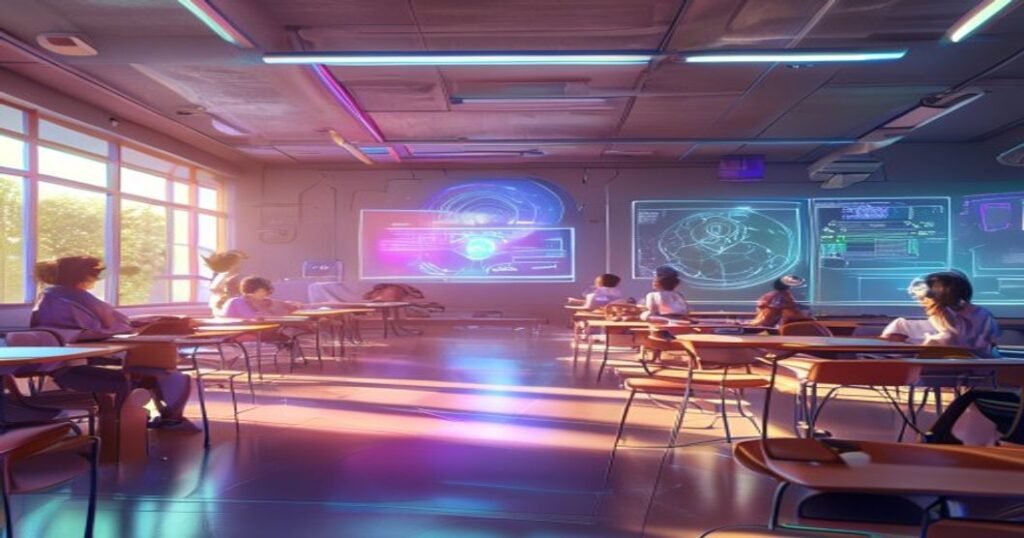

Alright, let’s talk about AI. If you’re anything like me, your feed is probably buzzing with talk of artificial intelligence transforming everything from art to self-driving cars. It’s a technological marvel, an existential threat, and the next big thing, all rolled into one. But here’s a question that keeps me up at night: what does this mean for education? Is AI merely a fancy new gadget for schools, or is it fundamentally reshaping how we learn, teach, and prepare for the future? My take? It’s a profound, complex, and utterly unavoidable shift that, if leveraged correctly, could truly unlock human potential in ways we’ve only dreamed of.
For decades, our education systems have largely operated on a one-size-fits-all model. A teacher stands at the front, delivers information, and students, with their myriad learning styles, paces, and interests, are expected to absorb it. It’s like expecting everyone to wear the same size shoe – it fits some perfectly, pinches others, and leaves many stumbling. This is where AI steps onto the stage, not as a replacement for the human touch, but as a powerful amplifier for personalized learning.
Beyond the One-Size-Fits-All Model: The Dawn of Personalized Learning
Imagine a learning environment where every student has a personal tutor, available 24/7, who understands their strengths, identifies their weaknesses, and adapts the curriculum to their individual needs in real-time. This isn’t science fiction; it’s the promise of AI in education, and it’s happening right now.
AI algorithms can analyze a student’s performance data, from quiz scores to engagement levels, to pinpoint exactly where they’re struggling or excelling. Instead of moving on with the class, a student who hasn’t quite grasped a concept can be offered supplementary materials, different explanations, or interactive exercises tailored to their specific learning gap. Conversely, advanced students can be challenged with deeper dives or complex problems, keeping them engaged and preventing boredom. This isn’t just about remedial work; it’s about optimizing the learning path for *every* individual.
Intelligent Tutoring Systems: Your 24/7 Academic Sidekick
One of the most exciting applications of AI is in intelligent tutoring systems. These platforms act like a super-smart academic sidekick, providing instant feedback on assignments, answering questions, and guiding students through complex problems step-by-step. Think about it: a student working on a math problem late at night no longer has to wait until morning to ask their teacher. The AI tutor can offer hints, explain the underlying principles, and even generate similar practice problems until mastery is achieved. This dramatically reduces the frustration that often leads to disengagement and helps build confidence.
Moreover, these systems can learn and evolve. As they interact with more students, they become better at predicting common misconceptions, identifying effective teaching strategies, and even adapting their communication style to resonate with different learners. It’s like having an infinitely patient, endlessly knowledgeable mentor by your side.
Empowering Educators: AI as a Force Multiplier, Not a Replacement
Now, some might fear that AI will sideline teachers, making their roles obsolete. I strongly disagree. Instead, I see AI as a monumental force multiplier for educators, freeing them from the drudgery of administrative tasks and allowing them to focus on what truly matters: mentorship, critical thinking, and fostering human connection.
Consider the sheer volume of grading, attendance tracking, and curriculum planning that teachers tackle daily. AI can automate many of these tasks, from instantly grading multiple-choice quizzes to flagging essays for plagiarism and even providing preliminary feedback on written assignments. This doesn’t just save time; it provides teachers with richer, more immediate data on student performance, allowing them to intervene proactively rather than reactively.
With AI handling the grunt work, teachers can spend more quality time with students, offering personalized guidance, facilitating collaborative projects, and cultivating essential soft skills like empathy, creativity, and resilience – qualities that no AI can replicate. It elevates the teacher from an information dispenser to a true guide, mentor, and inspirer.
Dynamic Content Creation and Curation: Learning That Never Sleeps
Another area where AI is making waves is in the creation and curation of educational content. Stale textbooks and static lesson plans are becoming a thing of the past. AI can help generate dynamic quizzes, interactive simulations, and adaptive learning modules that keep content fresh, engaging, and relevant. It can pull from vast repositories of information, synthesize complex topics, and even generate diverse examples to illustrate concepts in multiple ways.
Just as AI is rewriting the rules of entertainment and hooking audiences with personalized experiences, it’s also poised to redefine how we consume and interact with educational content. Imagine a history lesson that isn’t just text and images but an immersive virtual reality experience, dynamically generated by AI to explore a specific historical event from multiple perspectives. The possibilities for engaging learning are truly limitless.
Preparing for Tomorrow: Skills for an AI-Driven World
Perhaps one of the most critical aspects of AI in education is its role in preparing students for a rapidly evolving job market. The skills required for success are shifting dramatically. Rote memorization and repetitive tasks are increasingly being automated, making way for a greater emphasis on uniquely human capabilities.
We’re talking about critical thinking, complex problem-solving, creativity, collaboration, and ethical reasoning. Education needs to pivot from merely imparting facts to fostering these higher-order skills. AI, ironically, can be a tool in this transformation. By automating the basic stuff, it frees up classroom time to tackle truly challenging, interdisciplinary projects that require deep thought and collaboration. Moreover, understanding how AI works, its capabilities, and its limitations, is becoming a fundamental form of literacy. It’s not just about what jobs AI will create, but how it will reshape existing ones – a true AI earthquake for the job market. Preparing students for this future means equipping them not just to use AI, but to think critically about it and with it.
Navigating the Ethical Labyrinth: Challenges and Considerations
Of course, it would be naive to discuss the rise of AI in education without acknowledging the significant challenges and ethical considerations. This isn’t a utopian vision devoid of pitfalls. Data privacy, for instance, is paramount. Who owns the vast amounts of student data collected by AI systems, and how is it protected from misuse? We must ensure robust safeguards are in place.
Then there’s the issue of algorithmic bias. AI systems are only as unbiased as the data they’re trained on. If historical data reflects societal inequalities, AI could inadvertently perpetuate or even amplify those biases in educational recommendations, leading to an uneven playing field. Developers and educators must work hand-in-hand to audit and mitigate these biases.
The digital divide also looms large. While AI promises personalized learning for all, access to the necessary technology – reliable internet, devices, and the skills to use them – is not universal. We must proactively address this to ensure AI doesn’t exacerbate existing educational inequities.
The Indispensable Role of the Human Educator
Finally, there’s the danger of over-reliance. While AI can deliver facts and exercises, it cannot instill empathy, inspire passion, or foster the nuanced social-emotional development that human interaction provides. The warmth of a teacher’s encouragement, the subtle dynamics of a group discussion, the ethical dilemmas that only a human can truly guide students through – these elements are irreplaceable. Teachers will evolve from content deliverers to orchestrators of learning experiences, leveraging AI to enhance, not replace, their invaluable human touch. This isn’t a phenomenon we can simply observe; it’s a tsunami of change that reshapes everything from digital marketing to our very perception of intelligence. Ignoring its implications for education would be a grave mistake.
The Future is Now: Embracing the AI-Powered Classroom
The question isn’t whether AI will impact education; it’s how effectively we choose to integrate it. The AI-powered classroom is not a distant dream; it’s a rapidly unfolding reality. Educational institutions, policymakers, educators, and even students need to embrace this shift with open minds, critical thinking, and a commitment to ethical implementation.
This means investing in infrastructure, providing continuous professional development for teachers to master AI tools, and designing curricula that prepare students not just for current jobs, but for roles that don’t even exist yet. It means fostering an environment where experimentation is encouraged and where the focus remains steadfastly on the learner.
In conclusion, AI in education is far more than a hype machine; it’s a transformative force that, when wielded thoughtfully and ethically, promises to revolutionize learning. It offers the unprecedented opportunity to personalize education on a massive scale, empower educators to focus on what truly matters, and equip future generations with the skills needed to thrive in a world increasingly shaped by intelligent machines. The journey ahead is complex, but the destination – a more equitable, engaging, and effective learning experience for every student – is a future worth building, now.


