
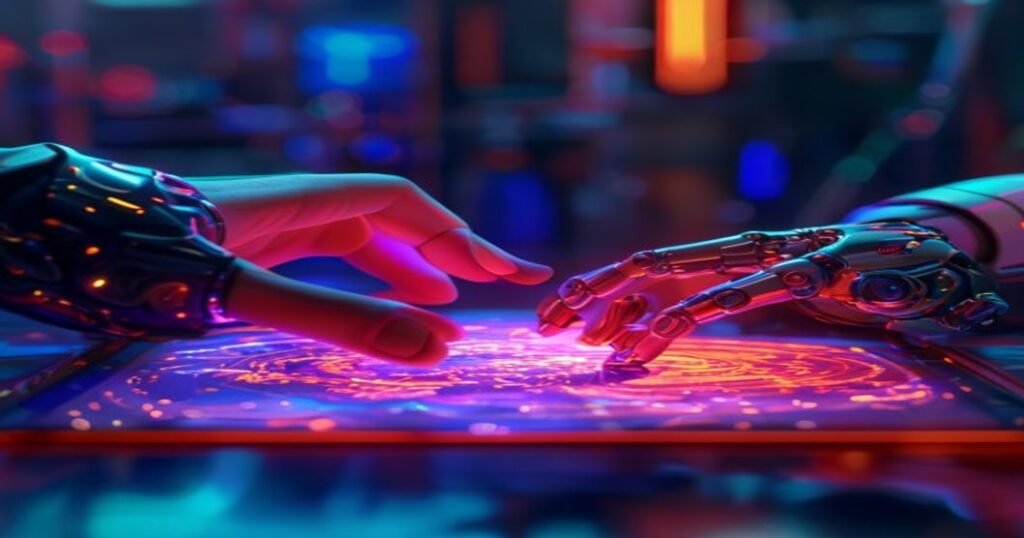

The AI Creative Revolution: Is Your Imagination About to Be Supercharged or Suppressed?
Remember those sci-fi movies where robots took over the world? Well, the robots are here, but they’re not wielding laser guns – they’re wielding paintbrushes, typewriters, and musical instruments. We’re living through an unprecedented era where Artificial Intelligence isn’t just crunching numbers or optimizing logistics; it’s actively stepping into the realm of creativity, traditionally considered the exclusive domain of humanity. From generating breathtaking art to composing intricate musical pieces, AI’s presence in creative industries is no longer a distant whisper but a booming reality. And honestly, it’s got many of us – myself included – scratching our heads, wondering: Is AI an artistic ally, a powerful tool to amplify our human potential, or a looming threat ready to eclipse our unique imaginative spark?
It’s a question that permeates every creative field, from visual arts to literature, from music production to film-making. The sheer speed at which AI capabilities are advancing is dizzying, leaving many to feel a mix of awe, excitement, and more than a little apprehension. Let’s dive deep into this fascinating, sometimes unsettling, intersection of silicon and soul, exploring how AI is reshaping our creative landscape right now.
The Generative AI Tsunami: A New Era of Creation
Let’s be clear: we’re not just talking about predictive text or smart filters that make your selfies look better. We’re talking about generative AI – algorithms capable of creating entirely new, original content from simple prompts. This isn’t just mimicking; it’s generating. Think about it: a machine that can write a compelling news article, design a unique logo, or even script a short film, complete with character dialogue and scene descriptions, all from a few descriptive sentences. It’s a paradigm shift, folks. What started as novel experiments in labs has quickly matured into sophisticated tools that are democratizing creation, accelerating workflows, and fundamentally challenging our understanding of authorship and artistic process.
The impact of this technology is nothing short of revolutionary. It’s not just about what AI can do on its own, but how it integrates with and changes human workflows. This powerful wave is truly transforming everything from marketing content to academic research. In fact, if you want a deeper dive into how this powerful wave is truly transforming the foundations of our modern world, I highly recommend checking out our discussion on The Generative AI Revolution: Reshaping Our World, One Prompt at a Time. It’s truly a global phenomenon that touches far more than just the arts.
AI as a Creative Partner: Amplifying Human Potential
For many, the initial reaction to AI in creative fields is fear. ‘Will it take my job? Will art lose its soul?’ These are undeniably valid questions, and we’ll tackle them head-on shortly. But first, let’s consider the undeniable upside. Imagine a writer battling writer’s block, who suddenly has an AI assistant capable of suggesting plot twists, character backstories, or even different narrative styles to break through the impasse. Or a graphic designer needing endless variations of an icon or a texture, generated in seconds instead of hours of tedious manual labor.
In these scenarios, AI isn’t necessarily replacing the artist; it’s often acting as an incredibly powerful co-pilot, a tireless assistant that handles the mundane, repetitive, or technically complex tasks, freeing up human creators to focus on the truly innovative, conceptual, and emotionally resonant aspects of their work. This augmentation allows artists to experiment faster, iterate more, and push the boundaries of their creativity in ways that were previously resource-prohibitive. It democratizes access to sophisticated creative tools, allowing more people to bring their visions to life.
The Storyteller’s New Toolkit: Crafting Narratives with a Digital Pen
The field of storytelling, in particular, is experiencing a seismic shift. Human beings have been telling stories since the dawn of time – it’s how we make sense of the world, how we pass down wisdom, and how we connect across generations. Now, AI is injecting itself into this fundamental human act, not just as a tool to draft outlines but to genuinely craft narratives. From personalized stories in interactive games to dynamic content generation for marketing campaigns, AI is becoming a silent co-author in countless narratives. It can analyze vast datasets of existing stories to understand plot structures, character archetypes, and emotional arcs, then apply that knowledge to generate new tales.
This evolution is particularly profound as AI allows for unparalleled personalization and scale in narrative creation. Imagine a child’s bedtime story that adapts to their name, their favorite animal, and their unique interests in real-time. Or an advertising campaign that generates thousands of slightly varied narratives, each tailored to a specific demographic segment based on their online behavior. If you’re curious about the mechanics and implications of this new era of narrative construction, you absolutely must read our deep dive into Rewriting Reality: How AI is Crafting the Future of Every Story You’ll Ever Love. It really illustrates how fundamental this shift is to the very fabric of how we consume and create stories.
From Pixels to Personalities: AI’s Impact on Entertainment
And it’s not just the core storytelling process that’s evolving. The entire entertainment landscape is being redefined by AI. Think about how video games are becoming more adaptive and immersive, how visual effects are becoming more stunning and accessible, or how music generation is evolving beyond simple loops into complex compositions. AI is enabling game developers to create more intricate and responsive worlds, allowing non-player characters (NPCs) to exhibit more dynamic and believable personalities that adapt to player choices, and even composing adaptive soundtracks that respond to in-game action, intensifying or calming based on the situation.
In film, AI is being used for everything from pre-visualization and script analysis to de-aging actors and generating hyper-realistic CGI elements with unprecedented speed and cost-efficiency. In music, AI can generate new melodies, harmonies, and even entire tracks in various styles, serving as a powerful assistant for composers and producers looking for inspiration or specific sonic textures. This level of personalized and dynamic entertainment was once pure fantasy. It’s an incredibly exciting time, and for a comprehensive look at how these innovations are playing out across various media, from film to music to gaming, our article on From Pixels to Personalities: How AI is Orchestrating the Future of Entertainment provides an incredible overview of this unfolding revolution.
The Ethical & Existential Questions: Where Do Humans Fit?
However, with great power comes great responsibility – and some serious questions. As AI generates increasingly sophisticated and ‘original’ works, what constitutes ‘originality’ when a machine is involved? How do we attribute authorship, and what about copyright? These aren’t just academic debates; they have profound implications for artists’ livelihoods, their intellectual property, and the very concept of artistic ownership.
Then there’s the ‘soul’ question. Can AI truly feel? Can it imbue its creations with the raw emotion, personal experience, and human vulnerability that often define the greatest art? My honest opinion? Not yet. AI can simulate emotion, it can learn patterns of human expression from vast datasets, but the lived experience, the unique perspective born from joy, sorrow, love, and struggle that fuels profound art is, for now, uniquely human. The challenge isn’t to make AI feel, but to ensure human creators continue to feel deeply, and to express those feelings in a world increasingly augmented by machines, ensuring the human touch remains invaluable.
Beyond the Creative Niche: A Societal Metamorphosis
It’s crucial to remember that this creative upheaval isn’t happening in a vacuum. AI’s influence extends far beyond the studios, galleries, and writing rooms. Its silent, pervasive reshaping of industries, economies, and even our daily interactions is a testament to its profound impact on nearly every sector. From accelerating healthcare diagnostics to optimizing urban planning, from climate modeling to enhancing financial analysis, AI is steadily integrating into the very fabric of our global society. The creative sector, with its highly visible and often emotionally charged output, is merely one compelling front in a much larger, global transformation. For a truly eye-opening perspective on this extensive integration and how AI is fundamentally altering the foundations of our world, often behind the scenes, I urge you to explore Beyond the Code: How AI is Silently Reshaping Every Corner of Our Global Society. It puts the creative revolution into a much broader, and frankly, more awe-inspiring context, demonstrating just how deeply AI is woven into our collective future.
The Future: Human Creativity Amplified, Not Replaced
So, where does this leave us, the human creators, the dreamers, the storytellers? My take is this: the future of creativity isn’t a battle between human and machine, but a powerful partnership. AI will increasingly take over many of the mundane, the repetitive, and the technically complex tasks, acting as an unparalleled assistant. This liberation will free us to explore bolder ideas, experiment with new forms, and focus intensely on the uniquely human aspects of creation: empathy, personal narrative, intentional bias (the good kind!), and the sheer, unpredictable joy of true, novel innovation.
The value of human-generated content, imbued with authentic experience and raw emotion, might actually increase in an AI-saturated world. It will become a mark of quality, a testament to genuine human connection, and a beacon of original thought in a sea of algorithms. The artists who thrive will be those who master the tools, understand their limitations, and leverage AI to magnify their distinctly human vision, rather than being overshadowed by it.
Conclusion: Embrace the Tools, Nurture the Soul
We are standing at the precipice of a new creative renaissance, powered by algorithms yet still anchored by human ingenuity. The tools are evolving at warp speed, changing what’s possible and challenging our definitions. But the fundamental impulse to create, to tell stories, to make sense of our existence through art – that remains immutable. The AI creative revolution isn’t about replacing the spark of human imagination; it’s about fanning the flames, challenging us to reach new heights, and perhaps, forcing us to redefine what it truly means to be a creator in an increasingly intelligent world.
Embrace the tools, understand the implications, and never stop nurturing that uniquely human fire within. The best art, I believe, will always be born from the heart, guided by the mind, and now, perhaps, amplified by the machine. The canvas is bigger, the palette is richer, and the stories we can tell are more diverse than ever before. It’s an exciting, slightly terrifying, but ultimately exhilarating time to be a creator.


