
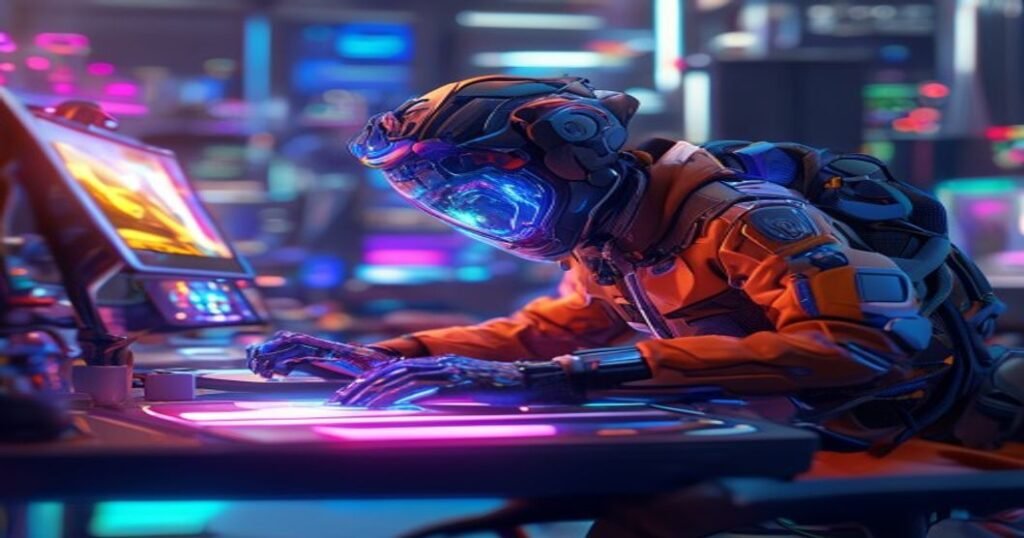

The Infinite Canvas: How Generative AI is Unleashing a Tidal Wave of Creativity and Redefining Reality
Alright, let’s get real for a moment. If you’ve been anywhere near the internet, or frankly, any conversation about technology lately, you’ve heard the buzz: Generative AI. It’s not just a fancy new phrase; it’s a seismic shift, a revolution unfolding right before our eyes. And if you ask me, it’s one of the most thrilling, terrifying, and utterly transformative forces we’ve encountered in the digital age.
Remember when AI felt like something out of a sci-fi movie? Something that could recognize faces, recommend movies, or beat chess grandmasters? That was yesterday. Today, we’re talking about AI that creates. AI that writes compelling articles, composes original music, designs breathtaking art, generates realistic images, and even crafts functional code. This isn’t just about processing information; it’s about imagining, inventing, and innovating with a speed and scale that’s frankly mind-boggling.
It’s an Invisible Revolution: How AI is Quietly Reshaping Our World, One Smart Device at a Time, but with generative AI, it’s anything but quiet. It’s loud, vibrant, and bursting with new possibilities. And if you’re not paying attention, you’re missing the biggest creative and industrial upheaval of our time.
What Exactly is Generative AI? Understanding the Magic Behind the Curtain
At its core, Generative AI refers to a category of artificial intelligence models that can produce novel content. Unlike traditional AI that might analyze or classify existing data, generative models learn patterns, structures, and styles from vast datasets and then use that understanding to generate entirely new, original outputs. Think of it like this: instead of just identifying a cat in a picture, a generative AI can draw a new cat, in any style you describe, that has never existed before.
The secret sauce often involves complex neural network architectures, like Generative Adversarial Networks (GANs) or Large Language Models (LLMs). These models train on unimaginable amounts of data – text, images, audio, video – absorbing the nuances of human expression and creativity. Once trained, they don’t just regurgitate what they’ve seen; they synthesize, combine, and extrapolate to produce fresh content that often blurs the line between human and machine creation.
Beyond the Hype: Real-World Applications That Will Blow Your Mind
The true power of generative AI isn’t just in its ability to create cool pictures of dogs in space. Its impact is reaching into virtually every industry, fundamentally altering how we work, learn, and interact with the world.
1. Content Creation & Storytelling Transformed
- Text Generation: From marketing copy and blog posts to screenplays and even entire novels, generative AI can produce human-like text at scale. Imagine a content creator using AI to brainstorm ideas, draft outlines, or even write first versions of articles, freeing up their time for deeper research and refinement.
- Image & Video Creation: Gone are the days of needing expensive studios for basic visuals. AI can conjure photorealistic images from text prompts, generate stunning artwork, or even create entire video sequences. This is a game-changer for advertising, media, and design, democratizing access to high-quality visual content.
- Music & Sound: Composers are now leveraging AI to generate melodies, harmonies, and even full orchestral pieces. From background scores for games to personalized therapeutic soundscapes, the possibilities are limitless.
2. Supercharging Software Development
Developers, rejoice! Generative AI is becoming an invaluable co-pilot. It can:
- Generate Code: Write functions, complete code snippets, or even generate entire applications from natural language descriptions.
- Debug & Optimize: Identify errors and suggest fixes, or propose more efficient ways to structure code.
- Accelerate Prototyping: Rapidly build out UI elements or backend logic, dramatically speeding up development cycles.
This isn’t about replacing developers; it’s about empowering them to build faster, smarter, and with fewer mundane tasks bogging them down.
3. Innovation in Science & Research
This is where things get truly exciting for humanity. Generative AI is a powerful engine for discovery:
- Drug Discovery: AI can design novel molecular structures with specific properties, potentially accelerating the development of new medicines. Instead of trial-and-error in labs, AI can simulate and generate millions of potential compounds.
- Materials Science: Researchers are using AI to design new materials with unprecedented strength, conductivity, or other desired characteristics.
- Personalized Medicine: Imagine AI generating highly personalized treatment plans or even designing custom prosthetics. Indeed, The Algorithmic Doctor: How AI is Rewriting the Future of Personalized Health and Longevity for Everyone, and generative AI is a key part of that rewrite.
4. Redefining Design & Engineering
From architectural blueprints to industrial components, generative design is optimizing for efficiency, aesthetics, and functionality. Engineers can input desired parameters, and AI can generate thousands of optimal designs, often leading to structures and forms humans might never have conceived. This could even extend to complex systems like smart city planning or optimizing traffic flow, creating more harmonious and efficient environments.
5. Your Pocket Supercomputer: On-Device Generative AI
It’s not just happening in the cloud. The processing power in our hands is growing exponentially. Your Pocket Supercomputer: How On-Device AI is Revolutionizing Smartphones and Our Lives Forever, and generative AI is at the forefront of this evolution. Imagine your smartphone instantly generating personalized sticker packs from your doodles, creating unique ringtones, or even editing your photos and videos with incredible detail, all without sending data to a remote server. This brings faster, more private, and more accessible generative capabilities to billions.
The Human Element: Opportunity and the Unavoidable ‘AI Tsunami’
Now, let’s talk about the elephant in the room. What about jobs? Will AI take over everything? My opinion? Not quite, but it will fundamentally change everything. We’re in the midst of The AI Tsunami: How to Ride the Wave and Thrive in the Future of Work (Instead of Drowning!), and generative AI is a major contributor to this wave.
History teaches us that new technologies often create more jobs than they destroy, albeit different ones. Generative AI won’t replace human creativity; it will augment it. It will automate the mundane, the repetitive, and the process-heavy aspects of creative and intellectual work, freeing humans to focus on higher-level strategic thinking, emotional intelligence, critical judgment, and original ideation – the very things AI currently struggles with.
This demands a shift in skills. The future workforce needs to be adept at ‘prompt engineering’ – the art of effectively communicating with AI to get desired outputs. We’ll need critical thinkers who can discern AI-generated content from reality, and ethical leaders who can guide the responsible deployment of these powerful tools. It’s not about competing with AI; it’s about collaborating with it.
Ethical Considerations & The Road Ahead
Of course, with great power comes great responsibility. Generative AI introduces significant ethical challenges:
- Misinformation and Deepfakes: The ability to generate highly realistic but fabricated content poses serious risks for truth and trust.
- Copyright and Ownership: Who owns AI-generated art? What if AI trains on copyrighted material? These are legal minefields we’re just beginning to navigate.
- Bias Amplification: If AI is trained on biased data, it will perpetuate and even amplify those biases in its outputs. Ensuring fairness and inclusivity is paramount.
- Job Displacement: While new jobs will emerge, significant reskilling and upskilling efforts are necessary to support those whose roles are directly impacted.
Addressing these issues isn’t an afterthought; it must be central to the development and deployment of generative AI. We need robust regulatory frameworks, transparent AI models, and public education to navigate this complex landscape responsibly.
The Infinite Possibilities Are Just Beginning
Generative AI isn’t just a technological marvel; it’s a mirror reflecting our own human ingenuity back at us, amplified a thousandfold. It’s challenging our definitions of creativity, authorship, and even reality itself. We are standing at the precipice of an era where machines are not just tools, but collaborators in the act of creation.
For individuals, this means unprecedented opportunities to create, innovate, and express themselves. For businesses, it means unlocking new efficiencies, personalized customer experiences, and entirely new product categories. And for society, it promises advancements in science, medicine, and art that were once unimaginable.
The canvas is infinite, and the possibilities are just beginning to unfold. Are you ready to pick up your digital brush and paint the future with generative AI?


