
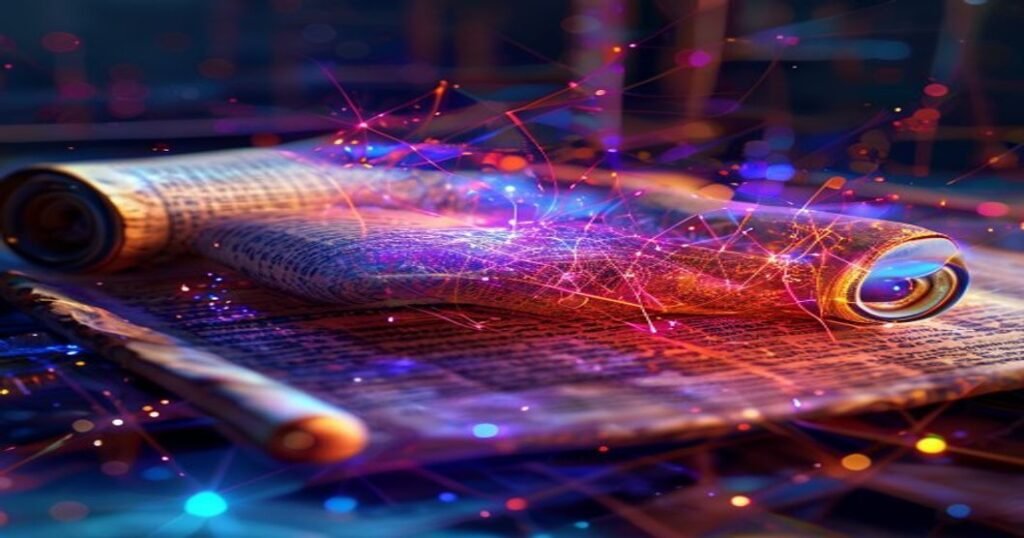

The Echoes of Tomorrow: How AI is Unearthing, Rewriting, and Shaping the Story of Our Past
We often think of history as a neatly bound book, its pages filled with facts etched in stone. But what if those pages are incomplete? What if entire chapters are missing, distorted, or simply waiting for a new kind of reader to interpret them? For too long, our understanding of the past has been filtered through the lenses of the victorious, the literate, and the privileged. It’s a grand narrative, no doubt, but one riddled with gaps, assumptions, and sometimes, outright biases. This isn’t a criticism of historians; it’s a recognition of the inherent limitations of human perspective and the often-scant evidence left behind by time. But what if a new, incredibly powerful, and utterly tireless ‘historian’ has entered the scene? What if Artificial Intelligence isn’t just about shaping our future, but fundamentally redefining our past?
Let me tell you, the ground beneath the feet of traditional historical research is shifting, and it’s being moved by algorithms. We’re not talking about simply digitizing old texts; we’re talking about AI actively participating in the act of discovery, interpretation, and even reconstruction. It’s a seismic shift that, frankly, excites me to no end, while also urging caution. This isn’t just news; it’s a historical event in the making.
The Allure of the Unseen Past: Why History Needs a Digital Helping Hand
For centuries, the historian’s toolkit consisted of dusty archives, brittle manuscripts, archaeological digs, and oral traditions. Each source, invaluable as it is, comes with its own set of challenges. Documents are often incomplete, biased by their authors, or simply lost to fire, flood, or neglect. Archaeological sites offer tantalizing glimpses but rarely a full picture. Oral histories fade or transform over generations. The sheer volume of potentially relevant information, scattered across continents and buried under layers of time, is simply beyond human capacity to process entirely.
Think about it: how many forgotten languages hold secrets yet to be deciphered? How many millions of uncatalogued documents sit in forgotten corners of the world’s libraries? How many ancient settlements lie undetected beneath dense vegetation or remote deserts? It’s a vast, dark ocean of untapped knowledge, and for a long time, we’ve only been able to skim its surface with the tools we had.
AI as the Ultimate Digital Archaeologist and Chronicler
This is where AI steps in, not as a replacement for human historians, but as an indispensable partner, an augmentative force. Imagine an entity capable of sifting through petabytes of data in a fraction of the time it would take a human researcher. We’re talking about scanning millions of medieval texts for subtle linguistic shifts, cross-referencing ancient trade routes with modern climate data, or even identifying previously unknown settlements from satellite imagery. AI’s ability to recognize patterns, anomalies, and connections across disparate datasets is simply breathtaking.
Projects are already underway where AI is being used to reconstruct fragmented ancient texts, piece together shattered pottery, and even translate previously undecipherable scripts. It’s like having an army of tireless digital archaeologists working around the clock. The potential to unearth marginalized voices, to understand the lives of common people rather than just kings and queens, becomes a tangible reality. It’s truly a testament to how The Invisible Hand: How AI is Quietly Remaking Our World, One Smart Interaction at a Time, extending its reach even into the profound depths of our collective past.
The Infinite Canvas: Generative AI and the ‘What Ifs’ of History
But AI’s role isn’t limited to mere data analysis. Generative AI, the branch of AI that can create new content, is opening up entirely new avenues for historical exploration. Imagine feeding an AI every known detail about a lost ancient city – its architecture, its culture, its daily life – and having it generate a vivid, interactive 3D reconstruction. This isn’t just about pretty pictures; it’s about creating immersive experiences that allow us to ‘walk through’ history, to understand spatial relationships and the feeling of a place in a way no static map or text could convey.
Moreover, generative AI is pushing the boundaries of historical ‘what ifs.’ Historians have always pondered counterfactuals – what if Rome hadn’t fallen? What if a key battle had a different outcome? Now, with advanced simulation capabilities, AI can construct plausible alternative scenarios based on vast historical data, allowing us to explore the branching paths of history with unprecedented rigor. It’s akin to exploring an Infinite Canvas: How Generative AI is Unleashing a New Era of Creativity and Innovation, not just for art or music, but for understanding the very fabric of time. This ability to simulate, to ‘play through’ history, feels like a new frontier. It makes you wonder: Game Over for Predictability? How AI is Rewriting the Rules of Play and Crafting Unforgettable Worlds, even when those ‘worlds’ are historical realities.
The Peril of Algorithmic Bias: Who Controls the Narrative?
Yet, for all its potential, AI is not a magic bullet, nor is it inherently neutral. This is where my cautious side takes over. AI systems are trained on data – and that data, collected and curated by humans over centuries, is steeped in biases. Historical records often reflect the perspectives of dominant groups, overlooking women, minorities, and marginalized communities. If we feed this biased data into an AI without critical awareness, we risk not only perpetuating these biases but amplifying them, legitimizing flawed narratives with the veneer of algorithmic objectivity.
The danger is real: an AI could inadvertently ‘erase’ certain histories by finding no data on them, or worse, generate interpretations that reinforce harmful stereotypes. We must be incredibly vigilant about the datasets we use, the algorithms we develop, and the human oversight that remains absolutely critical. The ultimate responsibility for ethical historical interpretation still rests squarely on our shoulders. AI is a tool, a powerful one, but a tool nonetheless.
A Glimpse into Tomorrow’s Archives: How AI Shapes the Future of History
Looking ahead, AI isn’t just revising our past; it’s actively shaping the way our present moments will be recorded and understood as future history. From automated news archives to sophisticated data analytics of societal trends, the very fabric of our contemporary information is increasingly processed and organized by AI. This means the ‘raw material’ for future historians will be fundamentally different, more vast, and more complex than anything we’ve seen before.
The global race to develop advanced AI technologies also plays a crucial role here. Nations investing heavily in AI will likely have a disproportionate influence on the tools and frameworks used to interpret both their own histories and global events. Consider regions like Pakistan, which is making significant strides in its technological landscape. Understanding how countries like this contribute to and utilize AI will be crucial for a truly global, inclusive historical narrative. It truly makes you ponder the implications when we consider the advancements described in pieces like Silicon Sind or Algorithm Alley? Pakistan’s Unstoppable March Towards an AI-Powered Future!. The way we develop and deploy AI today will directly impact how our children, and their children, understand the world we live in now.
The Ongoing Human Story
Ultimately, AI offers an unprecedented opportunity to enrich our understanding of history, to fill in the blanks, challenge old assumptions, and bring forgotten stories to light. It’s a journey into the past, guided by the cutting edge of the future. But this journey demands constant human engagement, critical thinking, and an unwavering commitment to accuracy and ethical representation. The story of humanity, in all its messy, complex, and beautiful glory, is far too important to leave entirely to algorithms.
We are living through a unique moment where the tools of tomorrow are literally redefining yesterday. It’s a fascinating, sometimes unnerving, but ultimately exhilarating prospect. As content creators and chroniclers of our time, we must embrace this technological wave, not as a threat, but as an opportunity to build a more complete, more nuanced, and ultimately, more truthful narrative of our shared human experience.


