
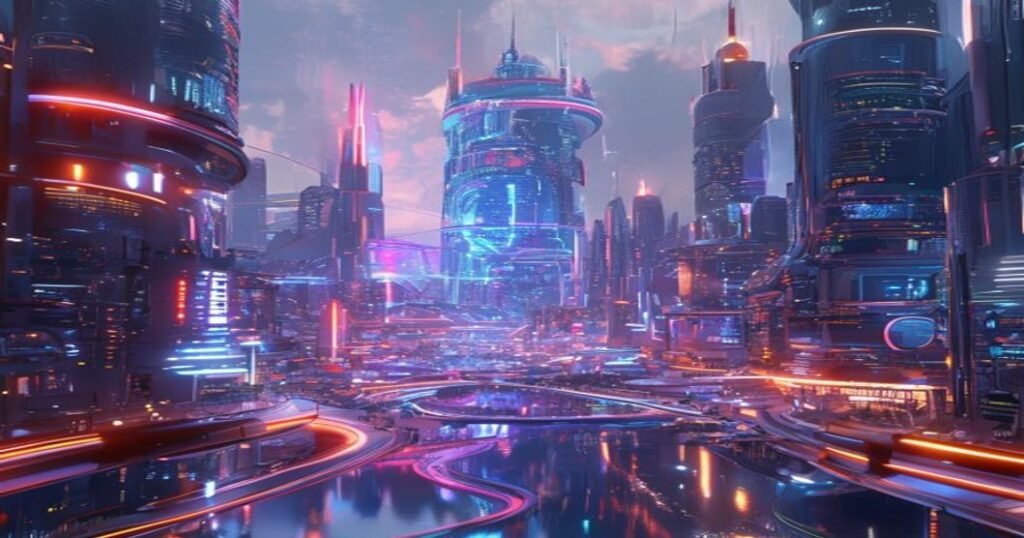

The AI Acceleration: Are We Ready for the Machine That Thinks (and Creates) Like Us?
Alright, let’s be brutally honest for a moment. If you’re not feeling a slight tremor of excitement – or perhaps a dash of existential dread – when you hear ‘Artificial Intelligence’ these days, you’ve probably been living under a rock. And honestly, even the rocks might be getting AI-generated weather reports soon! What we’re witnessing now isn’t just another tech trend; it’s a seismic shift, a redefinition of what ‘smart’ even means. We’re not talking about robots serving coffee (though they do that too!), but about machines that can write poetry, compose symphonies, design architecture, and even hold conversations that blur the lines between silicon and soul. This isn’t just an invisible revolution; it’s a very visible, very loud declaration that the future is here, and it’s powered by algorithms.
The Generative AI Tsunami: From Code to Creativity
Remember when AI was mostly about crunching numbers, optimizing logistics, or recommending your next Netflix binge? Simple stuff, right? Well, buckle up, because generative AI has smashed through those limitations with the force of a digital tsunami. Suddenly, we have Large Language Models (LLMs) that can draft entire articles, summarise complex reports, or even brainstorm marketing campaigns with startling coherence and creativity. Image generators are conjuring photorealistic scenes or fantastical art from a few text prompts. Video AI is creating entire shorts, music AI is composing soundtracks, and 3D AI is building virtual worlds.
It’s mind-boggling, even for us tech enthusiasts who’ve been tracking this space for years. What used to take teams of designers, writers, and artists weeks or months can now be prototyped in minutes. This isn’t just efficiency; it’s a fundamental change in the creative process, a democratisation of tools that were once exclusive to the highly skilled. And yes, it’s also a little terrifying for those of us who make a living by putting words on a page or pixels on a screen. But more on that later.
Beyond the Hype: Where AI is Actually Making Waves
Let’s ground this in reality, because while the flashy creative applications grab headlines, AI’s true power is permeating every facet of our lives, often without us even realizing it:
- Healthcare: AI is accelerating drug discovery, personalizing treatment plans, and even helping diagnose diseases earlier than human eyes might catch. Imagine a world where life-saving breakthroughs happen at warp speed – that’s AI’s promise.
- Business & Finance: From hyper-personalizing customer experiences to detecting sophisticated fraud and optimizing supply chains, AI is becoming the invisible backbone of modern commerce. It’s about making smarter decisions, faster.
- Education: AI-powered tutors are adapting learning experiences to individual students, identifying knowledge gaps, and making education more accessible and engaging.
- Science & Research: Complex simulations, materials science, climate modeling – AI is tackling problems of scale and complexity that were previously beyond human computational power, pushing the boundaries of what we can understand about our universe.
- Personal Productivity: Think smart assistants that genuinely anticipate your needs, email managers that sort your inbox like a seasoned PA, or tools that help you focus by filtering out digital noise.
The list goes on, and it’s expanding daily. AI isn’t just automating tasks; it’s augmenting human capabilities, allowing us to focus on higher-level thinking, creativity, and empathy. Or at least, that’s the hopeful narrative.
The Human Equation: Anxious Minds, Evolving Roles
Now, let’s address the elephant in the digital room: jobs. The whispers, and sometimes outright shouts, about AI taking over jobs are impossible to ignore. Will writers be replaced by LLMs? Will graphic designers be rendered obsolete by image generators? It’s a valid concern, and one that requires a nuanced perspective.
My take? The nature of work is changing, not disappearing. History has shown us that technological revolutions displace some jobs while creating entirely new ones. The industrial revolution didn’t eliminate work; it redefined it. The internet didn’t eliminate jobs; it birthed entire industries. AI is doing the same. It’s automating repetitive, mundane, or even complex analytical tasks, freeing up human potential for roles that demand creativity, critical thinking, emotional intelligence, and interpersonal skills – things AI is still notoriously bad at (and likely will be for a long time).
This is precisely why we’re seeing the great career reshuffle unfold before our eyes. The demand isn’t just for AI engineers; it’s for ‘prompt engineers,’ AI ethicists, human-AI interface designers, data custodians, and creatives who can leverage AI tools to amplify their own output. The key isn’t to compete with AI, but to collaborate with it, to master the art of prompt crafting, to understand its limitations, and to apply our uniquely human judgment and creativity to its output. Lifelong learning isn’t just a buzzword anymore; it’s a survival strategy.
Navigating the Ethical Minefield and Digital Overload
Of course, this dazzling progress comes with its own set of critical questions and thorny ethical dilemmas:
- Bias: AI models learn from data, and if that data is biased (as much human-generated data is), the AI will perpetuate and even amplify those biases. How do we build equitable AI?
- Misinformation: Deepfakes, AI-generated fake news, and propaganda are becoming incredibly sophisticated. Distinguishing truth from fiction is harder than ever.
- Control & Autonomy: As AI systems become more powerful and autonomous, how do we ensure they align with human values and goals? Who is accountable when an AI makes a mistake?
- Data Privacy: The fuel for AI is data, and vast amounts of it. Protecting individual privacy in an AI-driven world is a monumental challenge.
- Digital Well-being: As AI makes our digital interactions even more personalized and potentially addictive, the importance of maintaining digital well-being becomes paramount. How do we use these powerful tools without letting them consume us?
These aren’t just technical problems; they are societal, philosophical, and deeply human. We cannot afford to outsource our critical thinking to algorithms. We must remain vigilant, engage in public discourse, and demand ethical development and deployment of these technologies. The onus is on all of us – developers, policymakers, educators, and everyday users – to shape an AI-powered future that benefits humanity, not just profits.
The Road Ahead: Embrace, Adapt, Innovate
So, where does that leave us? On the cusp of an era unlike any before. The AI acceleration is real, it’s happening now, and it’s irreversible. It’s a double-edged sword, offering unprecedented opportunities for progress, creativity, and problem-solving, alongside significant challenges to our economic, social, and ethical frameworks.
My advice? Don’t bury your head in the sand. Engage with AI. Experiment with the tools. Understand its capabilities and its limitations. Focus on developing those uniquely human skills – critical thinking, creativity, emotional intelligence, complex problem-solving, and adaptability – that will allow you to thrive in a world where machines handle more and more of the heavy lifting.
The future isn’t about humans vs. machines; it’s about humans with machines. It’s about harnessing this incredible power to build a better, more intelligent, and perhaps, more human future. It’s a thrilling, terrifying, and utterly compelling journey, and we’ve only just begun.


