
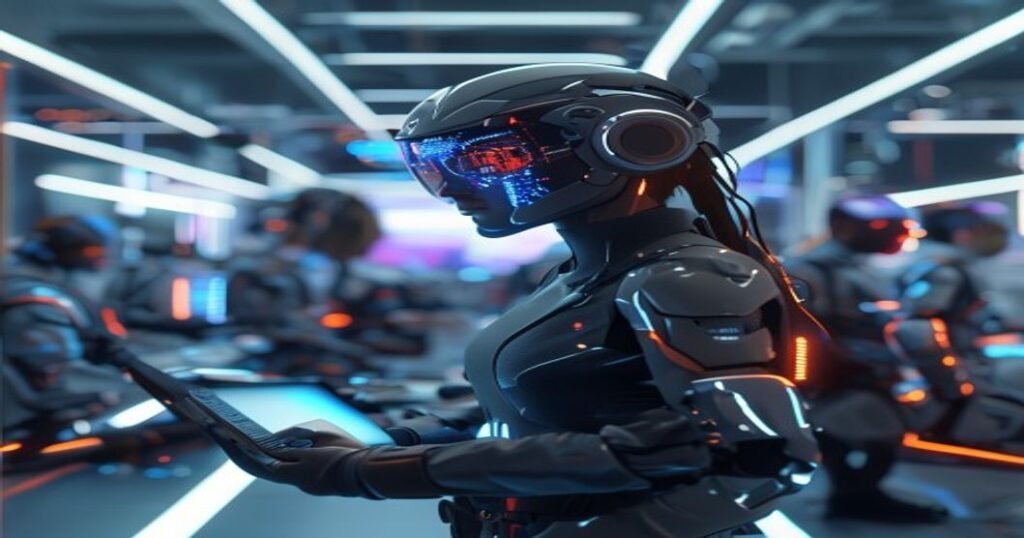

Welcome to 2026. The world of work, as we knew it just a few years ago, is undergoing a profound and irreversible transformation. Fueled by the relentless march of Artificial Intelligence (AI) and the immersive emergence of the Metaverse, the global job market is not merely evolving; it’s experiencing a ‘Great Reshuffle’. This isn’t just about new tools or platforms; it’s about a fundamental redefinition of roles, skills, and the very nature of employment. For individuals, businesses, and governments, understanding and adapting to these tectonic shifts is not optional – it’s crucial for survival and prosperity.
The Dawn of the Automated Workforce: AI’s Impact on Jobs
Artificial Intelligence, once a concept confined to science fiction, is now an omnipresent force in our professional lives. By 2026, AI algorithms are seamlessly integrating into virtually every industry, automating routine, repetitive, and data-intensive tasks with unprecedented efficiency. From customer service chatbots handling complex queries to AI-powered diagnostics in healthcare, and automated financial analysis, the breadth of AI’s reach is staggering. This isn’t just about machines replacing humans; it’s about a paradigm shift where human-AI collaboration becomes the norm.
While concerns about job displacement are valid, the reality is more nuanced. AI is not eliminating work; it’s changing it. Tasks that once required human input are now handled by algorithms, freeing up human workers to focus on higher-level, more creative, and strategic functions. This transition demands a significant pivot in workforce capabilities. As we explored in The Great Automation Shift: How AI & the Hyper-Real Metaverse Are Reshaping Global Labor & Society by 2026, the emphasis is shifting from ‘doing’ to ‘thinking,’ ‘designing,’ and ‘innovating.’ The ability to work *with* AI, rather than against it, is now a foundational skill.
New Roles Emerge: The AI-Centric Professional
The rise of AI has directly led to the creation of entirely new job categories that were unimaginable a decade ago. Roles like ‘AI Prompt Engineer’ – individuals skilled in crafting precise instructions for generative AI models – are now highly sought after. We also see an increased demand for ‘AI Ethicists’ who ensure AI systems are developed and deployed responsibly, and ‘AI Trainers’ who fine-tune machine learning models with human oversight. Data Scientists and Machine Learning Engineers remain critical, but their focus has broadened to include ethical considerations and interpretability of complex AI outputs. Businesses are investing heavily in these areas, as highlighted in The Great AI-Metaverse Investment Boom: Navigating Opportunities & Risks in 2026, recognizing the immense potential and inherent risks of this technological revolution.
Building Worlds, Building Careers: The Metaverse Economy in 2026
Parallel to AI’s ascent, the Metaverse has transitioned from a niche gaming concept to a burgeoning economic frontier. By 2026, it represents not just a new form of digital interaction but a vibrant ecosystem for commerce, education, entertainment, and professional collaboration. Imagine attending a global conference in a hyper-realistic virtual venue, conducting remote surgeries through digital twins, or even designing virtual apparel for avatars – these are not distant dreams but current realities shaping the job market.
The Metaverse is creating a unique demand for skills that blend creativity with technical prowess. ‘Metaverse Architects’ design and build virtual environments, ‘Virtual Event Producers’ orchestrate engaging experiences within these digital spaces, and ‘Digital Fashion Designers’ create wearable art for avatars. Beyond these, roles like ‘NFT Strategists,’ ‘Blockchain Developers’ specializing in virtual assets, and ‘Digital Twin Engineers’ (creating virtual replicas of physical objects for analysis and simulation) are becoming cornerstones of this new economy. The foundational infrastructure for this immersive future is also rapidly developing, with advancements in areas like 6G connectivity playing a pivotal role. As detailed in 6G, AI, and the Metaverse: The Telecom Triad Redefining Connectivity by 2026, robust and ubiquitous connectivity is essential for the seamless, low-latency experiences the Metaverse promises.
From Pixel to Profit: Monetizing the Virtual Frontier
The Metaverse is not just about creating experiences; it’s about monetizing them. This virtual economy is spawning countless entrepreneurial opportunities. Individuals and small businesses can now design and sell virtual goods, offer services within digital worlds (e.g., virtual tutoring, event planning, art creation), and even develop entire metaverse-native businesses. Understanding digital property rights, blockchain technology, and virtual commerce models are critical for navigating this landscape. The sheer scale of potential transactions and interactions within the Metaverse points to an unprecedented expansion of the digital economy, demanding a new breed of professionals adept at operating in both physical and virtual realms.
Essential Skills for the 2026 Job Market: Future-Proofing Your Career
In this rapidly evolving landscape, what skills are paramount for not just surviving, but thriving in the 2026 job market? It’s a blend of traditional human strengths augmented by digital proficiency:
- Adaptability & Lifelong Learning: The most crucial skill is the ability to continuously learn, unlearn, and relearn. Technologies will change, and so must our skill sets. A growth mindset is non-negotiable.
- Digital Literacy & Tech Fluency: Beyond basic computer skills, this means understanding how AI tools work, navigating Metaverse platforms, and comprehending data analytics. It’s about being comfortable interacting with and leveraging advanced technologies.
- Critical Thinking & Problem Solving: As AI handles routine tasks, humans will be called upon to solve complex, unstructured problems that require nuanced judgment, creativity, and strategic thinking.
- Creativity & Innovation: AI can generate content, but human creativity remains the spark for novel ideas, artistic expression, and innovative solutions. This includes thinking outside the box for AI applications and Metaverse experiences.
- Emotional Intelligence & Collaboration: As automation increases, uniquely human skills like empathy, communication, negotiation, and teamwork become even more valuable. Effective collaboration between humans and AI, and among diverse human teams (potentially across virtual spaces), will drive success.
- Ethical AI & Digital Citizenship: Understanding the ethical implications of AI and the Metaverse is critical. This includes data privacy, algorithmic bias, digital well-being, and responsible participation in virtual communities.
Navigating the Global Tipping Point: Societal & Economic Shifts
The combined force of AI and the Metaverse is not just reshaping individual careers; it’s acting as a Global Tipping Point: How AI, the Metaverse, and Geopolitical Realities are Redefining Our World by 2026. Education systems worldwide are scrambling to update curricula to prepare students for these new realities. Governments are grappling with policy changes related to job retraining, universal basic income (UBI) debates, and regulating digital economies. The competitive advantage of nations will increasingly depend on their ability to cultivate a tech-savvy, adaptable workforce and foster innovation in AI and Metaverse technologies.
This grand transformation also brings societal challenges, including the risk of widening digital divides and exacerbating inequalities if access to technology and education isn’t equitable. It necessitates a concerted effort from policymakers, educators, and industry leaders to ensure that the benefits of this technological revolution are broadly shared, and that no segment of society is left behind in this rapid march towards a hyper-digital future.
Preparing for Tomorrow, Today
For individuals, the message is clear: continuous learning and skill adaptation are no longer career enhancers but fundamental requirements. Embrace online courses, certifications, and experimental projects in AI and Metaverse technologies. For businesses, investing in employee upskilling and reskilling programs is paramount to maintaining a competitive edge. Organizations must foster a culture of innovation and experimentation, encouraging employees to explore new tools and workflows. Creating diverse teams that can collectively navigate the complexities of AI ethics, data governance, and metaverse design will be key.
Conclusion
The job market of 2026 is a dynamic, exhilarating, and at times daunting landscape, fundamentally reshaped by AI and the Metaverse. While automation will undoubtedly alter traditional roles, it simultaneously unlocks a universe of new opportunities, demanding a workforce that is adaptable, creative, and ethically minded. The future belongs to those who view technology not as a threat, but as a powerful collaborator. By proactively embracing lifelong learning, cultivating essential human-centric skills, and understanding the profound societal shifts underway, we can collectively navigate this great reshuffle and build a prosperous, innovative future of work.


